Purple coneflower vs Black-eyed Susan
Both are North American prairie daisies with a raised cone in the middle, and both feed goldfinches through the winter if the seed heads are left standing. Purple coneflower (Echinacea) has pink-purple petals around a spiny orange cone; black-eyed Susan (Rudbeckia) has golden petals around a dark brown one. They flower together in high summer and are one of the classic pairs.
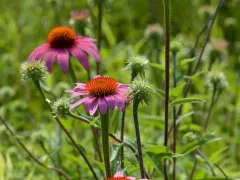 Purple coneflower Purple coneflowerEchinacea purpurea |  Black-eyed Susan Black-eyed SusanRudbeckia fulgida | |
|---|---|---|
| Size | 3 ft tall, 18 in wide | 24 in tall, 18 in wide |
| Plant | 18 in apart | 18 in apart |
| Zones | 3 to 9 | 3 to 9 |
| Light | Full sun | Full sun to part sun |
| Soil | Well-drained, average fertility | Well-drained, average fertility |
| Flowers | Late June to early September; purple, pink | Mid July to mid September; yellow |
| Leaves | Medium, herbaceous | Medium, herbaceous |
| Job in a bed | Drift | Drift |
| Pets | No toxicity recorded | No toxicity recorded |
| Deer | Resistant | Resistant |
| Native | Yes | Yes |
| Spread | Moderate risk | Moderate risk |
Rows where they differ are marked. Flowering times are for zone 5.
Which to choose
- Choose purple coneflower for more height (3 ft against 24 in).
- Choose black-eyed Susan for more shade and a smaller space (24 in against 3 ft).
Can they grow together?
Yes: they are recorded as partners. Beside purple coneflower, black-eyed Susan is purple against yellow, opposite each other on the colour wheel, if you choose those colours, in flower together for nine weeks. They share full sun and zones 3 to 9.
Read more: all about purple coneflower, and all about black-eyed Susan, each with a bed the planner designed around it.