Dwarf Alberta spruce vs Dwarf Hinoki cypress
Both are slow evergreens for a small garden. Dwarf Alberta spruce grows as a dense, perfect cone, formal and very regular, and suffers from spider mites in hot, dry spots. Dwarf Hinoki cypress grows into an irregular, layered shape of shell-like sprays, more like a bonsai, and likes some shelter from hot afternoon sun.
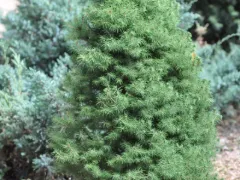 Dwarf Alberta spruce Dwarf Alberta sprucePicea glauca 'Conica' | Dwarf Hinoki cypress Chamaecyparis obtusa 'Nana Gracilis' | |
|---|---|---|
| Size | 8 ft tall, 4 ft wide | 5 ft tall, 3½ ft wide |
| Plant | 3½ ft apart | 3 ft apart |
| Zones | 3 to 6 | 4 to 8 |
| Light | Full sun | Full sun to part shade |
| Soil | Well-drained, average fertility | Evenly moist, rich fertility |
| Flowers | None | None |
| Leaves | Fine, evergreen | Fine, evergreen |
| Job in a bed | Accent | Specimen |
| Pets | No toxicity recorded | No toxicity recorded |
| Deer | Resistant | Not listed as resistant |
| Native | Variety of a native | No |
| Spread | Low risk | Low risk |
Rows where they differ are marked. Flowering times are for zone 5.
Which to choose
- Choose dwarf Alberta spruce for colder gardens (to zone 3), dry summers, deer country, a native garden, more height (8 ft against 5 ft) and more wildlife.
- Choose dwarf Hinoki cypress for more shade, warmer gardens (to zone 8), moist soil and a smaller space (5 ft against 8 ft).
Can they grow together?
Yes: they grow in the same conditions. Beside dwarf Alberta spruce, dwarf Hinoki cypress is low enough (5 ft) to stand in front of it. They share full sun and zones 4 to 6.
Read more: all about dwarf Alberta spruce, and all about dwarf Hinoki cypress, each with a bed the planner designed around it.