Cup plant
Silphium perfoliatum · Asteraceae
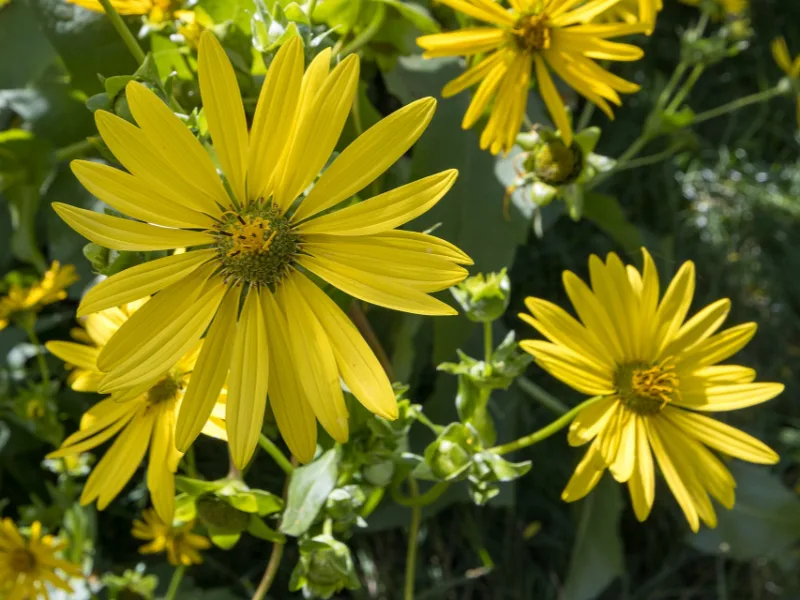
A giant of the prairie: square stems well above head height, with paired leaves that join to form cups which hold rainwater, topped with yellow daisies in late summer.
- Size
- 8 ft tall, 3½ ft wide
- Zones
- 3 to 9
- Light
- Full sun
- Flowers
- Mid July to early September
- Pets
- No toxicity recorded
- Job in a bed
- Specimen
Invasive in parts of North America. Self-seeds heavily and forms large colonies. Native to the central United States, but listed as invasive in parts of the Northeast and banned from sale in New York and Connecticut. Check local guidance before planting. The planner never chooses it.
Where cup plant goes in a border
At 8 ft it belongs at the back of a bed. In the planner's ten height classes it is super tall (over 6½ ft).
Its job: specimen. A feature plant with a shape of its own. It stands alone with room around it, and repeats only at a distance.
A magnificent wildlife plant in its home range, the central prairies. It self-seeds so heavily that it is banned in parts of the Northeast, so the planner will not choose it. Compass plant is a better-behaved relative.
- Large native meadows in the central states
- Wildlife gardens: birds drink from the cups and eat the seed
- Screening
What to plant with cup plant
Plants recorded as good partners for it, and what each pairing does:
- Joe Pye weed 'Gateway': in flower together for seven weeks, from late July; happy in the same moist soil.
- New England aster: medium leaves against its bold ones; low enough (4 ft) to stand in front of it; happy in the same moist soil.
- Big bluestem: purple against yellow, opposite each other on the colour wheel, in flower together for four weeks; fine leaves against its bold ones.
Questions about cup plant
Does cup plant need sun or shade?
Cup plant grows in full sun (6 or more hours of direct sun a day).
It wants soil that stays evenly moist, rich in organic matter, and a good soak in dry spells. Once settled in, it stands drought.
What zones does cup plant grow in?
USDA zones 3 to 9. It is hardy to zone 3, which means it survives winter nights down to about −30 °F (−34 °C).
Gardening in Canada? Use the USDA zone for your town: Canada's own zone map uses different numbers.
When does cup plant flower in my zone?
In zone 5 it flowers mid July to early September. As a summer flower it moves about half a week for every zone: earlier where it is warmer.
| Zone 3 | Mid July to early September |
|---|---|
| Zone 4 | Mid July to early September |
| Zone 5 | Mid July to early September |
| Zone 6 | Mid July to early September |
| Zone 7 | Early July to early September |
| Zone 8 | Early July to early September |
| Zone 9 | Late June to early September |
Worked out from Hopkins' bioclimatic law: spring arrives about four days later for each degree of latitude north, and one zone is roughly two degrees. A warm spring or a cold one moves any garden two weeks either way.
How far apart should cup plant be planted?
3 ft (90 cm) apart, from the middle of one plant to the middle of the next. That is a little closer than its full width of 3½ ft (100 cm), so a group knits into one patch.
It grows 8 ft (240 cm) tall. Give it the full distance from anything taller, or it will lean out towards the light.
How many cup plant plants do I need?
At 3 ft apart, set out in staggered rows:
- 1 to fill 10 square feet (about 1 m²)
- 4 for a single row 10 ft (3 m) long
- 4 to fill a 4 × 8 ft bed on its own
In a mixed border, plant it as one, with clear ground around it: a feature plant is seen as an object, and a group of them is a thicket.
Is cup plant poisonous to dogs and cats?
No toxicity is recorded for dogs, cats, horses or people, according to NC State Extension.
"Not toxic" is not "edible": a pet that eats a lot of any plant can be sick.
What can I plant instead of cup plant?
Cup plant is listed as invasive in parts of North America, so the planner never uses it. These do the most similar job, and are native:
- Sweet Joe Pye weed: the same job in a bed and the same flowering time; 24 in shorter, pink, not yellow.
- Hardy hibiscus: the same job in a bed and the same flowering time; 3 ft shorter, red, pink or white, not yellow.
Matched the way the planner's Swap button matches plants: the same job in a bed, then size, then flowering time.
Do deer eat cup plant?
They may. NC State does not list it as resistant to deer or rabbits. Where they visit, protect it, or plant it among ones they avoid.
Will cup plant spread?
It seeds itself about; the risk of it taking over is high. Self-seeds heavily and forms large colonies. Native to the central United States, but listed as invasive in parts of the Northeast and banned from sale in New York and Connecticut. Check local guidance before planting.
It is listed as invasive in parts of North America, and the planner never chooses it.
What flowers after cup plant?
Cup plant is over by early September. These start as it finishes and carry the same spot on, so it never goes flat:
- New England aster: from early September to mid October, 4 ft tall, to stand in front of it and cover its fading stems (a recorded partner).
- Garden chrysanthemum: from mid September to late October, 24 in tall, to stand in front of it and cover its fading stems.
- Swamp sunflower: from late September to late October, 6½ ft tall.
What does cup plant look like in winter?
Cup plant dies down, but leave the stems standing: the seed heads stand through the winter, and songbirds eat the seed. Cut them down in early spring, before the new shoots come.
Is cup plant good for bees and butterflies?
Cup plant is visited by pollinators, bees, butterflies, hummingbirds, beneficial insects and songbirds.
It is native to the United States.
More Silphium
- Compass plant Silphium laciniatum
Every fact on record
- Type
- Perennial
- Size
- 8 ft (240 cm) tall, 3½ ft (100 cm) wide
- Plant
- 3 ft (90 cm) apart
- Height class
- Super tall (over 6½ ft)
- Place in the bed
- Back
- Flowers
- Mid July to early September; daisies; yellow
- Leaves
- Bold texture, herbaceous; green
- Shape
- Upright, self-seeding
- Hardy in
- USDA zones 3 to 9
- Light
- Full sun
- Soil
- Rich, evenly moist
- Water
- Moderate
- Feeding
- None needed
- Family
- Asteraceae
- Comes from
- Southeastern US
- Attracts
- Pollinators, bees, butterflies, hummingbirds, beneficial insects, songbirds
- Stands up to
- Drought
Checked against NC State Extension. Flowering times are for zone 5: later in colder zones, earlier in warmer ones. Toxicity and spread information is a general gardening guide, not veterinary or medical advice, and invasive status varies by region. If a person or pet eats a plant, contact poison control or a vet. Check your local invasive species list before planting anything with a spread warning.