Nandina 'Firepower'
Nandina domestica 'Firepower' · Berberidaceae
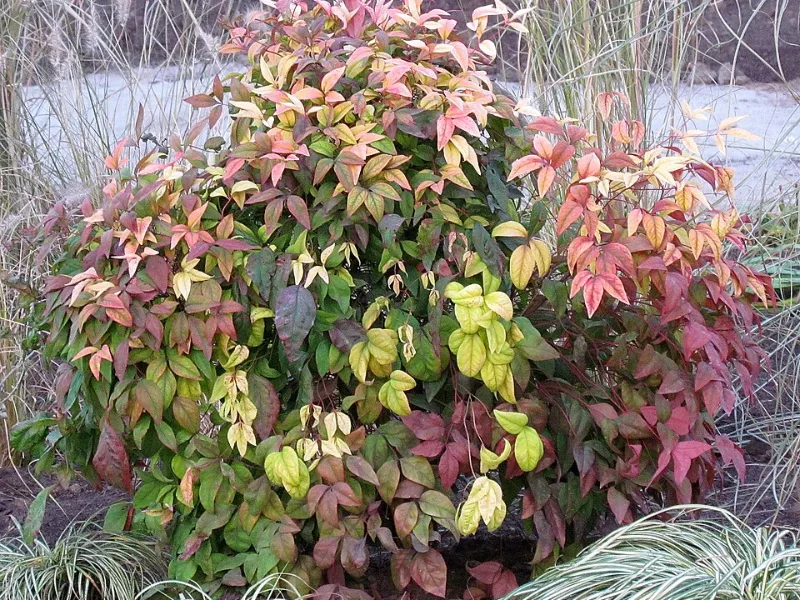
A dwarf, rounded nandina with broad, lime-green leaves that turn brilliant red in autumn and stay red all winter. It does not flower or fruit.
- Size
- 24 in tall, 24 in wide
- Zones
- 6 to 9
- Light
- Full sun to part shade
- Flowers
- Grown for its leaves
- Pets
- Toxic (severe)
- Job in a bed
- Drift
Invasive in parts of North America. This variety is fruitless and does not spread. The species it belongs to is listed as invasive across the Southeast, and its berries are poisonous to birds. The planner never chooses it.
Where nandina 'Firepower' goes in a border
At 24 in it belongs at the front of a bed. In the planner's ten height classes it is medium short (18 to 24 in).
Its job: drift. Planted in a small group of three or five, and repeated further along in the other number.
Because it sets no berries it cannot seed into woodland or poison birds, as the species does. The planner still leaves it out, since the species is listed as invasive in the Southeast.
- Red winter foliage
- Massing as a low evergreen
- Containers
What to plant with nandina 'Firepower'
Plants recorded as good partners for it, and what each pairing does:
- Lilyturf: adds the flowers, early August to mid September; spires rising out of its mound.
- Juniper 'Blue Star'.
- Glossy abelia: adds the flowers, mid June to early October; tall enough (5 ft) to stand behind it.
Questions about nandina 'Firepower'
Does nandina 'Firepower' need sun or shade?
Nandina 'Firepower' grows in full sun (6 or more hours of direct sun a day), part sun (4 to 6 hours of sun, including some afternoon sun) and part shade (2 to 4 hours of sun, mostly in the morning). It is one of the few that also put up with deep shade.
It wants ordinary well-drained soil, of average fertility, and little watering once settled. Once settled in, it stands drought.
What zones does nandina 'Firepower' grow in?
USDA zones 6 to 9. It is hardy to zone 6, which means it survives winter nights down to about 0 °F (−18 °C).
Gardening in Canada? Use the USDA zone for your town: Canada's own zone map uses different numbers.
How far apart should nandina 'Firepower' be planted?
20 in (50 cm) apart, from the middle of one plant to the middle of the next. That is a little closer than its full width of 24 in (60 cm), so a group knits into one patch.
It grows 24 in (60 cm) tall. Give it the full distance from anything taller, or it will lean out towards the light.
How many nandina 'Firepower' plants do I need?
At 20 in apart, set out in staggered rows:
- 4 to fill 10 square feet (about 1 m²)
- 7 for a single row 10 ft (3 m) long
- 14 to fill a 4 × 8 ft bed on its own
In a mixed border, plant it as a group of three or five, with a second group further along in the other number.
Is nandina 'Firepower' poisonous to dogs and cats?
Yes: severe toxicity to people, dogs, cats and horses. All parts, especially the berries, can release cyanide if eaten, and have killed birds, pets and livestock.
Rated from NC State Extension and the ASPCA. Where references disagree, the more cautious rating is used.
What can I plant instead of nandina 'Firepower'?
Nandina 'Firepower' is listed as invasive in parts of North America (4 listings), so the planner never uses it. These do the most similar job:
- Deutzia 'Yuki Cherry Blossom': the same job in a bed; 4 in shorter, flowers early May to early June.
- Boxwood 'Green Gem': the same size; an edging, not a drift, fine leaves, not medium.
- Spurge 'Chameleon': the same job in a bed; 6 in shorter, 4 in narrower.
Matched the way the planner's Swap button matches plants: the same job in a bed, then size, then flowering time.
Do deer eat nandina 'Firepower'?
Mostly not. NC State lists it as resistant to deer. No plant is proof against a hungry deer in a hard winter, but this one is low on the menu.
Will nandina 'Firepower' spread?
It grows as a clump that slowly widens; the risk of it taking over is moderate. This variety is fruitless and does not spread. The species it belongs to is listed as invasive across the Southeast, and its berries are poisonous to birds.
It is listed as invasive in parts of North America, and the planner never chooses it.
What does nandina 'Firepower' look like in winter?
Nandina 'Firepower' keeps its chartreuse and red leaves all winter, so it is one of the plants that hold a bed together from November to March, when the perennials have gone. It is grown for red winter foliage as well.
Is nandina 'Firepower' good for bees and butterflies?
Nandina 'Firepower' is visited by songbirds.
More Nandina
- Heavenly bamboo Nandina domestica
In these guides
Every fact on record
- Type
- Shrub
- Size
- 24 in (60 cm) tall, 24 in (60 cm) wide
- Plant
- 20 in (50 cm) apart
- Height class
- Medium short (18 to 24 in)
- Place in the bed
- Front
- Flowers
- None: grown for its foliage
- Leaves
- Medium texture, evergreen; chartreuse, red
- Shape
- Mounding, clumping
- Hardy in
- USDA zones 6 to 9
- Light
- Full sun, part sun, part shade
- Soil
- Average, well-drained
- Water
- Low
- Feeding
- None needed
- Family
- Berberidaceae
- Comes from
- Central and Southern China and Japan
- Attracts
- Songbirds
- Stands up to
- Deer, drought, salt, deep shade
Checked against NC State Extension and ASPCA poison lists. Flowering times are for zone 5: later in colder zones, earlier in warmer ones. Toxicity and spread information is a general gardening guide, not veterinary or medical advice, and invasive status varies by region. If a person or pet eats a plant, contact poison control or a vet. Check your local invasive species list before planting anything with a spread warning.