Common boxwood vs Japanese holly 'Soft Touch'
Japanese holly is the commonest substitute for box: small, glossy evergreen leaves on a dense shrub that clips well. Unlike box it is not affected by box blight. It is less tolerant of dry soil and of alkaline soil than box, and in cold zones it can burn in winter wind.
 Common boxwood Common boxwoodBuxus sempervirens | 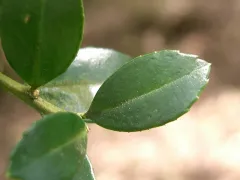 Japanese holly 'Soft Touch' Japanese holly 'Soft Touch'Ilex crenata 'Soft Touch' | |
|---|---|---|
| Size | 10 ft tall, 10 ft wide | 2½ ft tall, 3 ft wide |
| Plant | 6½ ft apart | 2½ ft apart |
| Zones | 5 to 8 | 5 to 8 |
| Light | Full sun to part shade | Full sun to part shade |
| Soil | Well-drained, average fertility | Well-drained, average fertility |
| Flowers | None | None |
| Leaves | Fine, evergreen | Fine, evergreen |
| Job in a bed | Anchor | Drift |
| Pets | Toxic (moderate) | Toxic (mild) |
| Deer | Resistant | Resistant |
| Native | No | No |
| Spread | Low risk | Low risk |
Rows where they differ are marked. Flowering times are for zone 5.
Which to choose
- Choose common boxwood for more height (10 ft against 2½ ft).
- Choose Japanese holly 'Soft Touch' for a smaller space (2½ ft against 10 ft) and more wildlife.
Can they grow together?
Yes: they grow in the same conditions. Beside common boxwood, Japanese holly 'Soft Touch' is low enough (2½ ft) to stand in front of it. They share full sun, part sun and part shade and zones 5 to 8.
Read more: all about common boxwood, and all about Japanese holly 'Soft Touch', each with a bed the planner designed around it.