Black-eyed Susan vs Brown-eyed Susan
Two native rudbeckias with gold, dark-eyed daisies in late summer. Black-eyed Susan (Rudbeckia fulgida) is a long-lived perennial, about two feet, with bigger flowers, and slowly spreads into drifts. Brown-eyed Susan (Rudbeckia triloba) is twice the height and bushy, smothered in hundreds of smaller flowers into autumn, and lives only two or three years, carrying on by seeding itself. Its lighter, looser look suits a meadow-style planting.
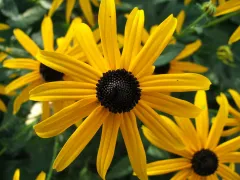 Black-eyed Susan Rudbeckia fulgida |  Brown-eyed Susan Rudbeckia triloba | |
|---|---|---|
| Size | 24 in tall, 18 in wide | 4 ft tall, 24 in wide |
| Plant | 18 in apart | 18 in apart |
| Zones | 3 to 9 | 4 to 8 |
| Light | Full sun to part sun | Full sun to part sun |
| Soil | Well-drained, average fertility | Well-drained, average fertility |
| Flowers | Mid July to mid September; yellow | Late July to early October; yellow |
| Leaves | Medium, herbaceous | Medium, herbaceous |
| Job in a bed | Drift | Drift |
| Pets | No toxicity recorded | No toxicity recorded |
| Deer | Resistant | Resistant |
| Native | Yes | Yes |
| Spread | Moderate risk | Moderate risk |
Rows where they differ are marked. Flowering times are for zone 5.
Which to choose
- Choose black-eyed Susan for colder gardens (to zone 3), warmer gardens (to zone 9) and a smaller space (24 in against 4 ft).
- Choose brown-eyed Susan for more height (4 ft against 24 in).
Can they grow together?
Yes: they grow in the same conditions. What brown-eyed Susan brings beside black-eyed Susan: in flower together for nine weeks, from late July; tall enough (4 ft) to stand behind it. They share full sun and part sun and zones 4 to 8.
Read more: all about black-eyed Susan, and all about brown-eyed Susan, each with a bed the planner designed around it.