Butterfly bush vs Blue Chip butterfly bush
The common butterfly bush seeds itself on to riverbanks, roadsides and waste ground, and is listed as invasive or as a noxious weed in parts of the United States, the Pacific Northwest above all. 'Blue Chip' was bred to set almost no seed, and it is knee-high instead of eight feet, so it fits among perennials. Both flower from midsummer to frost. Both feed adult butterflies, but neither feeds the caterpillars of any North American butterfly.
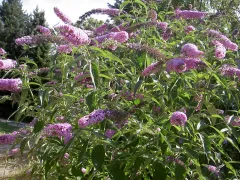 Butterfly bush Buddleja davidii | 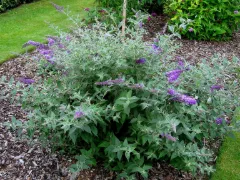 Butterfly bush 'Blue Chip' Buddleja 'Blue Chip' | |
|---|---|---|
| Size | 8 ft tall, 6½ ft wide | 2½ ft tall, 2½ ft wide |
| Plant | 6 ft apart | 2½ ft apart |
| Zones | 5 to 9 | 5 to 9 |
| Light | Full sun | Full sun |
| Soil | Well-drained, average fertility | Well-drained, average fertility |
| Flowers | Early July to early October; purple, pink, white | Early July to early October; lavender |
| Leaves | Medium, deciduous | Fine, deciduous |
| Job in a bed | Anchor | Drift |
| Pets | No toxicity recorded | No toxicity recorded |
| Deer | Resistant | No record |
| Native | No | No |
| Spread | Invasive in places | Low risk |
Rows where they differ are marked. Flowering times are for zone 5.
Which to choose
- Choose butterfly bush for dry summers, more height (8 ft against 2½ ft) and more wildlife.
- Choose butterfly bush 'Blue Chip' for a plant that stays put (the other is invasive in places) and a smaller space (2½ ft against 8 ft).
Read more: all about butterfly bush, and all about butterfly bush 'Blue Chip', each with a bed the planner designed around it.