Japanese blood grass vs red switchgrass
Japanese blood grass is a red form of cogongrass, one of the world's worst weeds. The red form spreads slowly, but it can revert to the green, aggressive type; the species is a federal noxious weed in the United States, and selling any form is banned in many states. Switchgrass 'Shenandoah' is a native prairie grass whose blades turn wine-red from midsummer, taller and with a haze of pink seed heads: the red grass to grow instead.
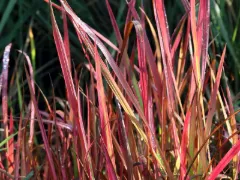 Japanese blood grass Imperata cylindrica 'Red Baron' | 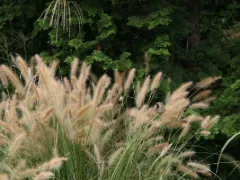 Switchgrass 'Shenandoah' Panicum virgatum 'Shenandoah' | |
|---|---|---|
| Size | 18 in tall, 18 in wide | 4 ft tall, 24 in wide |
| Plant | 12 in apart | 24 in apart |
| Zones | 5 to 9 | 4 to 9 |
| Light | Full sun to part sun | Full sun |
| Soil | Evenly moist, average fertility | Well-drained, average fertility |
| Flowers | None | Late July to mid September; pink |
| Leaves | Fine, herbaceous | Fine, herbaceous |
| Job in a bed | Drift | Accent |
| Pets | No toxicity recorded | No toxicity recorded |
| Deer | Not listed as resistant | Resistant |
| Native | No | Variety of a native |
| Spread | Invasive in places | Low risk |
Rows where they differ are marked. Flowering times are for zone 5.
Which to choose
- Choose Japanese blood grass for more shade, moist soil and a smaller space (18 in against 4 ft).
- Choose switchgrass 'Shenandoah' for colder gardens (to zone 4), deer country, a native garden, a plant that stays put (the other is invasive in places), more height (4 ft against 18 in) and more wildlife.
Read more: all about Japanese blood grass, and all about switchgrass 'Shenandoah', each with a bed the planner designed around it.