Rose of Sharon vs hardy hibiscus
Both are hibiscus with saucer-shaped flowers in late summer, and both leaf out very late in spring. Rose of Sharon is a woody shrub from Asia, upright and about ten feet tall, with smaller flowers over a long season; older kinds seed themselves everywhere, so choose a seedless variety. Hardy hibiscus is a North American native that dies to the ground each winter, then grows five feet in a summer and opens the biggest flowers of any hardy plant, as wide as a dinner plate. It wants more water than Rose of Sharon.
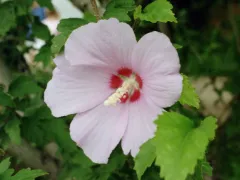 Rose of Sharon Hibiscus syriacus | 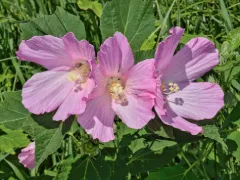 Hardy hibiscus Hibiscus moscheutos | |
|---|---|---|
| Size | 10 ft tall, 6½ ft wide | 5 ft tall, 3½ ft wide |
| Plant | 5 ft apart | 3 ft apart |
| Zones | 5 to 9 | 4 to 9 |
| Light | Full sun | Full sun |
| Soil | Well-drained, average fertility | Evenly moist, rich fertility |
| Flowers | Mid July to mid September; pink, purple, white, blue | Late July to mid September; red, pink, white |
| Leaves | Medium, deciduous | Bold, herbaceous |
| Job in a bed | Anchor | Specimen |
| Pets | No toxicity recorded | No toxicity recorded |
| Deer | Resistant | Not listed as resistant |
| Native | No | Yes |
| Spread | High risk | Low risk |
Rows where they differ are marked. Flowering times are for zone 5.
Which to choose
- Choose rose of Sharon for deer country and more height (10 ft against 5 ft).
- Choose hardy hibiscus for colder gardens (to zone 4), moist soil, a native garden and a smaller space (5 ft against 10 ft).
Can they grow together?
Yes: they grow in the same conditions. What hardy hibiscus brings beside rose of Sharon: in flower together for nine weeks, from late July; bold leaves against its medium ones; low enough (5 ft) to stand in front of it. They share full sun and zones 5 to 9.
Read more: all about rose of Sharon, and all about hardy hibiscus, each with a bed the planner designed around it.