Spanish bluebell vs English bluebell
English bluebells have narrow, deep violet bells that hang along one side of a stem that nods over at the tip, and they are sweetly scented. Spanish bluebells are sturdier, with wider bells all round an upright stem, little scent, and pink and white forms as well as blue. The Spanish kind grows almost anywhere and multiplies so fast that it is hard to dig out; it crosses with the English kind, and has escaped into the wild in the Pacific Northwest. Both are poisonous.
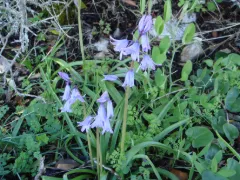 Spanish bluebell Hyacinthoides hispanica | 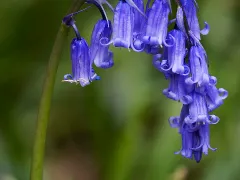 English bluebell Hyacinthoides non-scripta | |
|---|---|---|
| Size | 16 in tall, 6 in wide | 12 in tall, 6 in wide |
| Plant | 4 in apart | 4 in apart |
| Zones | 3 to 8 | 4 to 8 |
| Light | Full sun to shade | Part sun to shade |
| Soil | Well-drained, average fertility | Evenly moist, rich fertility |
| Flowers | Early May to late May; blue, pink, white | Early May to late May; blue |
| Leaves | Medium, summer-dormant | Medium, summer-dormant |
| Job in a bed | Bulb layer | Bulb layer |
| Pets | Toxic (severe) | Toxic (severe) |
| Deer | Resistant | No record |
| Native | No | No |
| Spread | High risk | Moderate risk |
Rows where they differ are marked. Flowering times are for zone 5.
Which to choose
- Choose Spanish bluebell for colder gardens (to zone 3) and dry summers.
- Choose English bluebell for moist soil.
Can they grow together?
Yes: they grow in the same conditions. What English bluebell brings beside Spanish bluebell: in flower together for four weeks, from early May. They share part sun, part shade and shade and zones 4 to 8.
Read more: all about Spanish bluebell, and all about English bluebell, each with a bed the planner designed around it.