Host plants for the henry's elfin
The garden plants whose leaves henry's elfin caterpillars eat, and a bed the planner designed around them.
The henry's elfin (Callophrys henrici) is a butterfly. Like every butterfly and moth, it can lay its eggs only on the plants its caterpillars can eat, its host plants. A garden with nectar flowers feeds the adults as they pass; a garden with host plants is where the next generation is raised.
These eight garden plants are recorded by NC State as hosts for its caterpillars. Expect chewed leaves: that is the point. Do not spray, and leave fallen leaves under the plants in winter, where many caterpillars and pupae spend it.
8 plants: 8 shrubs.
The host plants
-
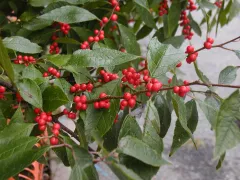
Winterberry
8 ft · grown for its leaves
A native holly that drops its leaves in autumn to show branches packed with bright red berries, which last into winter until the birds take them.
-
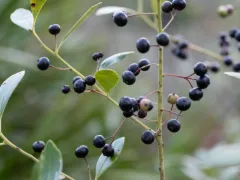
Inkberry
6½ ft · grown for its leaves
A native evergreen holly with small, spineless, dark leaves and black berries.
-

Winterberry 'Winter Red'
8 ft · early June to late June
After the leaves fall, every branch is crowded with bright red berries that hold their colour until late winter, longer than any other winterberry.
-
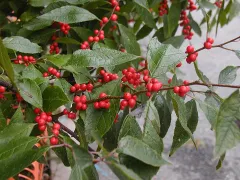
Winterberry 'Berry Poppins'
3½ ft · early June to late June
A dwarf winterberry, waist high, that carries a heavy crop of red berries on bare stems through winter.
-
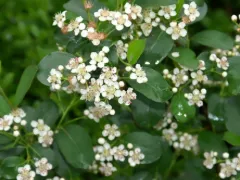
Winterberry 'Red Sprite'
4 ft · grown for its leaves
A compact winterberry, a little over a metre tall, with very large red berries.
-
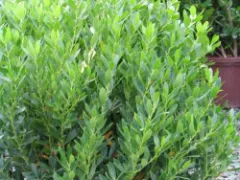
Inkberry 'Shamrock'
4 ft · grown for its leaves
A compact inkberry that stays dense and leafy to the ground, with bright green new growth.
-
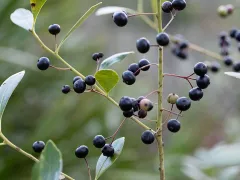
Inkberry 'Gem Box'
2½ ft · grown for its leaves
A dwarf form of the native inkberry holly: a tight ball of small, dark, glossy leaves, with red tips on the new growth in spring.
-
Dwarf yaupon holly
4 ft · grown for its leaves
A dense, rounded mound of tiny evergreen leaves, native to the Southeast.
A bed for the henry's elfin
The planner designed this 16 × 8 ft (4.9 × 2.4 m) bed for zone 6 and full sun when this page was made, keeping inkberry, inkberry 'Gem Box' and inkberry 'Shamrock' on it.
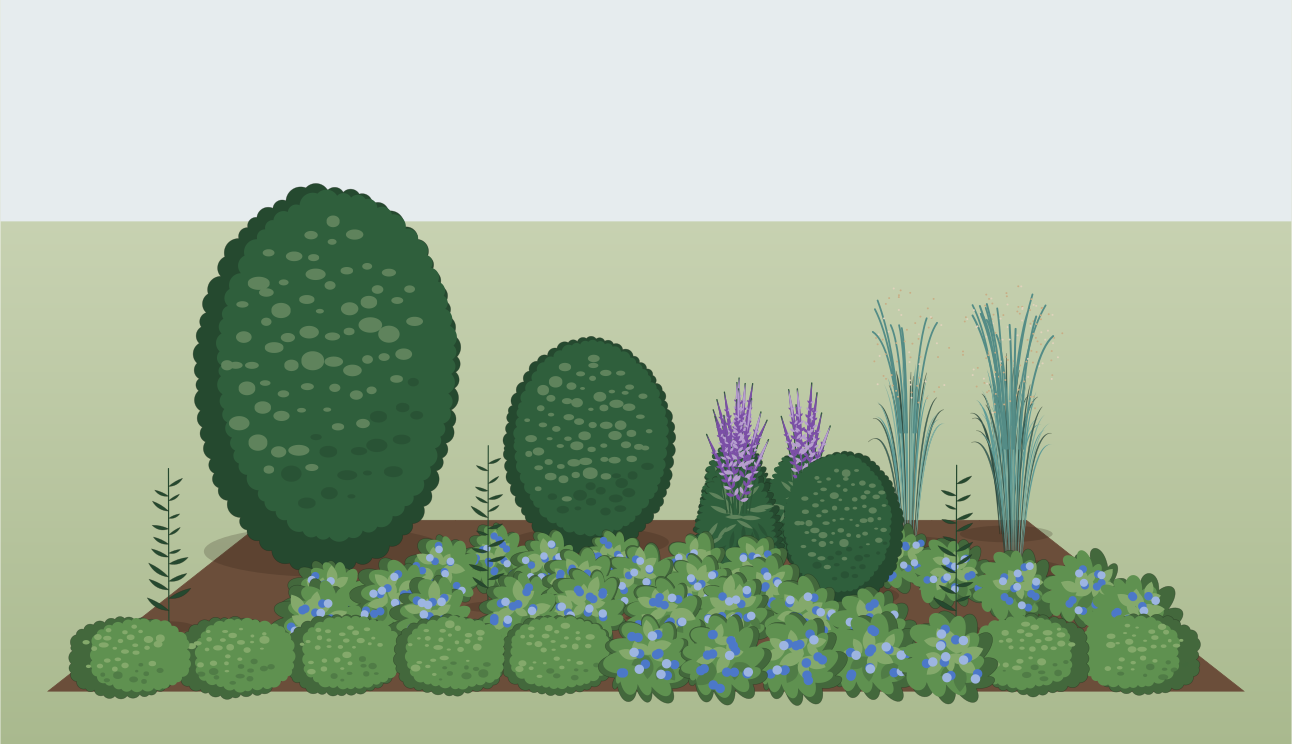
The plants
- 1 Inkberry × 1, dark green leaves
- 2 Inkberry 'Gem Box' × 1, dark green leaves
- 3 Inkberry 'Shamrock' × 1, dark green leaves
- 4 Leadwort × 30, blue
- 5 Creeping phlox 'Emerald Blue' × 7, blue
- 6 Switchgrass 'Prairie Sky' × 3, tan
- 7 Astilbe 'Purple Candles' × 3, purple
- 8 Camassia × 3, white
- 9 Double snowdrop × 12, white
- 10 Easter lily × 3, white
Planned as a naturalistic planting: low grasses and groundcovers, the matrix, make up 44% of the planted ground. The back corners are held by inkberry and switchgrass 'Prairie Sky', the tallest plants on the plan. Creeping phlox 'Emerald Blue' and leadwort finish the front edge.
The planner's own design check: 8 Excellent, 6 Good, 2 Satisfactory, 1 Needs revision. Its weakest point is foliage: Inkberry, inkberry 'Gem Box' and inkberry 'Shamrock' are grown for their leaves, and cover 37% of the planted ground. The Foliage control above the plan asks for about 10%.
Open this bed in the planner Change its size, the sun or the style, move plants about, or swap one for another.
All 8 plants
Middle of a bed 1
- Inkberry 'Gem Box' 2½ ft · grown for its leaves
Back of a bed 7
- Dwarf yaupon holly 4 ft · grown for its leaves
- Inkberry 6½ ft · grown for its leaves
- Inkberry 'Shamrock' 4 ft · grown for its leaves
- Winterberry 8 ft · grown for its leaves
- Winterberry 'Berry Poppins' 3½ ft · early June to late June
- Winterberry 'Red Sprite' 4 ft · grown for its leaves
- Winterberry 'Winter Red' 8 ft · early June to late June