Host plants for the silvery checkerspot
The garden plants whose leaves silvery checkerspot caterpillars eat, and a bed the planner designed around them.
The silvery checkerspot (Chlosyne nycteis) is a butterfly. Like every butterfly and moth, it can lay its eggs only on the plants its caterpillars can eat, its host plants. A garden with nectar flowers feeds the adults as they pass; a garden with host plants is where the next generation is raised.
These 16 garden plants are recorded by NC State as hosts for its caterpillars. Expect chewed leaves: that is the point. Do not spray, and leave fallen leaves under the plants in winter, where many caterpillars and pupae spend it.
16 plants: 16 perennials.
The host plants
-

Purple coneflower
3 ft · late June to early September
A tough native with purple-pink petals around a bronze cone, blooming for weeks in midsummer.
-

Black-eyed Susan
24 in · mid July to mid September
Masses of golden, dark-centred flowers from midsummer into fall.
-

Coneflower 'White Swan'
2½ ft · early July to early September
White, slightly drooping petals around a large orange-bronze cone, on a plant a little shorter than the purple kinds.
-

Coneflower 'PowWow Wild Berry'
22 in · late June to mid September
A compact, well-branched coneflower with flowers of a deep, saturated rose-purple that does not fade in the sun.
-

Coneflower 'Magnus'
3 ft · early July to early September
Large, rose-purple daisies whose petals are held flat, not drooping, around a coppery-orange cone.
-
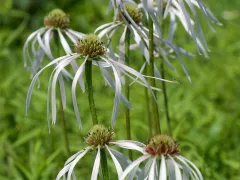
Pale purple coneflower
3 ft · mid June to mid July
Long, pale pink petals hang like ribbons from a tall dark cone in early summer, weeks before purple coneflower.
-

Grey-headed coneflower
4 ft · early July to late August
Drooping, soft yellow petals hang like a skirt beneath a tall grey cone that turns brown, on thin stems that sway in the wind.
-

Brown-eyed Susan
4 ft · late July to early October
A bushy plant smothered in hundreds of small, golden, dark-eyed daisies from late summer to frost.
-

Gloriosa daisy
2½ ft · late June to mid September
The roadside black-eyed Susan and its large-flowered garden forms, in gold, orange and mahogany, often two-toned.
-

Woodland sunflower
4 ft · mid July to early September
Bright yellow daisies on slender stems with paired, stalkless leaves, in the dry shade at the edge of a wood, from midsummer.
-

Maximilian sunflower
8 ft · early September to mid October
Tall, unbranched stems, far above head height, lined from top to bottom with golden-yellow sunflowers in early autumn.
-

Swamp sunflower
6½ ft · late September to late October
A wall of golden daisies with dark centres in October on stems well above head height.
A bed for the silvery checkerspot
The planner designed this 16 × 8 ft (4.9 × 2.4 m) bed for zone 6 and full sun when this page was made, keeping black-eyed Susan, brown-eyed Susan and coneflower 'Green Jewel' on it.
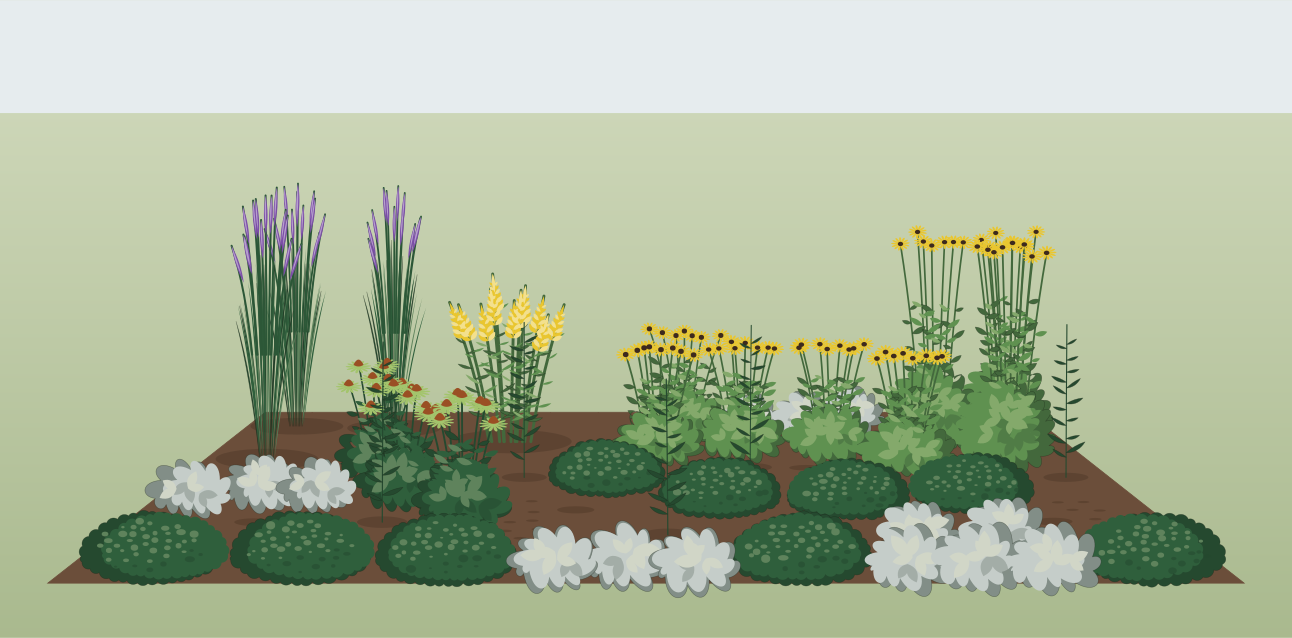
The plants
- 1 Black-eyed Susan × 5, yellow
- 2 Brown-eyed Susan × 3, yellow
- 3 Coneflower 'Green Jewel' × 3, green
- 4 Bearberry × 9, pink
- 5 Plantain-leaved pussytoes × 14, silver leaves
- 6 Big bluestem 'Blackhawks' × 3, purple
- 7 Goldenrod 'Fireworks' × 1, yellow
- 8 Schubert's allium × 4, pink
- 9 Easter lily × 5, white
- 10 Hyacinth × 12, blue
Planned as a naturalistic planting: low grasses and groundcovers, the matrix, make up 55% of the planted ground. The scheme leans cool (pink, purple and blue) and uses yellow for warmth, with green and white to calm things between them. Big bluestem 'Blackhawks' and goldenrod 'Fireworks', recognised partners, are side by side.
The planner's own design check: 12 Excellent, 4 Good, 1 Satisfactory.
Open this bed in the planner Change its size, the sun or the style, move plants about, or swap one for another.
All 16 plants
Middle of a bed 10
- Black-eyed Susan 24 in · mid July to mid September
- Coneflower 'Green Jewel' 24 in · early July to early September
- Coneflower 'Kim's Knee High' 20 in · early July to late August
- Coneflower 'Magnus' 3 ft · early July to early September
- Coneflower 'PowWow Wild Berry' 22 in · late June to mid September
- Coneflower 'White Swan' 2½ ft · early July to early September
- Gloriosa daisy 2½ ft · late June to mid September
- Gloriosa daisy 'Indian Summer' 3 ft · early July to early October
- Pale purple coneflower 3 ft · mid June to mid July
- Purple coneflower 3 ft · late June to early September
Back of a bed 6
- Brown-eyed Susan 4 ft · late July to early October
- Grey-headed coneflower 4 ft · early July to late August
- Maximilian sunflower 8 ft · early September to mid October
- Swamp sunflower 6½ ft · late September to late October
- Sweet coneflower 'Henry Eilers' 4½ ft · late July to mid September
- Woodland sunflower 4 ft · mid July to early September