Host plants for the eastern tiger swallowtail
The garden plants whose leaves eastern tiger swallowtail caterpillars eat, and a bed the planner designed around them.
The eastern tiger swallowtail (Papilio glaucus) is a butterfly. Like every butterfly and moth, it can lay its eggs only on the plants its caterpillars can eat, its host plants. A garden with nectar flowers feeds the adults as they pass; a garden with host plants is where the next generation is raised.
These three garden plants are recorded by NC State as hosts for its caterpillars. Expect chewed leaves: that is the point. Do not spray, and leave fallen leaves under the plants in winter, where many caterpillars and pupae spend it.
3 plants: 3 shrubs.
The host plants
-

Dwarf flowering almond
4½ ft · late April to early May
Slender, upright stems are wrapped from top to bottom in double, pink pompom flowers in spring, before the leaves.
-
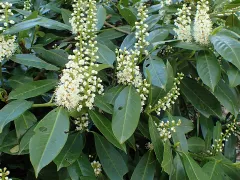
Schip laurel
10 ft · late April to early May
Narrow, glossy, dark evergreen leaves on an upright, vase-shaped shrub, with scented white flower spikes in spring.
-
Cherry laurel 'Otto Luyken'
3½ ft · late April to mid May
A low, wide-spreading evergreen with narrow, glossy, dark leaves held at an upward angle, and upright spikes of white flowers in spring.
A bed for the eastern tiger swallowtail
The planner designed this 16 × 8 ft (4.9 × 2.4 m) bed for zone 6 and full sun when this page was made, keeping cherry laurel 'Otto Luyken', dwarf flowering almond and schip laurel on it.
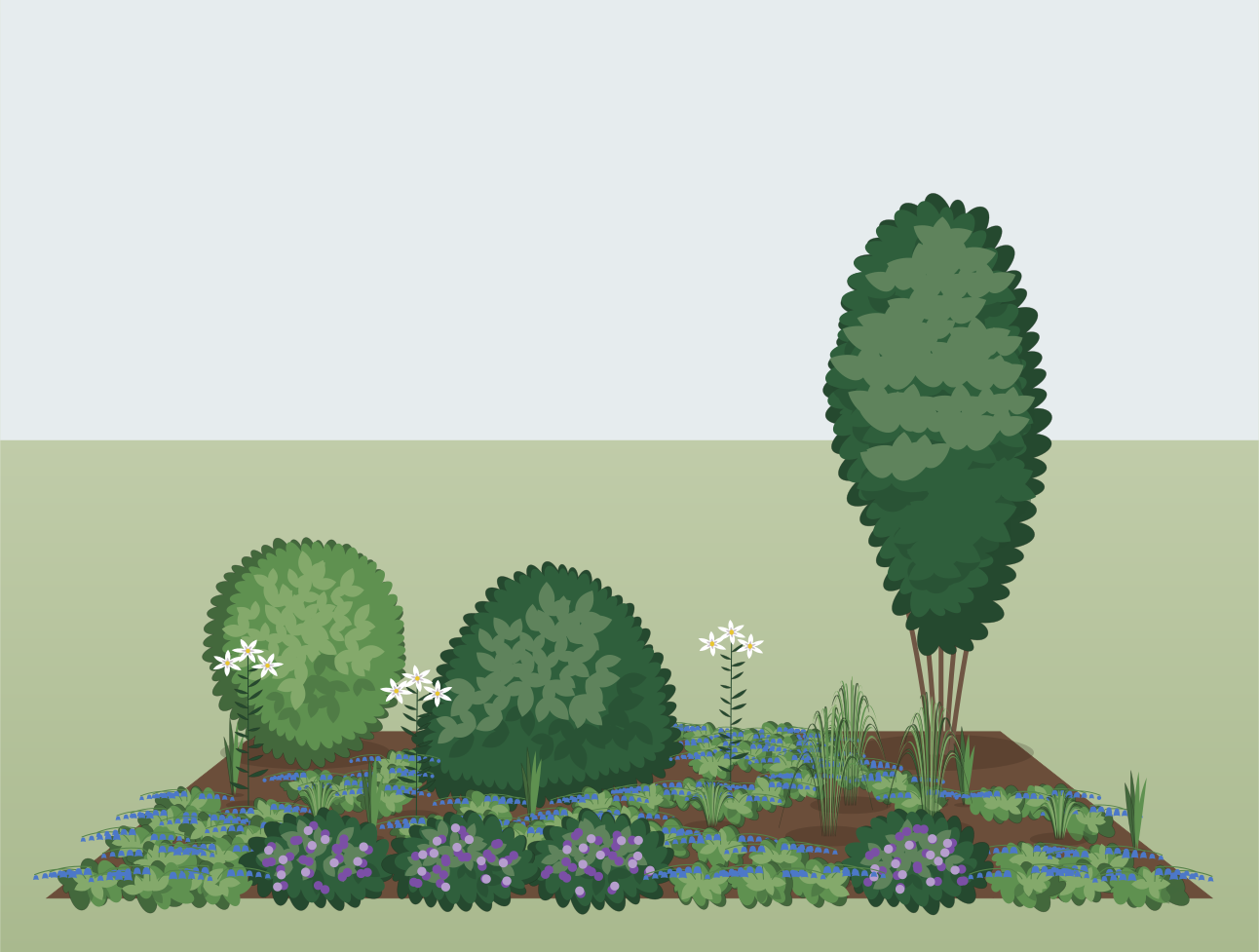
The plants
- 1 Cherry laurel 'Otto Luyken' × 1, white
- 2 Dwarf flowering almond × 1, pink
- 3 Schip laurel × 1, white
- 4 Verbena 'Homestead Purple' × 4, purple
- 5 Fairy thimbles × 56, blue
- 6 Palm sedge × 3, green leaves
- 7 Easter lily × 3, white
- 8 Schubert's allium × 3, pink
- 9 Hardy gladiolus × 5, pink
Planned as a naturalistic planting: low grasses and groundcovers, the matrix, make up 53% of the planted ground. White is the colour seen most, on 3 of the 8 kinds grown for their flowers. The back corners are held by dwarf flowering almond and schip laurel, the tallest plants on the plan.
The planner's own design check: 9 Excellent, 7 Good, 1 Needs revision. Its weakest point is height and scale: Heights average about 10 in at the front, 2 ft in the middle and 6 ft at the back. Along the back row the heights step up and down, between 3½ ft and 10 ft, and no two neighbours are the same height.
Open this bed in the planner Change its size, the sun or the style, move plants about, or swap one for another.
All 3 plants
Back of a bed 3
- Cherry laurel 'Otto Luyken' 3½ ft · late April to mid May
- Dwarf flowering almond 4½ ft · late April to early May
- Schip laurel 10 ft · late April to early May