Host plants for the pearl crescent
The garden plants whose leaves pearl crescent caterpillars eat, and a bed the planner designed around them.
The pearl crescent (Phyciodes tharos) is a butterfly. Like every butterfly and moth, it can lay its eggs only on the plants its caterpillars can eat, its host plants. A garden with nectar flowers feeds the adults as they pass; a garden with host plants is where the next generation is raised.
These nine garden plants are recorded by NC State as hosts for its caterpillars. Expect chewed leaves: that is the point. Do not spray, and leave fallen leaves under the plants in winter, where many caterpillars and pupae spend it.
9 plants: 9 perennials.
The host plants
-
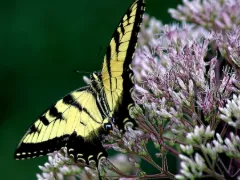
Hollow Joe-Pye weed
7 ft · late July to mid September
The giant of the family: hollow, wine-purple stems, taller than a door, carry huge domes of dusty mauve-pink flowers covered in butterflies.
-
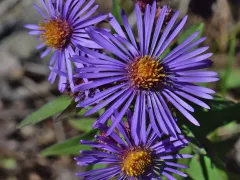
New England aster
4 ft · early September to mid October
A tall native that closes the season with clouds of purple or pink daisies.
-
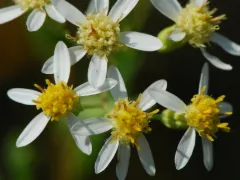
Flat-topped aster
5 ft · early August to mid September
Tall, leafy stems end in wide, flat heads of small white daisies with yellow centres, from late summer.
-
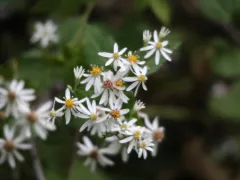
White wood aster
24 in · late August to early October
A froth of small white daisies on dark, wiry stems in early autumn, in the dry shade under trees where little else will flower.
-
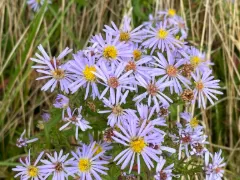
New York aster
3 ft · late August to mid October
The Michaelmas daisy of English borders: masses of daisies in purple, blue, pink or white in early autumn, on smooth-leaved plants from dwarf to tall.
-
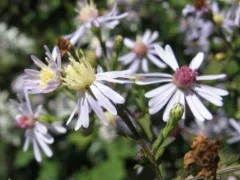
Blue wood aster
3 ft · mid September to mid October
A haze of small, pale blue daisies in autumn above heart-shaped leaves.
-
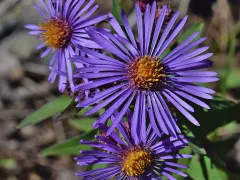
New England aster 'Purple Dome'
20 in · early September to mid October
A compact New England aster that makes a low, wide cushion, hidden under deep violet daisies for a month in early autumn.
-

Smooth aster 'Bluebird'
3½ ft · early September to mid October
Clouds of violet-blue, yellow-centred daisies in early autumn on a vase-shaped plant with smooth, blue-green leaves that stay clean all season.
-
New England aster 'Alma Pötschke'
3½ ft · late August to mid October
Daisies of a vivid, glowing salmon-rose, a colour found in no other aster, on sturdy stems in early autumn.
A bed for the pearl crescent
The planner designed this 16 × 8 ft (4.9 × 2.4 m) bed for zone 6 and full sun when this page was made, keeping flat-topped aster, hollow Joe-Pye weed and New England aster on it.
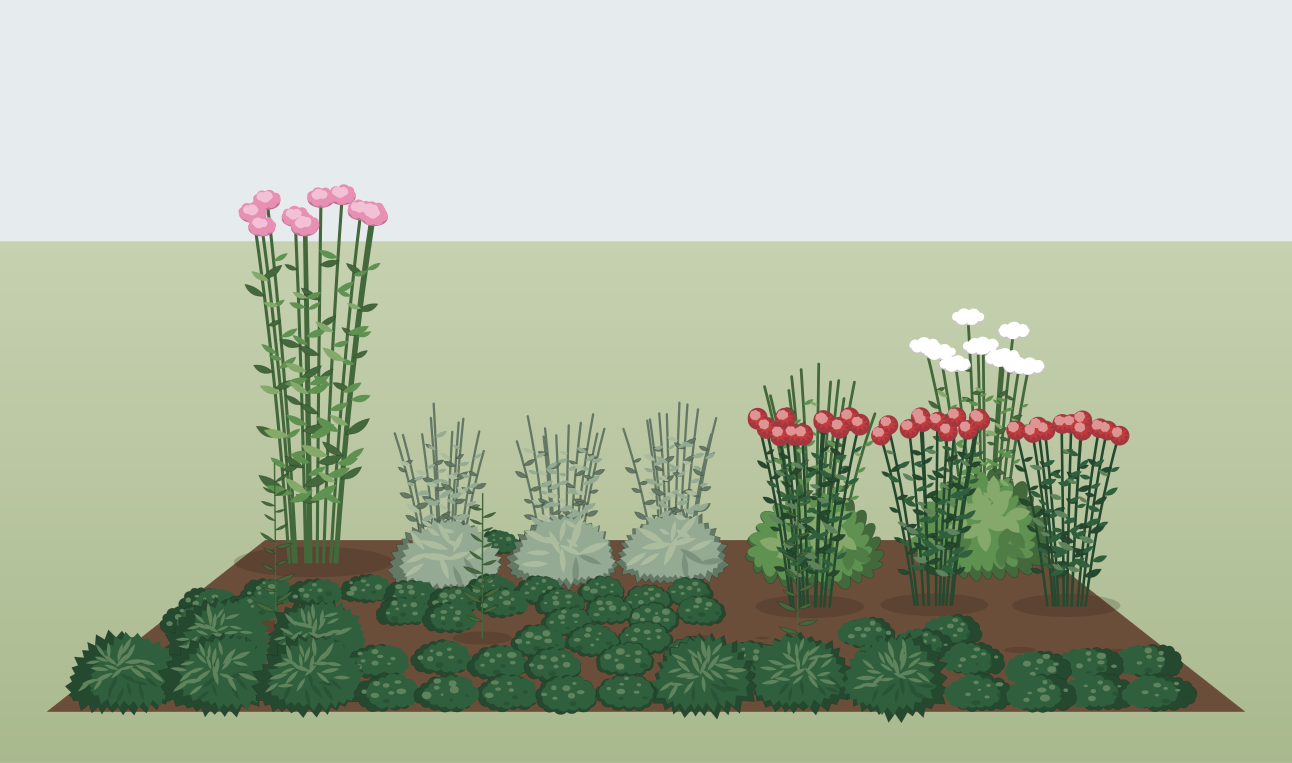
The plants
- 1 Flat-topped aster × 1, white
- 2 Hollow Joe-Pye weed × 1, pink
- 3 New England aster × 1, purple
- 4 Stemless gentian × 51, blue
- 5 Winter heath × 8, pink
- 6 Bee balm 'Raspberry Wine' × 3, red
- 7 Southernwood × 3, grey-green leaves
- 8 Asiatic lily × 3, orange
- 9 Hardy gladiolus × 5, pink
- 10 Persian fritillary × 3, purple
Planned as a naturalistic planting: low grasses and groundcovers, the matrix, make up 51% of the planted ground. The back corners are held by hollow Joe-Pye weed and flat-topped aster, the tallest plants on the plan. The bed is tied together by its repeats: two kinds come round again along it, stemless gentian and winter heath.
The planner's own design check: 7 Excellent, 8 Good, 2 Satisfactory.
Open this bed in the planner Change its size, the sun or the style, move plants about, or swap one for another.
All 9 plants
Middle of a bed 4
- Blue wood aster 3 ft · mid September to mid October
- New England aster 'Purple Dome' 20 in · early September to mid October
- New York aster 3 ft · late August to mid October
- White wood aster 24 in · late August to early October
Back of a bed 5
- Flat-topped aster 5 ft · early August to mid September
- Hollow Joe-Pye weed 7 ft · late July to mid September
- New England aster 4 ft · early September to mid October
- New England aster 'Alma Pötschke' 3½ ft · late August to mid October
- Smooth aster 'Bluebird' 3½ ft · early September to mid October