Host plants for the common wood-nymph
The garden plants whose leaves common wood-nymph caterpillars eat, and a bed the planner designed around them.
The common wood-nymph (Cercyonis pegala) is a butterfly. Like every butterfly and moth, it can lay its eggs only on the plants its caterpillars can eat, its host plants. A garden with nectar flowers feeds the adults as they pass; a garden with host plants is where the next generation is raised.
These 10 garden plants are recorded by NC State as hosts for its caterpillars. Expect chewed leaves: that is the point. Do not spray, and leave fallen leaves under the plants in winter, where many caterpillars and pupae spend it.
10 plants: 10 grasses.
The host plants
-
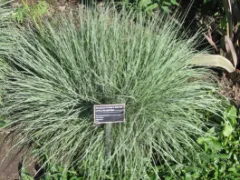
Little bluestem
3 ft · grown for its leaves
Blue-green summer blades turn copper and bronze in autumn and hold their colour through winter.
-
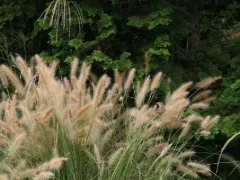
Switchgrass 'Shenandoah'
4 ft · grown for its leaves
Green blades turn wine-red from midsummer, topped by a cloud of fine, pink-tinged seed heads.
-
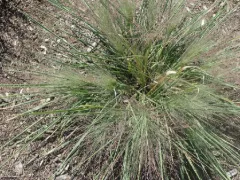
Little bluestem 'Standing Ovation'
3½ ft · early August to mid September
A little bluestem selected to stay bolt upright even in rich soil.
-
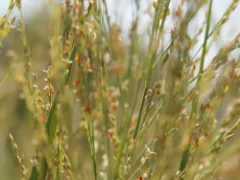
Switchgrass 'Northwind'
5½ ft · early August to early October
The most upright switchgrass: a narrow, rigid column of olive-blue leaves that never flops, turning gold in autumn and standing through winter.
-

Little bluestem 'The Blues'
3 ft · early August to early October
Stems and leaves of strong powder blue through summer, turning burgundy, orange and pink in autumn, with fluffy silver seed heads.
-

Switchgrass 'Heavy Metal'
4½ ft · late July to mid September
Stiffly upright, metallic blue leaves topped with a fine haze of pink flowers in late summer.
-

Switchgrass 'Cheyenne Sky'
3 ft · late July to mid September
A compact, vase-shaped switchgrass whose blue-green leaves begin to turn wine red in early summer, with purple flower heads to match.
-

Bitter switchgrass 'Dewey Blue'
4 ft · early August to early October
A wide fountain of intensely blue-grey leaves that arch to the ground, with airy, tan flower heads in late summer.
-

Switchgrass 'Cloud Nine'
7 ft · early August to early October
The giant switchgrass: blue-green leaves and a huge, billowing cloud of golden flowers well above head height by early autumn.
-
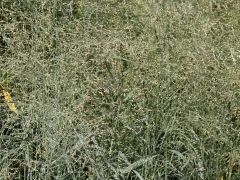
Switchgrass 'Prairie Sky'
5 ft · early August to early October
The bluest switchgrass: powder-blue leaves on an upright clump, topped with a pale haze of flowers in late summer, then yellow in autumn.
A bed for the common wood-nymph
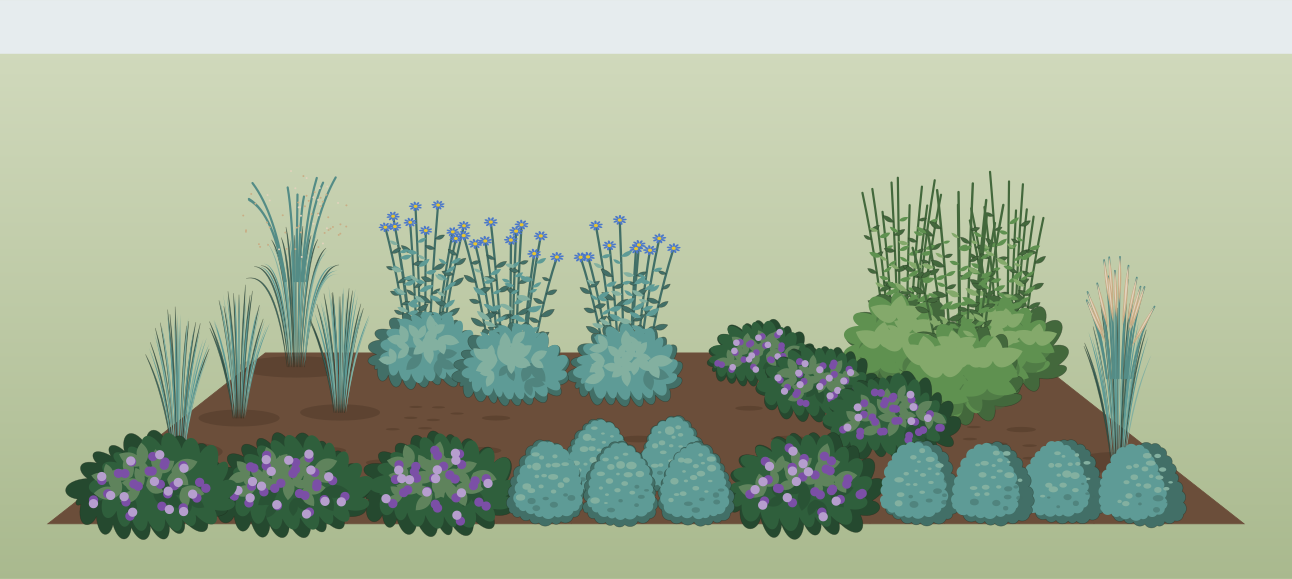
The planner designed this 16 × 8 ft (4.9 × 2.4 m) bed for zone 6 and full sun when this page was made, keeping bitter switchgrass 'Dewey Blue', little bluestem and little bluestem 'Standing Ovation' on it.
The plants
- 1 Bitter switchgrass 'Dewey Blue' × 1, tan
- 2 Little bluestem × 3, blue-green leaves
- 3 Little bluestem 'Standing Ovation' × 1, tan
- 4 Verbena 'Homestead Purple' × 7, purple
- 5 Cottage pinks × 9, pink
- 6 Smooth aster 'Bluebird' × 3, blue
- 7 Tatarian aster 'Jindai' × 3, purple
- 8 Schubert's allium × 5, pink
- 9 Persian fritillary × 5, purple
- 10 Daffodil 'Dutch Master' × 12, yellow
Planned as a naturalistic planting: low grasses and groundcovers, the matrix, make up 46% of the planted ground. Verbena 'Homestead Purple' flowers longest, for 21 weeks. The scheme leans cool (purple, pink and blue) and uses yellow for warmth, with tan to calm things between them.
The planner's own design check: 10 Excellent, 6 Good, 1 Satisfactory. It flags one thing to watch: Nothing on this plan is highly poisonous or an aggressive spreader.
Open this bed in the planner Change its size, the sun or the style, move plants about, or swap one for another.
All 10 plants
Middle of a bed 3
- Little bluestem 3 ft · grown for its leaves
- Little bluestem 'The Blues' 3 ft · early August to early October
- Switchgrass 'Cheyenne Sky' 3 ft · late July to mid September
Back of a bed 7
- Bitter switchgrass 'Dewey Blue' 4 ft · early August to early October
- Little bluestem 'Standing Ovation' 3½ ft · early August to mid September
- Switchgrass 'Cloud Nine' 7 ft · early August to early October
- Switchgrass 'Heavy Metal' 4½ ft · late July to mid September
- Switchgrass 'Northwind' 5½ ft · early August to early October
- Switchgrass 'Prairie Sky' 5 ft · early August to early October
- Switchgrass 'Shenandoah' 4 ft · grown for its leaves