Host plants for the imperial moth
The garden plants whose leaves imperial moth caterpillars eat, and a bed the planner designed around them.
The imperial moth (Eacles imperialis) is a moth. Like every butterfly and moth, it can lay its eggs only on the plants its caterpillars can eat, its host plants. A garden with nectar flowers feeds the adults as they pass; a garden with host plants is where the next generation is raised.
These eight garden plants are recorded by NC State as hosts for its caterpillars. Expect chewed leaves: that is the point. Do not spray, and leave fallen leaves under the plants in winter, where many caterpillars and pupae spend it.
8 plants: 8 shrubs.
The host plants
-

Japanese maple 'Bloodgood'
15 ft · grown for its leaves
The best-known red Japanese maple: deeply cut leaves of dark burgundy that hold their colour all summer and turn crimson in autumn, on a small, layered tree.
-

Laceleaf Japanese maple 'Crimson Queen'
8 ft · grown for its leaves
A low, weeping dome of thread-fine, deep crimson foliage that cascades to the ground and turns scarlet in autumn.
-

Coral bark maple
16½ ft · grown for its leaves
Young branches of brilliant coral red, brightest in winter, carry small, pale green leaves that turn soft yellow and apricot in autumn.
-

Laceleaf Japanese maple 'Viridis'
8 ft · grown for its leaves
A cascading mound of bright green, finely cut leaves, like a fountain of ferns, that turns gold and orange in autumn.
-

Golden fullmoon maple
13 ft · grown for its leaves
Round, pleated leaves like open fans, of clear yellow-gold all summer, turning orange and red in autumn.
-

Dwarf white pine
5 ft · grown for its leaves
A soft, billowing mound of long, fine, blue-green needles: the eastern white pine in miniature.
-
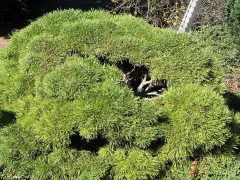
Mugo pine 'Mops'
3 ft · grown for its leaves
A dense, almost perfectly round pine that reaches waist height in ten years, with resinous buds like candles in winter.
-
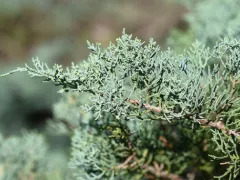
Juniper 'Grey Owl'
3 ft · grown for its leaves
Wide-spreading, feathery branches of soft silver-grey, held in graceful, arching layers, and studded with blue-grey berries.
A bed for the imperial moth
The planner designed this 16 × 8 ft (4.9 × 2.4 m) bed for zone 6 and part sun when this page was made, keeping coral bark maple, dwarf white pine and golden fullmoon maple on it.

The plants
- 1 Coral bark maple × 1, green leaves
- 2 Dwarf white pine × 1, blue-green leaves
- 3 Golden fullmoon maple × 1, chartreuse leaves
- 4 Striped bloody cranesbill × 16, pink
- 5 Leadwort × 22, blue
- 6 Brown-eyed Susan × 5, yellow
- 7 Foxglove beardtongue × 4, white
- 8 Asiatic lily × 3, yellow
- 9 Camassia × 3, blue
Planned as a naturalistic planting, but it does not yet read as one: low grasses and groundcovers, the matrix, make up 18% of the planted ground. The scheme leans cool (pink and blue) and uses yellow for warmth, with white to calm things between them. The most in flower at one time is 3 kinds, from late May. The Design check fails the share of foliage and room to grow, and says the style, heights and the front edge needs revision.
The planner's own design check: 5 Excellent, 7 Good, 3 Needs revision, 2 Fail. Its weakest point is foliage: Coral bark maple, dwarf white pine and golden fullmoon maple are grown for their leaves, and cover 74% of the planted ground. The Foliage control above the plan asks for about 10%.
Open this bed in the planner Change its size, the sun or the style, move plants about, or swap one for another.
All 8 plants
Middle of a bed 2
- Juniper 'Grey Owl' 3 ft · grown for its leaves
- Mugo pine 'Mops' 3 ft · grown for its leaves
Back of a bed 6
- Coral bark maple 16½ ft · grown for its leaves
- Dwarf white pine 5 ft · grown for its leaves
- Golden fullmoon maple 13 ft · grown for its leaves
- Japanese maple 'Bloodgood' 15 ft · grown for its leaves
- Laceleaf Japanese maple 'Crimson Queen' 8 ft · grown for its leaves
- Laceleaf Japanese maple 'Viridis' 8 ft · grown for its leaves