Plants with orange flowers
Plants with orange flowers, the hottest colour in the garden, and the purple and blue that make it sing.
Orange is the hottest colour in a garden and the rarest among the warm ones: there are fewer orange flowers than red or yellow, and very few of them grow in shade. Many are lilies, tulips, heleniums, geums and crocosmias, plants of sun and summer.
Orange is the opposite of blue, and the classic way to use it is against blue and purple: orange lilies above a sea of catmint, or heleniums beside asters. With purple or bronze leaves and the tawny heads of grasses it makes a hot border that glows in the low evening sun. Keep it away from cool pinks, which it makes look sickly.
Every plant here has orange flowers, or comes in orange.
67 plants: 37 perennials, 20 bulbs and 10 shrubs.
The dozen to start with
-
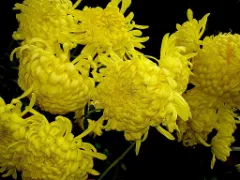
Garden chrysanthemum
24 in · mid September to late October · also in yellow, red, pink, purple and white
The florist's mum: dense domes of daisies, pompoms or buttons in every autumn colour.
-
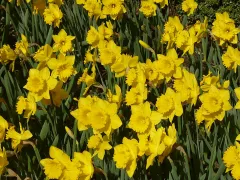
Daffodil
16 in · mid April to early May · also in yellow and white
The most reliable spring bulb: it comes back and multiplies for decades, and deer and rodents leave it alone.
-
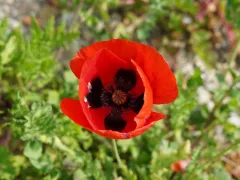
Oriental poppy
2½ ft · late May to late June · also in red, pink and white
Enormous, crepe-paper flowers in scarlet, orange, pink or white, usually with a black blotch at the base, in early summer.
-
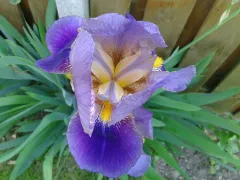
Bearded iris
2½ ft · late May to mid June · also in purple, blue, white, yellow, pink and red
Ruffled, often scented flowers in almost every colour stand above fans of grey, sword-shaped leaves in late spring.
-
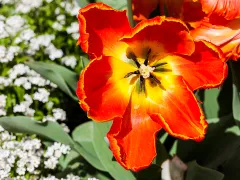
Tulip
18 in · late April to mid May · also in red, pink, yellow, white and purple
Clean, saturated colour on upright stems in mid to late spring.
-
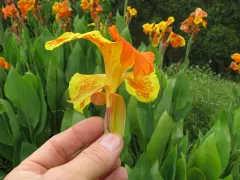
Canna
5 ft · early July to early October · also in red, yellow and pink · host plant
Huge, paddle-shaped leaves, green, bronze or striped, topped with bright flowers in red, orange, yellow or pink from midsummer to frost.
-

Daylily
2½ ft · late June to early August · also in yellow and red
Nearly indestructible, with each flower lasting a single day but many buds opening over several weeks.
-
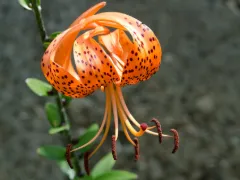
Tiger lily
4 ft · late July to late August
Orange, black-spotted flowers with petals curled right back, up to twenty on a stem, in late summer.
-

Hybrid tea rose
4 ft · early June to early October · also in red, pink, yellow and white
The florist's rose: large, high-centred, often fragrant flowers, one to a long stem, on an upright, rather stiff bush.
-
Northern Lights azalea
5 ft · mid May to early June · also in pink, yellow and white
Deciduous azaleas bred in Minnesota, with flower buds that survive -35 C.
-
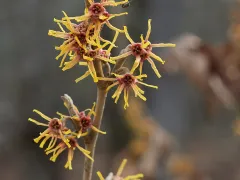
Vernal witch hazel
8 ft · mid January to early March · with yellow and red
Small, spidery flowers of yellow to rusty red, with a strong, spicy scent, open on mild days from January to March.
-

Shrubby cinquefoil
3 ft · early June to mid September · also in yellow, white and pink
A small, twiggy, very hardy shrub with fine leaves and buttercup-like flowers in yellow, white, pink or orange from June to frost.
A bed planned only from these plants
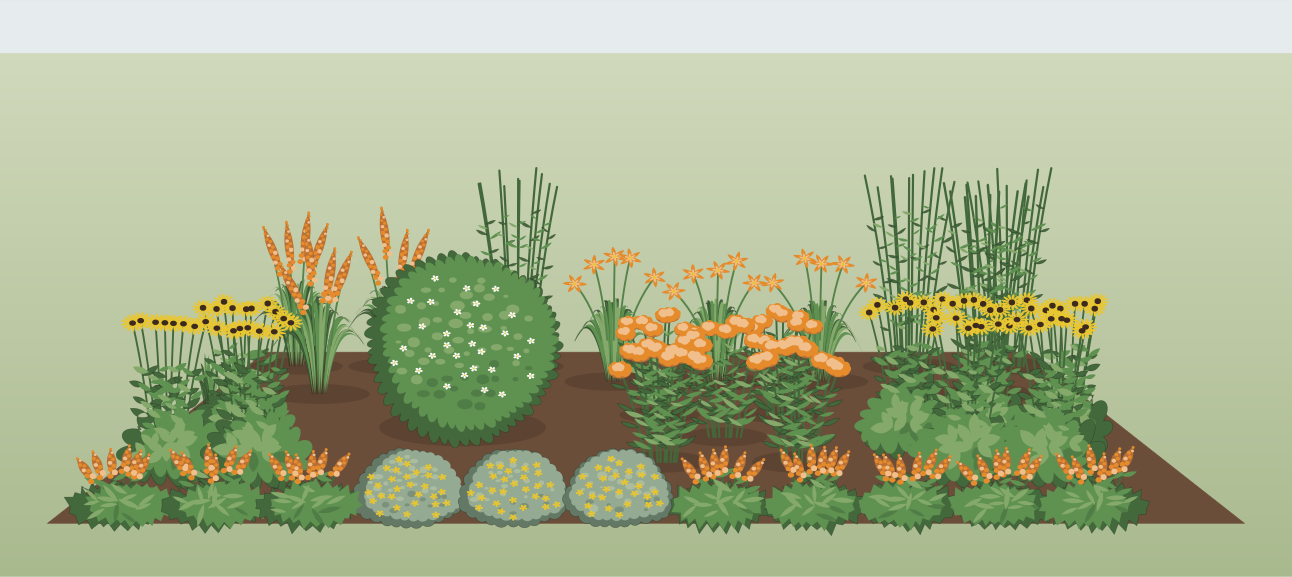
The planner was given only the plants on this page that suit zone 6 and full sun, and designed this 16 × 8 ft (4.9 × 2.4 m) bed from them when the page was made.
The plants
- 1 Rock rose × 3, yellow
- 2 Pineleaf penstemon × 8, orange
- 3 Sneezeweed × 4, red
- 4 Red hot poker × 3, orange
- 5 Shrubby cinquefoil × 1, white
- 6 Gloriosa daisy × 8, yellow
- 7 Butterfly weed × 5, orange
- 8 Daylily × 3, orange
- 9 Tulip × 3, pink
- 10 Daffodil × 3, yellow
Planned as a contemporary bed: 39 of the 39 plants that stand in groups (100%) are set out in a pattern with their neighbours: a straight row, a triangle, or five like the five on a dice. The scheme leans hot (yellow, orange and red) and uses pink for relief, with white to calm things between them. The flowering is at its height from late June, with 7 kinds out together.
The planner's own design check: 6 Excellent, 11 Good.
Open this bed in the planner Change its size, the sun or the style, move plants about, or swap one for another.
All 67 plants
Show all 67, by where they go in a bed
Front of a bed 14
- Avens 'Mai Tai' 18 in · mid May to mid July · with pink
- Barrenwort 'Amber Queen' 18 in · late April to mid June · with yellow
- California fuchsia 18 in · early August to mid October · with red
- Daffodil 16 in · mid April to early May · also in yellow and white
- Daffodil 'Jetfire' 10 in · late March to mid April · with yellow
- Greigii tulip 10 in · mid April to early May · also in red, yellow and pink
- Ice plant 'Fire Spinner' 2 in · mid May to late June · with pink and purple
- Iceland poppy 16 in · early May to late June · also in yellow, white, pink and red
- Orange barrenwort 14 in · mid April to mid May
- Pineleaf penstemon 12 in · mid June to early August · also in yellow
- Rock rose 10 in · late May to early July · also in yellow, pink, red and white
- Rock rose 'Henfield Brilliant' 10 in · late May to mid July · with red
- Tulip 18 in · late April to mid May · also in red, pink, yellow, white and purple
- Water avens 16 in · early May to late June · with pink
Middle of a bed 29
- Asiatic lily 3 ft · late June to mid July · also in yellow, red, pink and white
- Avens 'Totally Tangerine' 2½ ft · mid May to early August
- Bearded iris 2½ ft · late May to mid June · also in purple, blue, white, yellow, pink and red
- Blackberry lily 3 ft · mid July to mid August
- Butterfly weed 24 in · late June to early August · host plant
- Chinese globeflower 'Golden Queen' 2½ ft · early June to mid July
- Chrysanthemum 'Mary Stoker' 24 in · late August to mid October · with yellow
- Coneflower 'Cheyenne Spirit' 2 ft · late June to early September · also in red, yellow, pink and cream
- Coneflower 'Hot Papaya' 2½ ft · early July to early September · with red
- Crocosmia 'Emily McKenzie' 24 in · early August to mid September · with red
- Darwin hybrid tulip 24 in · late April to mid May · also in red, yellow, pink and white
- Daylily 2½ ft · late June to early August · also in yellow and red
- Floribunda rose 3 ft · early June to early October · also in red, pink, yellow and white
- Garden chrysanthemum 24 in · mid September to late October · also in yellow, red, pink, purple and white
- Globeflower 2½ ft · mid May to late June · also in yellow
- Gloriosa daisy 2½ ft · late June to mid September · also in yellow and red · host plant
- Griffith's spurge 'Fireglow' 3 ft · late May to early July · with red
- Ligularia 'Desdemona' 3½ ft · late July to early September · with yellow
- Montbretia 2½ ft · mid July to late August · also in red and yellow
- Oriental poppy 2½ ft · late May to late June · also in red, pink and white
- Peony 'Coral Charm' 3 ft · mid May to early June · with pink
- Red hot poker 'Flamenco' 3 ft · late June to late August · with red and yellow
- Shrubby cinquefoil 3 ft · early June to mid September · also in yellow, white and pink
- Sneezeweed 'Mardi Gras' 3 ft · early July to early September · with yellow and red
- Sneezeweed 'Moerheim Beauty' 3 ft · mid July to early September · with red
- Sneezeweed 'Sahin's Early Flowerer' 3 ft · late June to early October · with red and yellow
- Sunset hyssop 24 in · mid July to mid September
- Tulip 'Ballerina' 22 in · early May to mid May
- Yarrow 'Terracotta' 2½ ft · late June to late August · with yellow
Back of a bed 24
- Canada lily 5 ft · late June to mid July · also in yellow and red
- Canna 5 ft · early July to early October · also in red, yellow and pink · host plant
- Crown imperial 3½ ft · late April to early May · also in yellow and red
- Dahlia 3½ ft · mid July to mid October · also in red, pink, yellow, purple and white
- English rose 4 ft · early June to early October · also in pink, white, yellow and red
- False sunflower 'Summer Nights' 3½ ft · late June to early September · with yellow
- Flame azalea 8 ft · mid May to mid June · also in yellow and red
- Flowering quince 6 ft · late March to late April · also in red, pink and white
- Flowering quince 'Cameo' 4 ft · early April to early May · with pink
- Foxtail lily 6 ft · early June to early July · also in yellow, pink and white
- Gladiolus 4 ft · mid July to early September · also in red, pink, yellow, purple and white
- Henry's lily 6 ft · late July to late August
- Hybrid tea rose 4 ft · early June to early October · also in red, pink, yellow and white
- Ligularia 'Britt-Marie Crawford' 3½ ft · early August to early September
- Narrow-leaved foxtail lily 3½ ft · mid June to mid July · with yellow
- Northern Lights azalea 5 ft · mid May to early June · also in pink, yellow and white
- Red hot poker 3½ ft · late June to early August · also in red and yellow
- Rusty foxglove 5 ft · late June to early August · with brown
- Sneezeweed 4 ft · early August to late September · also in yellow and red
- Tiger lily 4 ft · late July to late August
- Trumpet lily 5 ft · mid July to early August · also in white, yellow and pink
- Turk's cap lily 6 ft · mid July to early August
- Vernal witch hazel 8 ft · mid January to early March · with yellow and red
- Witch hazel 'Jelena' 11½ ft · late January to mid March