Coral bells 'Plum Pudding'
Heuchera 'Plum Pudding' · Saxifragaceae
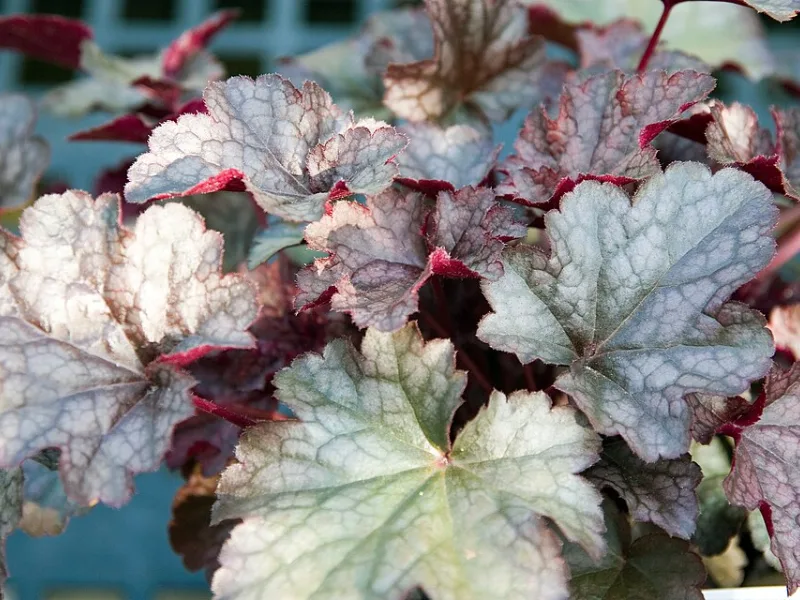
Shining plum-purple leaves overlaid with a metallic silver sheen and dark veins, in a tight, tidy mound.
- Size
- 10 in tall, 16 in wide
- Zones
- 4 to 9
- Light
- Part sun to part shade
- Flowers
- Grown for its leaves; flowers early June to mid July
- Pets
- Not checked
- Job in a bed
- Drift
A bed built around coral bells 'Plum Pudding'
The planner designed this bed around coral bells 'Plum Pudding' when this page was made: a 12 × 6 ft (3.7 × 1.8 m) English border in zone 6, part sun. It chose the other plants from the 708 that suit those conditions, and says below why coral bells 'Plum Pudding' stands where it does.
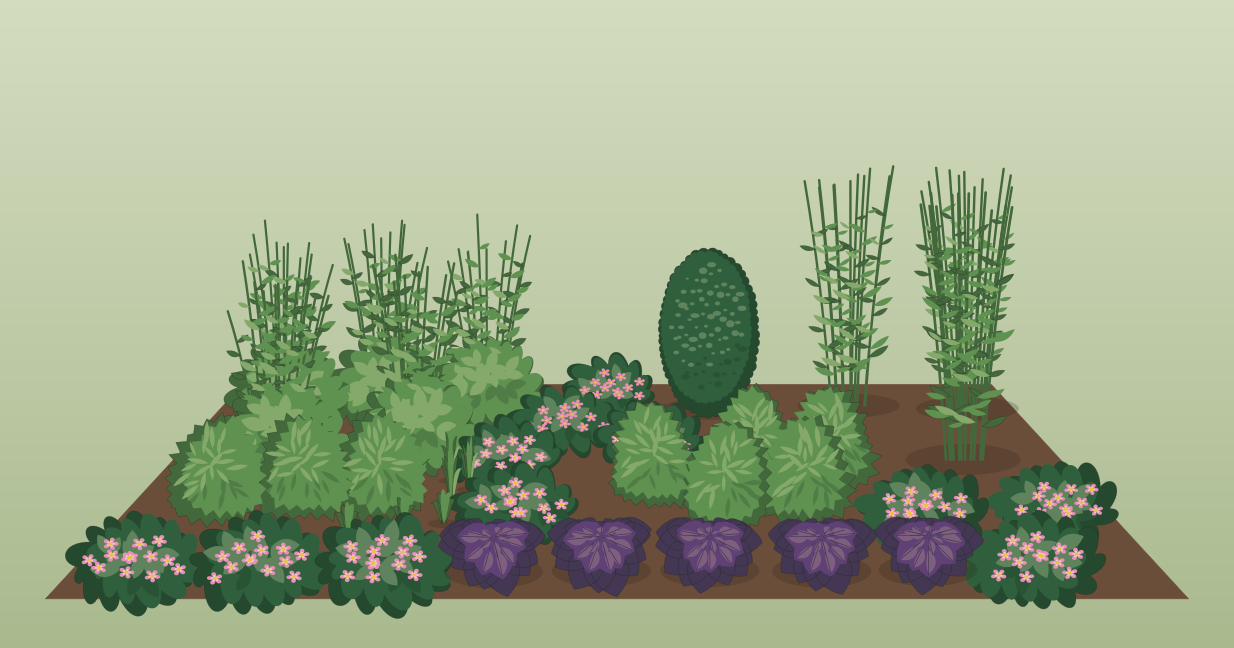
The plants
- 1 Coral bells 'Plum Pudding' × 5, purple leaves
- 2 Striped bloody cranesbill × 11, pink
- 3 Blue wood aster × 5, lavender
- 4 Garden phlox 'David' × 3, white
- 5 Dwarf English boxwood × 1, dark green leaves
- 6 Creeping Jacob's ladder × 8, blue
- 7 Hyacinth 'Delft Blue' × 3, blue
- 8 Daffodil 'February Gold' × 3, yellow
Why this plant
- The only bold leaves here. The rest are fine and medium. A change of leaf keeps plants distinct when nothing is in flower.
- Grown for leaf, not flower. So is dwarf English boxwood. Leaf lasts all season, where a flower lasts a few weeks.
Why here
- On the front edge. At 10 in it frames the bed without hiding it, and it is in leaf all season. It finishes 51% of the edge.
- 5 plants in one run. An unbroken run of one kind gives the edge a clean line.
- Bold leaf against fine. Striped bloody cranesbill is beside it: the strongest contrast of leaf there is.
Why now
- Here for its leaves, into winter. They cover the 8 weeks between early March and late November when nothing on the plan is in flower.
Planned as an English border: 6 of the 7 groups (86%) are drifts, longer along the bed than they are deep. Blue wood aster and garden phlox 'David' anchor the back corners of the bed: the tallest plants on the plan stand there. The bold leaves of coral bells 'Plum Pudding' are set against the fine leaves of striped bloody cranesbill, the kind of contrast that keeps a bed from blurring.
The planner's own design check: 15 Excellent, 2 Good. It flags one thing to watch: Nothing on this plan is highly poisonous or an aggressive spreader.
Open this bed in the planner Change its size, the sun or the style, move plants about, or swap one for another.
Where coral bells 'Plum Pudding' goes in a border
At 10 in it belongs at the front of a bed. In the planner's ten height classes it is low (6 to 12 in).
Its job: drift. Planted in a small group of three or five, and repeated further along in the other number.
One of the most reliable purple heucheras, and one that keeps a neat shape for years. The silver overlay catches low light, so it is never a dull, dead purple.
- Purple and silver foliage
- Edging a shady path
- Massing as groundcover
What to plant with coral bells 'Plum Pudding'
Plants recorded as good partners for it, and what each pairing does:
- Japanese painted fern: fine leaves against its bold ones; tall enough (18 in) to stand behind it.
- Hosta 'Blue Mouse Ears': medium leaves against its bold ones; spires rising out of its mound.
- Siberian bugloss: adds the flowers, late April to late May; tall enough (16 in) to stand behind it.
Questions about coral bells 'Plum Pudding'
Does coral bells 'Plum Pudding' need sun or shade?
Coral bells 'Plum Pudding' grows in part sun (4 to 6 hours of sun, including some afternoon sun) and part shade (2 to 4 hours of sun, mostly in the morning).
It wants ordinary well-drained soil, rich in organic matter, and a good soak in dry spells.
What zones does coral bells 'Plum Pudding' grow in?
USDA zones 4 to 9. It is hardy to zone 4, which means it survives winter nights down to about −20 °F (−29 °C).
Gardening in Canada? Use the USDA zone for your town: Canada's own zone map uses different numbers.
How far apart should coral bells 'Plum Pudding' be planted?
14 in (35 cm) apart, from the middle of one plant to the middle of the next. That is a little closer than its full width of 16 in (40 cm), so a group knits into one patch.
It grows 10 in (25 cm) tall. Give it the full distance from anything taller, or it will lean out towards the light.
How many coral bells 'Plum Pudding' plants do I need?
At 14 in apart, set out in staggered rows:
- 9 to fill 10 square feet (about 1 m²)
- 9 for a single row 10 ft (3 m) long
- 28 to fill a 4 × 8 ft bed on its own
In a mixed border, plant it as a group of three or five, with a second group further along in the other number.
In the bed above, the planner used five in one group.
What does coral bells 'Plum Pudding' look like in winter?
Coral bells 'Plum Pudding' holds some of its leaves into winter, more in a mild year or a sheltered spot, and they look tired by March. Cut the old ones off as new growth starts.
More Heuchera
- American alumroot Heuchera americana
- Coral bells Heuchera
- Coral bells 'Berry Smoothie' Heuchera 'Berry Smoothie'
- Coral bells 'Caramel' Heuchera 'Caramel'
- Coral bells 'Citronelle' Heuchera 'Citronelle'
- Coral bells 'Firefly' Heuchera sanguinea 'Leuchtkäfer'
- Coral bells 'Georgia Peach' Heuchera 'Georgia Peach'
- Coral bells 'Green Spice' Heuchera americana 'Green Spice'
- Coral bells 'Lime Rickey' Heuchera 'Lime Rickey'
- Coral bells 'Obsidian' Heuchera 'Obsidian'
- Coral bells 'Palace Purple' Heuchera micrantha 'Palace Purple'
- Hairy alumroot 'Autumn Bride' Heuchera villosa 'Autumn Bride'
- Prairie alumroot Heuchera richardsonii
- Scarlet coral bells Heuchera sanguinea
In these guides
- Low plants for the front of a border
- Silver and grey-leaved plants
- Plants with purple and burgundy leaves
Zone guides: Zone 4 · Zone 5 · Zone 6 · Zone 7 · Zone 8 · Zone 9
Every fact on record
- Type
- Perennial
- Size
- 10 in (25 cm) tall, 16 in (40 cm) wide
- Plant
- 14 in (35 cm) apart
- Height class
- Low (6 to 12 in)
- Place in the bed
- Front
- Flowers
- Early June to mid July; airy sprays; white, pink
- Leaves
- Bold texture, semi-evergreen; purple, silver
- Shape
- Mounding, clumping
- Hardy in
- USDA zones 4 to 9
- Light
- Part sun, part shade
- Soil
- Rich, well-drained
- Water
- Moderate
- Feeding
- Light, in spring
- Family
- Saxifragaceae
Not yet checked against an outside reference: its figures rest on general horticultural knowledge. Flowering times are for zone 5: later in colder zones, earlier in warmer ones. Toxicity and spread information is a general gardening guide, not veterinary or medical advice, and invasive status varies by region. If a person or pet eats a plant, contact poison control or a vet. Check your local invasive species list before planting anything with a spread warning.