Host plants for the milkweed tussock moth
The garden plants whose leaves milkweed tussock moth caterpillars eat, and a bed the planner designed around them.
The milkweed tussock moth (Euchaetes egle) is a moth. Like every butterfly and moth, it can lay its eggs only on the plants its caterpillars can eat, its host plants. A garden with nectar flowers feeds the adults as they pass; a garden with host plants is where the next generation is raised.
These three garden plants are recorded by NC State as hosts for its caterpillars. Expect chewed leaves: that is the point. Do not spray, and leave fallen leaves under the plants in winter, where many caterpillars and pupae spend it.
3 plants: 3 perennials.
The host plants
-

Butterfly weed
24 in · late June to early August
Flat clusters of vivid orange flowers in midsummer, covered in butterflies, on a low, bushy plant with a deep taproot.
-

Common milkweed
4 ft · late June to early August
Tall stems of broad leaves with drooping balls of dusky pink, heavily scented flowers, then warty pods of silky seed.
-

Purple milkweed
3 ft · early June to mid July
Domed clusters of rich rose-purple flowers, the deepest colour of any native milkweed, on sturdy stems in early summer.
A bed for the milkweed tussock moth
The planner designed this 16 × 8 ft (4.9 × 2.4 m) bed for zone 6 and full sun when this page was made, keeping butterfly weed, common milkweed and purple milkweed on it.
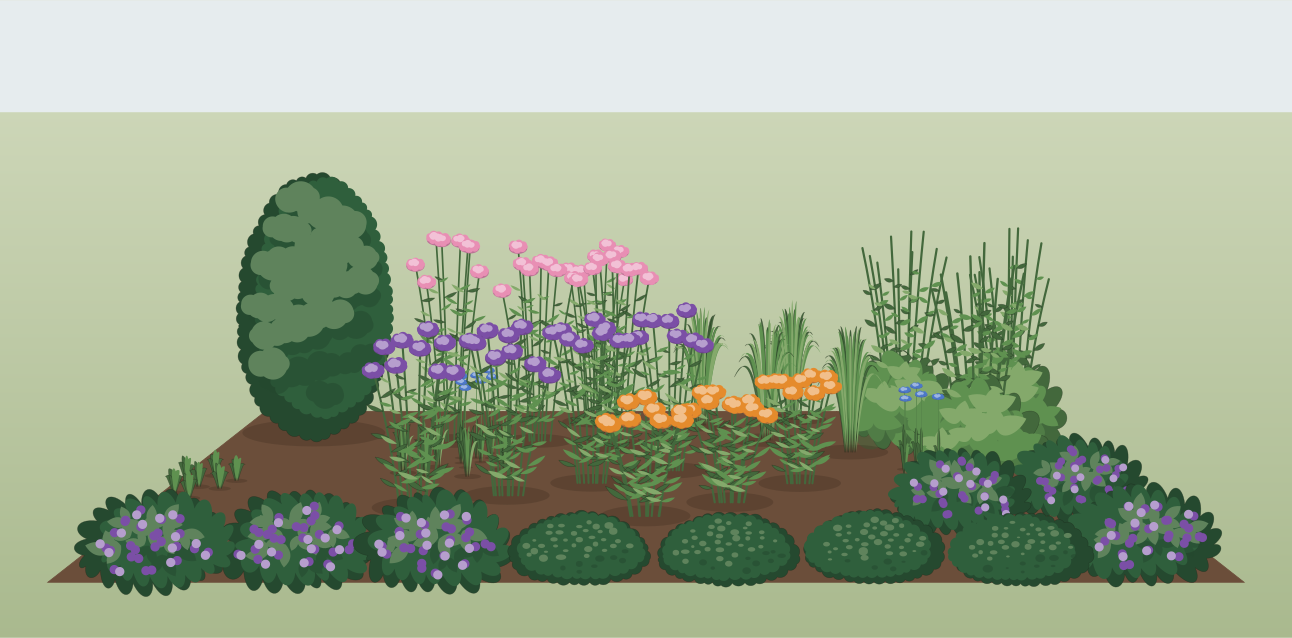
The plants
- 1 Butterfly weed × 3, orange
- 2 Common milkweed × 4, pink
- 3 Purple milkweed × 4, purple
- 4 Bearberry × 4, pink
- 5 Verbena 'Homestead Purple' × 6, purple
- 6 Dwarf Hinoki cypress × 1, dark green leaves
- 7 Northern sea oats × 4, tan
- 8 Tatarian aster 'Jindai' × 3, purple
- 9 Daffodil × 5, yellow
- 10 Triteleia 'Queen Fabiola' × 12, blue
- 11 Hyacinth 'Delft Blue' × 7, blue
Planned as a naturalistic planting: low grasses and groundcovers, the matrix, make up 52% of the planted ground. The flowering is at its height from late June, with 5 kinds out together. The scheme leans cool (pink, purple and blue) and uses orange and yellow for warmth, with tan to calm things between them.
The planner's own design check: 10 Excellent, 4 Good, 3 Satisfactory. It flags one thing to watch: Common milkweed spreads aggressively. Northern sea oats spreads aggressively.
Open this bed in the planner Change its size, the sun or the style, move plants about, or swap one for another.
All 3 plants
Middle of a bed 2
- Butterfly weed 24 in · late June to early August
- Purple milkweed 3 ft · early June to mid July
Back of a bed 1
- Common milkweed 4 ft · late June to early August