Northern sea oats
Chasmanthium latifolium · Poaceae
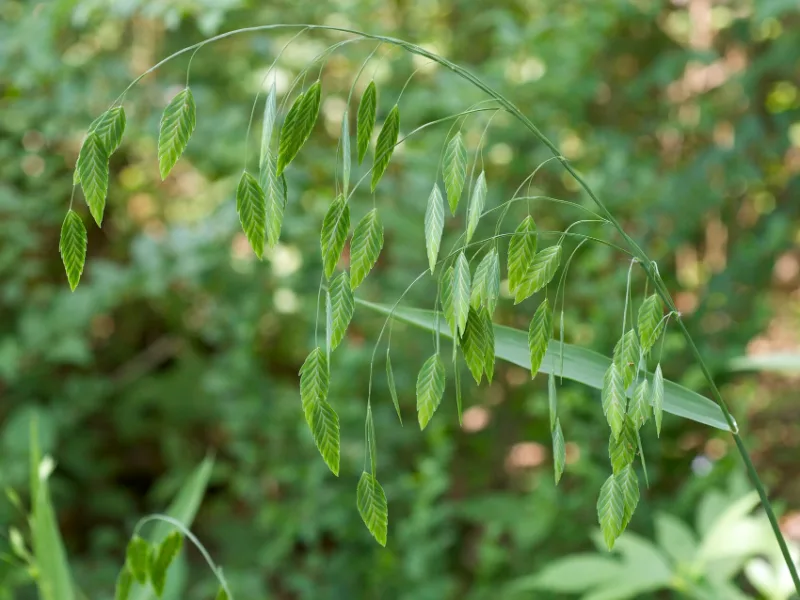
Flat, dangling seed heads, like flattened oats, hang from arching stems and turn from green to bronze. The leaves are broad and bamboo-like, and it is one of the few grasses that thrive in shade.
- Size
- 3½ ft tall, 24 in wide
- Zones
- 4 to 9
- Light
- Full sun to part shade
- Flowers
- Late July to mid September
- Pets
- No toxicity recorded
- Job in a bed
- Drift
A bed built around northern sea oats
The planner designed this bed around northern sea oats when this page was made: a 12 × 6 ft (3.7 × 1.8 m) naturalistic planting in zone 6, part sun. It chose the other plants from the 708 that suit those conditions, and says below why northern sea oats stands where it does.
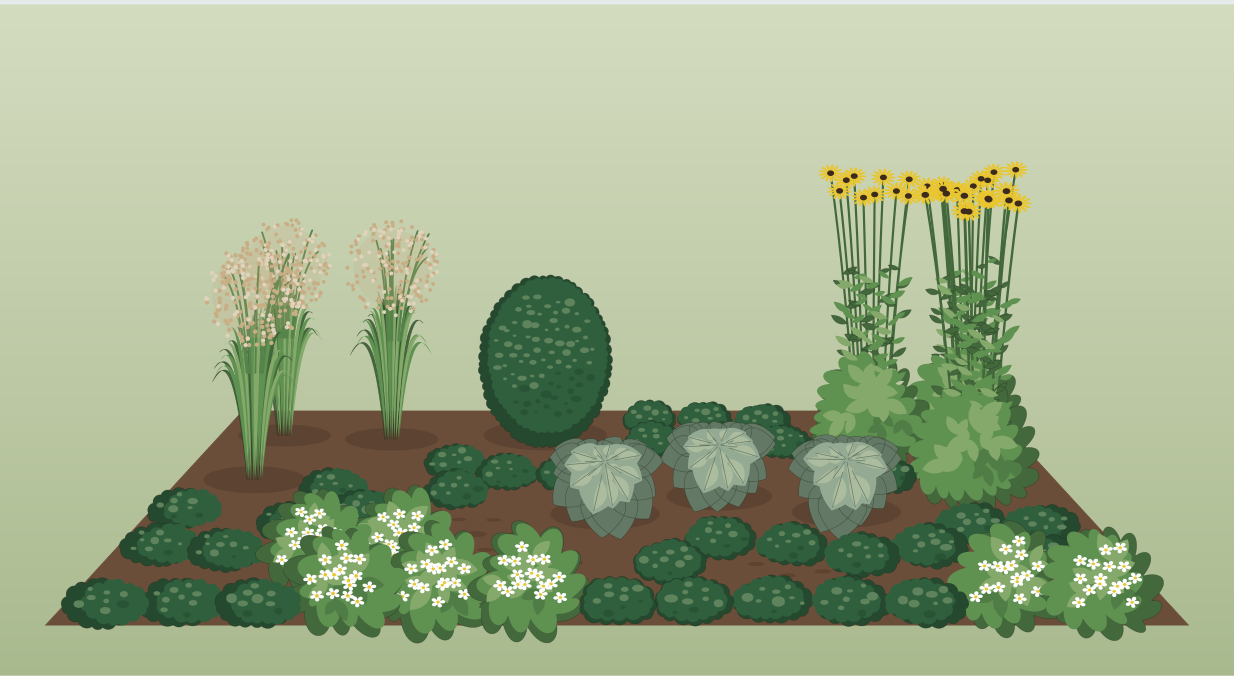
The plants
- 1 Northern sea oats × 3, tan
- 2 Stemless gentian × 35, blue
- 3 Carpathian bellflower × 7, white
- 4 Brown-eyed Susan × 3, yellow
- 5 Inkberry 'Gem Box' × 1, dark green leaves
- 6 Lady's mantle × 3, green
- 7 Meadow saffron × 3, pink
- 8 Fumewort × 8, purple
Why this plant
- Part of the matrix. The low fabric of grasses and groundcovers that the taller plants come up through.
- The only tan. Tan sits between stronger colours and calms them.
- Part of the bed's structure. Shrubs and grasses keep their shape when the perennials die down. So does inkberry 'Gem Box'.
Why here
- Anchors a back corner. At 3½ ft it is among the tallest plants here, and the tallest close the ends of the bed, where they stand in front of nothing.
- A step in the back row. Next to inkberry 'Gem Box' (2½ ft): no two neighbours there are the same height, so the back steps up and down like a skyline.
- 3 plants in one group. Massed, one kind reads as a single shape. Scattered, it would look spotty.
Why now
- In flower for 9 weeks. From late July to mid September.
- Part of the bed's peak. With Carpathian bellflower and brown-eyed Susan in late July: 3 kinds at once. No week has more.
- Stands through winter. Left uncut, it holds its shape until March, when the perennials have gone.
Planned as a naturalistic planting: low grasses and groundcovers, the matrix, make up 56% of the planted ground. The bed is tied together by its repeats: two kinds come round again along it, stemless gentian and Carpathian bellflower. There is more stemless gentian than anything else, 35 plants in all.
The planner's own design check: 13 Excellent, 3 Good, 1 Satisfactory. It flags one thing to watch: Meadow saffron is highly poisonous to people, dogs, cats and horses. Northern sea oats spreads aggressively.
Open this bed in the planner Change its size, the sun or the style, move plants about, or swap one for another.
Where northern sea oats goes in a border
At 3½ ft it belongs at the back of a bed. In the planner's ten height classes it is moderately tall (3 to 4 ft).
Its job: drift. Planted in a small group of three or five, and repeated further along in the other number.
The best ornamental grass for shade, with seed heads that move in a breeze. It seeds itself heavily, so use it where that is welcome, or cut the seed heads in autumn.
- Grasses for shade
- Dried arrangements
- Holding moist slopes
What to plant with northern sea oats
Plants recorded as good partners for it, and what each pairing does:
- Blue wood aster: in flower together for two weeks, from mid September.
- White wood aster: in flower together for five weeks, from late August; low enough (24 in) to stand in front of it.
- Solomon's seal: flowers first, early May to late May, so the spot is never empty; happy in the same moist soil.
Questions about northern sea oats
Does northern sea oats need sun or shade?
Northern sea oats grows in full sun (6 or more hours of direct sun a day), part sun (4 to 6 hours of sun, including some afternoon sun) and part shade (2 to 4 hours of sun, mostly in the morning).
It wants soil that stays evenly moist, of average fertility, and a good soak in dry spells. Once settled in, it stands drought.
What zones does northern sea oats grow in?
USDA zones 4 to 9. It is hardy to zone 4, which means it survives winter nights down to about −20 °F (−29 °C).
Gardening in Canada? Use the USDA zone for your town: Canada's own zone map uses different numbers.
When does northern sea oats flower in my zone?
In zone 5 it flowers late July to mid September. As a summer flower it moves about half a week for every zone: earlier where it is warmer.
| Zone 4 | Early August to mid September |
|---|---|
| Zone 5 | Late July to mid September |
| Zone 6 | Late July to mid September |
| Zone 7 | Mid July to mid September |
| Zone 8 | Mid July to mid September |
| Zone 9 | Mid July to mid September |
Worked out from Hopkins' bioclimatic law: spring arrives about four days later for each degree of latitude north, and one zone is roughly two degrees. A warm spring or a cold one moves any garden two weeks either way.
How far apart should northern sea oats be planted?
18 in (45 cm) apart, from the middle of one plant to the middle of the next. That is a little closer than its full width of 24 in (60 cm), so a group knits into one patch.
It grows 3½ ft (100 cm) tall. Give it the full distance from anything taller, or it will lean out towards the light.
How many northern sea oats plants do I need?
At 18 in apart, set out in staggered rows:
- 5 to fill 10 square feet (about 1 m²)
- 7 for a single row 10 ft (3 m) long
- 17 to fill a 4 × 8 ft bed on its own
In a mixed border, plant it as a group of three or five, with a second group further along in the other number.
In the bed above, the planner used three in one group.
Is northern sea oats poisonous to dogs and cats?
No toxicity is recorded for dogs, cats, horses or people, according to NC State Extension.
"Not toxic" is not "edible": a pet that eats a lot of any plant can be sick.
Do deer eat northern sea oats?
Mostly not. NC State lists it as resistant to deer. No plant is proof against a hungry deer in a hard winter, but this one is low on the menu.
Will northern sea oats spread?
It seeds itself about; the risk of it taking over is high. Self-seeds heavily, especially in moist soil. Cut off the seed heads in autumn before they shatter, or plant it where seedlings do not matter.
What flowers after northern sea oats?
Northern sea oats is over by mid September. These start as it finishes and carry the same spot on, so it never goes flat:
- Blue wood aster: from mid September to mid October, 3 ft tall (a recorded partner).
- Garden chrysanthemum: from mid September to late October, 24 in tall, to stand in front of it and cover its fading stems.
- Toad lily: from mid September to mid October, 2½ ft tall, to stand in front of it and cover its fading stems.
What does northern sea oats look like in winter?
Northern sea oats turns the colour of straw and, left uncut, stands through the winter, with seed for the birds. Cut it down in late winter, before the new shoots come up.
Is northern sea oats good for bees and butterflies?
Northern sea oats is visited by pollinators, butterflies and songbirds.
It is a host plant: the caterpillars of northern pearly-eye feed on its leaves. A butterfly can only lay its eggs on its host plants, so these do more for it than any nectar flower.
It is native to the United States and Canada.
More Chasmanthium
- Northern sea oats 'River Mist' Chasmanthium latifolium 'River Mist'
In these guides
- Plants for dry shade
- Plants for wet soil and rain gardens
- Salt-tolerant plants for roadsides and coasts
- Plants that grow near black walnut
- Plants for slopes and banks
- Deer-resistant plants for shade
- Pet-safe plants for a sunny border
- Pet-safe plants for shade
- Native plants for shade
- Garden plants native to Canada
- Plants for butterflies
- Plants that feed garden birds
- Host plants for the northern pearly-eye
Zone guides: Zone 4 · Zone 5 · Zone 6 · Zone 7 · Zone 8 · Zone 9
Every fact on record
- Type
- Grass
- Size
- 3½ ft (100 cm) tall, 24 in (60 cm) wide
- Plant
- 18 in (45 cm) apart
- Height class
- Moderately tall (3 to 4 ft)
- Place in the bed
- Back
- Flowers
- Late July to mid September; airy sprays; tan
- Leaves
- Medium texture, herbaceous; green
- Shape
- Upright, self-seeding
- Hardy in
- USDA zones 4 to 9
- Light
- Full sun, part sun, part shade
- Soil
- Average, evenly moist
- Water
- Moderate
- Feeding
- None needed
- Family
- Poaceae
- Comes from
- Central Canada, Central & E. U.S.A. to NE. Mexico
- Attracts
- Pollinators, butterflies, songbirds
- Host plant for
- Northern pearly-eye
- Stands up to
- Deer, drought, salt, wet soil, black walnut, erosion
Checked against NC State Extension. Flowering times are for zone 5: later in colder zones, earlier in warmer ones. Toxicity and spread information is a general gardening guide, not veterinary or medical advice, and invasive status varies by region. If a person or pet eats a plant, contact poison control or a vet. Check your local invasive species list before planting anything with a spread warning.