Plants for slopes and banks
Plants that hold the soil on a slope or bank, with dense roots that stop it washing away.
On a slope the rain runs off before it soaks in, and takes the soil with it. Grass is hard to mow there and patchy to grow. The answer is plants with dense, fibrous or spreading roots that knit the surface together: the plants below are listed by NC State for erosion control.
Plant in staggered rows across the slope, not up and down it, so each plant catches what runs off the one above, and set each in a small level pocket with a lip on the downhill side to hold water while it settles. Mulch with something coarse that will not wash down: shredded bark stays where fine compost slides.
107 plants: 34 perennials, 25 grasses and 48 shrubs.
The dozen to start with
-
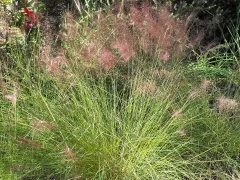
Pink muhly grass
3 ft · mid September to early November
In October a quiet mound of wiry, dark green leaves disappears under a billowing cloud of vivid pink that looks like cotton candy.
-

Creeping phlox
6 in · mid April to mid May
A low, spreading mat that turns into a sheet of colour in spring.
-
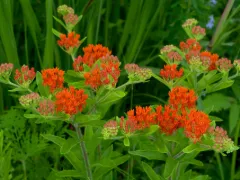
Butterfly weed
24 in · late June to early August · host plant
Flat clusters of vivid orange flowers in midsummer, covered in butterflies, on a low, bushy plant with a deep taproot.
-
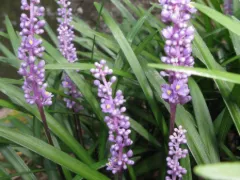
Lilyturf
16 in · early August to mid September
Evergreen clumps of dark, strap-shaped, grassy leaves, with spikes of violet flowers like grape hyacinths in late summer, followed by black berries.
-

Blue false indigo
4 ft · late May to mid June · host plant
Spikes of indigo-blue pea flowers in late spring on a plant that grows as big as a shrub, with blue-green leaves and black seed pods that rattle in winter.
-

Mexican feather grass
20 in · early June to late July
The finest-textured grass: hair-thin, bright green leaves and silky, blond flower heads that ripple like water in the slightest breeze.
-

Staghorn sumac 'Tiger Eyes'
6 ft · late June to mid July · host plant
Deeply cut, ferny leaves that open chartreuse, turn bright yellow on fuzzy, rose-pink stems, and end the year in orange and scarlet.
-

Switchgrass 'Shenandoah'
4 ft · grown for its leaves · host plant
Green blades turn wine-red from midsummer, topped by a cloud of fine, pink-tinged seed heads.
-
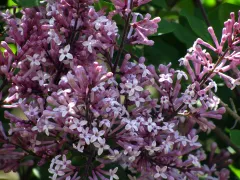
Dwarf Korean lilac 'Palibin'
5 ft · late May to early June
A dense, rounded lilac that stays small enough for a mixed bed and is smothered in fragrant lavender-pink flowers in late spring.
-

Smooth hydrangea 'Annabelle'
4 ft · late June to early September · host plant
Enormous white flower globes open lime-green, turn pure white and fade back to green.
-

Shrubby cinquefoil 'Goldfinger'
3 ft · early June to mid September
Large, bright golden-yellow flowers like small wild roses, from June until frost, on a dense, dark-leaved mound.
-
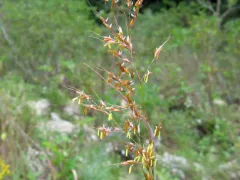
Indian grass
6 ft · late August to early October
Tall, blue-green leaves and, in early autumn, glossy, golden-bronze plumes with bright yellow anthers.
A bed planned only from these plants
The planner was given only the plants on this page that suit zone 6 and full sun, and designed this 16 × 8 ft (4.9 × 2.4 m) bed from them when the page was made.
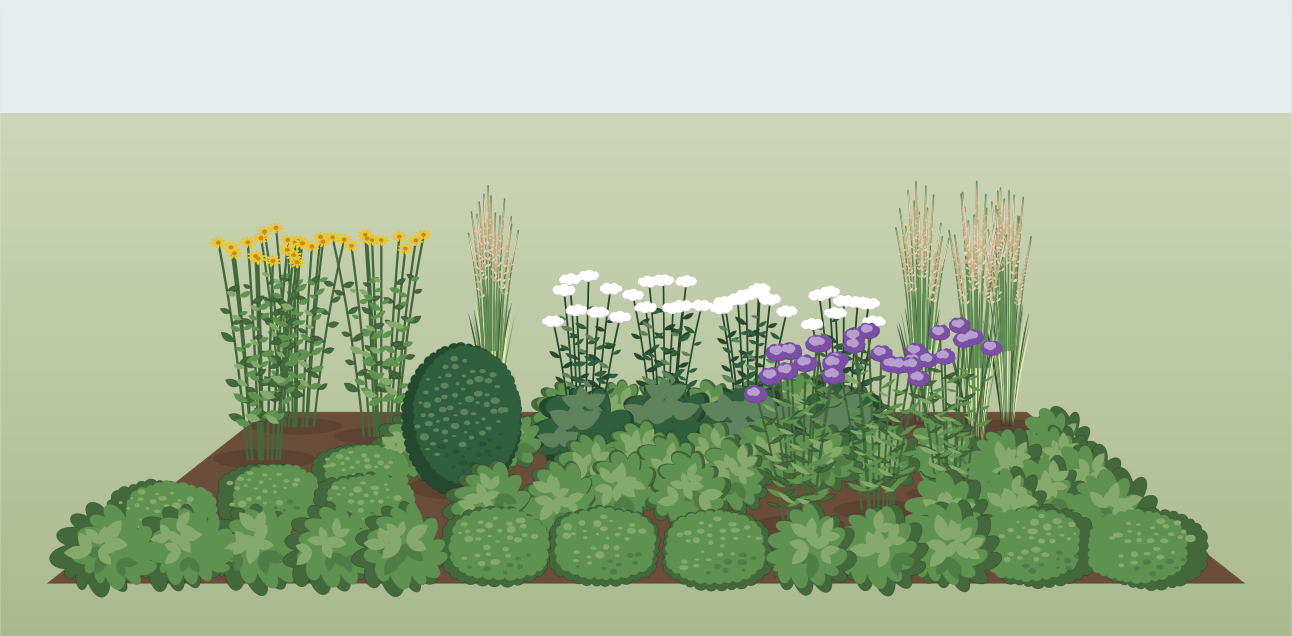
The plants
- 1 Creeping phlox 'Emerald Blue' × 9, blue
- 2 Leadwort × 39, blue
- 3 False sunflower × 3, yellow
- 4 Feather reed grass 'Avalanche' × 4, tan
- 5 Inkberry 'Gem Box' × 1, dark green leaves
- 6 Wild quinine × 4, white
- 7 Purple milkweed × 3, purple
Planned as a naturalistic planting: low grasses and groundcovers, the matrix, make up 58% of the planted ground. The longest in flower is feather reed grass 'Avalanche': 17 weeks, from mid June to early October. Leadwort and creeping phlox 'Emerald Blue' finish the front edge.
The planner's own design check: 9 Excellent, 7 Good. It flags one thing to watch: Nothing on this plan is highly poisonous or an aggressive spreader.
Open this bed in the planner Change its size, the sun or the style, move plants about, or swap one for another.
All 107 plants
Show all 107, by where they go in a bed
Front of a bed 29
- Bearberry cotoneaster 12 in · late May to mid June
- Cotoneaster 'Coral Beauty' 18 in · late May to early June
- Creeping juniper 'Blue Chip' 10 in · grown for its leaves
- Creeping juniper 'Blue Rug' 6 in · grown for its leaves
- Creeping juniper 'Mother Lode' 4 in · grown for its leaves
- Creeping phlox 6 in · mid April to mid May
- Creeping phlox 'Candy Stripe' 5 in · mid April to mid May
- Creeping phlox 'Emerald Blue' 5 in · mid April to mid May
- Creeping phlox 'Sherwood Purple' 8 in · early May to late May
- Creeping woodland phlox 8 in · late April to late May
- Goldenrod 'Golden Fleece' 18 in · late August to early October · host plant
- Heath aster 'Snow Flurry' 6 in · mid September to mid October
- Japanese garden juniper 12 in · grown for its leaves
- Japanese pachysandra 8 in · grown for its leaves
- Leadwort 10 in · early August to early October
- Lilyturf 16 in · early August to mid September
- Ornamental oregano 'Herrenhausen' 20 in · mid July to mid September
- Pennsylvania sedge 8 in · grown for its leaves
- Prairie dropseed 'Tara' 24 in · early August to mid September
- Sedum 'Dragon's Blood' 4 in · late June to early August
- Sedum 'John Creech' 2 in · grown for its leaves
- Sedum 'Tricolor' 4 in · late June to late July
- Shore juniper 'Blue Pacific' 12 in · grown for its leaves
- Siberian cypress 12 in · grown for its leaves
- Sweet flag 'Ogon' 10 in · grown for its leaves
- Variegated lilyturf 14 in · early August to mid September
- Wild ginger 6 in · grown for its leaves · host plant
- Wild strawberry 6 in · early May to early June
- Yellow ice plant 2 in · mid May to late June
Middle of a bed 31
- Abelia 'Kaleidoscope' 2½ ft · mid June to early October
- Adam's needle 3 ft · late June to mid July · host plant
- Blue grama 'Blonde Ambition' 2½ ft · mid July to mid October
- Blue oat grass 2½ ft · early June to early July
- Bottlebrush grass 3 ft · late June to late August · host plant
- Butterfly weed 24 in · late June to early August · host plant
- Cranberry cotoneaster 3 ft · late May to early June
- False sunflower 'Summer Sun' 3½ ft · late June to early September
- Fragrant sumac 'Gro-Low' 24 in · mid April to early May
- Gray's sedge 2½ ft · late May to early September
- Hyssop 20 in · early July to late August
- Inkberry 'Gem Box' 2½ ft · grown for its leaves · host plant
- Ironweed 'Iron Butterfly' 2½ ft · late August to early October
- Mexican feather grass 20 in · early June to late July
- Northern sea oats 'River Mist' 2½ ft · late July to mid September · host plant
- Pink muhly grass 3 ft · mid September to early November
- Prairie dropseed 2½ ft · mid August to mid September
- Purple milkweed 3 ft · early June to mid July · host plant
- Purple moor grass 'Moorhexe' 2½ ft · mid July to early September
- Purple moor grass 'Variegata' 24 in · mid July to mid September
- Rockspray cotoneaster 2½ ft · late May to early June
- Shrubby cinquefoil 3 ft · early June to mid September
- Shrubby cinquefoil 'Abbotswood' 2½ ft · early June to mid September
- Shrubby cinquefoil 'Goldfinger' 3 ft · early June to mid September
- Slender mountain mint 2½ ft · early July to late August · host plant
- Solomon's seal 3 ft · early May to late May
- Summersweet 'Hummingbird' 3 ft · mid July to mid August
- Switchgrass 'Cheyenne Sky' 3 ft · late July to mid September · host plant
- White sage 'Silver King' 3 ft · grown for its leaves
- White sage 'Valerie Finnis' 24 in · grown for its leaves
- Yucca 'Color Guard' 2½ ft · late June to mid July · host plant
Back of a bed 47
- American elderberry 10 ft · mid June to mid July
- Bitter switchgrass 'Dewey Blue' 4 ft · early August to early October · host plant
- Blue false indigo 4 ft · late May to mid June · host plant
- Buttonbush 6½ ft · late June to early August
- Common milkweed 4 ft · late June to early August · host plant
- Common witch hazel 15 ft · mid October to late November · host plant
- Coralberry 4 ft · mid July to early August
- Drooping leucothoe 4 ft · early May to late May
- Drooping leucothoe 'Rainbow' 4 ft · early May to late May
- Dwarf Korean lilac 'Palibin' 5 ft · late May to early June
- False spirea 'Sem' 3½ ft · late June to late July
- False sunflower 4 ft · late June to early September
- False sunflower 'Summer Nights' 3½ ft · late June to early September
- Feather reed grass 'Avalanche' 5 ft · mid June to early October
- Fragrant sumac 5 ft · mid April to late April
- Glossy abelia 5 ft · mid June to early October
- Indian grass 6 ft · late August to early October
- Indian grass 'Sioux Blue' 6 ft · late August to mid October
- Inkberry 6½ ft · grown for its leaves · host plant
- Inkberry 'Shamrock' 4 ft · grown for its leaves · host plant
- Maximilian sunflower 8 ft · early September to mid October · host plant
- Muhly grass 'White Cloud' 4 ft · early October to early November
- Northern bayberry 6½ ft · grown for its leaves · host plant
- Northern sea oats 3½ ft · late July to mid September · host plant
- Red osier dogwood 8 ft · late May to mid June · host plant
- Red twig dogwood 'Arctic Fire' 4 ft · grown for its leaves · host plant
- Siberian dogwood 6½ ft · late May to early June
- Smooth hydrangea 'Annabelle' 4 ft · late June to early September · host plant
- Smooth hydrangea 'Incrediball' 5 ft · late June to early September · host plant
- Smooth hydrangea 'Invincibelle Spirit II' 3½ ft · late June to mid September · host plant
- Snowberry 4 ft · mid June to mid July · host plant
- Spirea 'Ogon' 4 ft · early April to late April
- Staghorn sumac 'Tiger Eyes' 6 ft · late June to mid July · host plant
- Summersweet 6½ ft · mid July to mid August
- Summersweet 'Ruby Spice' 6 ft · mid July to mid August
- Switchgrass 'Cloud Nine' 7 ft · early August to early October · host plant
- Switchgrass 'Heavy Metal' 4½ ft · late July to mid September · host plant
- Switchgrass 'Northwind' 5½ ft · early August to early October · host plant
- Switchgrass 'Prairie Sky' 5 ft · early August to early October · host plant
- Switchgrass 'Shenandoah' 4 ft · grown for its leaves · host plant
- Tatarian dogwood 'Ivory Halo' 6 ft · grown for its leaves
- Variegated red twig dogwood 6½ ft · grown for its leaves
- White false indigo 4 ft · late May to late June · host plant
- Wild quinine 3½ ft · late June to late August
- Winged sumac 11½ ft · late July to late August · host plant
- Witch hazel 'Diane' 10 ft · early February to mid March
- Yellow twig dogwood 6½ ft · grown for its leaves · host plant