Plants for wet soil and rain gardens
Plants for soggy ground, low spots and rain gardens: ones that stand wet feet and still cope with a dry summer.
A rain garden is a shallow dip that catches the run-off from a roof, a drive or a lawn and lets it soak away within a day or two, instead of sending it down the drain. The plants in it have the hardest job in the garden: their roots sit in water after every storm, and in a dry August the same ground bakes.
So the bottom of the dip, which floods first and stays wet longest, wants the plants that like wet feet best; the sloping sides want ones that only put up with it; and the rim is ordinary border. Most of the plants below come from wet meadows and stream banks, and many are North American natives, which is why rain gardens are so often native gardens.
Plants here are recorded as standing wet soil, or as wanting moist to wet soil.
171 plants: 69 perennials, 16 ferns, 4 bulbs, 30 grasses and 52 shrubs.
The dozen to start with
-
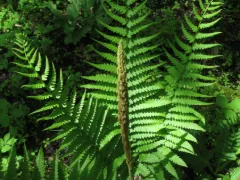
Cinnamon fern
4 ft · grown for its leaves · likes it wet
A tall vase of green fronds surrounds stiff, upright, cinnamon-brown spore stalks in spring.
-

Calla lily
2½ ft · mid May to mid July · likes it wet
Pure white, funnel-shaped flowers of great elegance, each wrapped around a yellow spike, above glossy, arrow-shaped leaves.
-
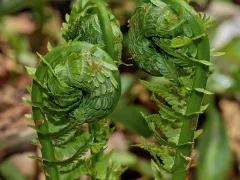
Ostrich fern
4 ft · grown for its leaves · likes it wet
Tall, feathery fronds form an elegant green vase that gives height at the back of a shady bed.
-
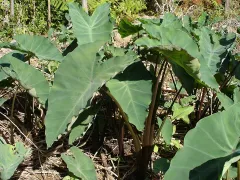
Elephant ear
5 ft · grown for its leaves · likes it wet
Enormous, heart-shaped, velvety leaves that point downwards, on stalks as tall as a person.
-
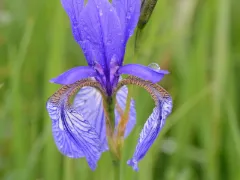
Siberian iris
2½ ft · late May to late June
Elegant, butterfly-like flowers in early summer above clumps of slender, grassy leaves.
-
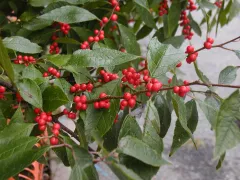
Winterberry
8 ft · grown for its leaves · host plant
A native holly that drops its leaves in autumn to show branches packed with bright red berries, which last into winter until the birds take them.
-

Bee balm
3 ft · early July to early August · host plant
Shaggy, colourful flower heads that draw hummingbirds, bees and butterflies.
-
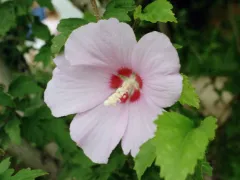
Rose of Sharon
10 ft · mid July to mid September
An upright shrub with hollyhock-like flowers in pink, purple, white or violet-blue from midsummer to autumn, when few shrubs flower.
-
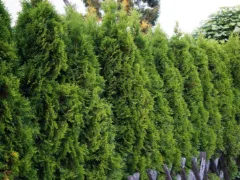
Arborvitae 'Emerald Green'
13 ft · grown for its leaves
A narrow, dense pyramid of bright emerald-green foliage that keeps its colour through winter.
-
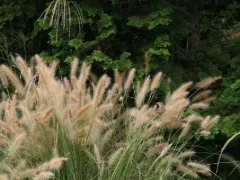
Switchgrass 'Shenandoah'
4 ft · grown for its leaves · host plant
Green blades turn wine-red from midsummer, topped by a cloud of fine, pink-tinged seed heads.
-
Red twig dogwood 'Arctic Fire'
4 ft · grown for its leaves · host plant
A compact form of the native red twig dogwood, with dark red winter stems, and it does not sucker.
-

Marsh marigold
16 in · mid April to early May · likes it wet
Glossy, buttercup-yellow flowers over rounded, shining leaves in early spring, at the edge of water or in boggy soil.
A bed planned only from these plants
The planner was given only the plants on this page that suit zone 6 and full sun, and designed this 16 × 8 ft (4.9 × 2.4 m) bed from them when the page was made.
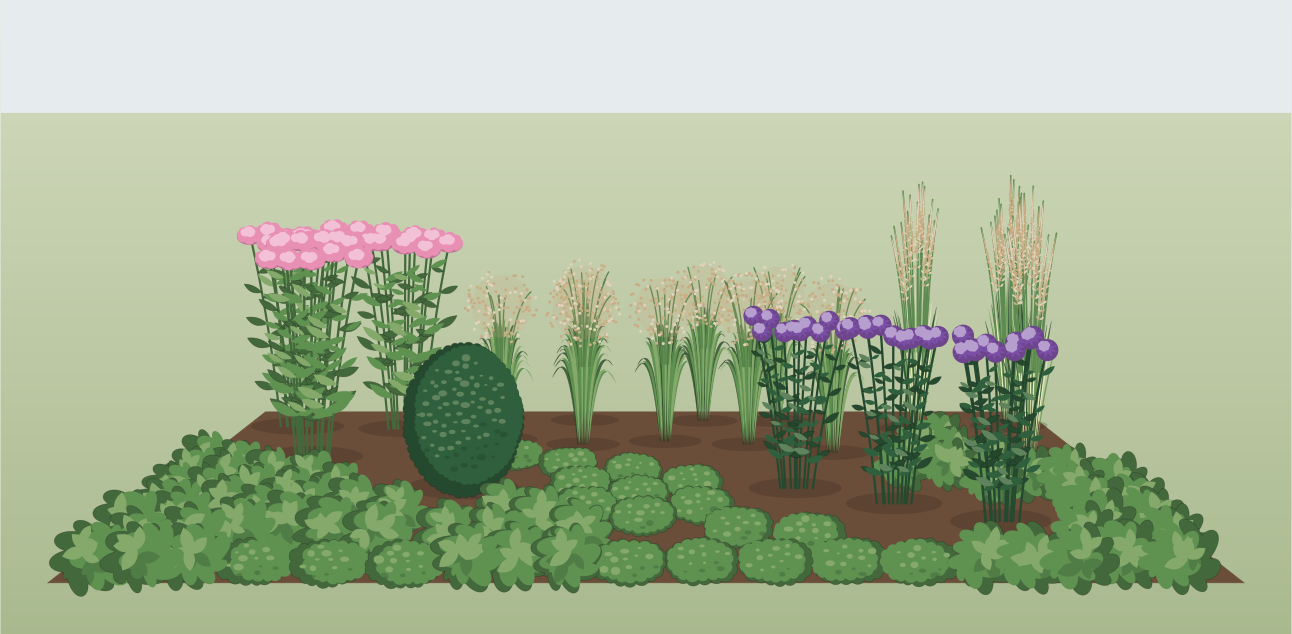
The plants
- 1 Mazus × 20, lavender
- 2 Common blue violet × 58, blue
- 3 Feather reed grass 'Avalanche' × 3, tan
- 4 Inkberry 'Gem Box' × 1, dark green leaves
- 5 Northern sea oats × 8, tan
- 6 Joe Pye weed 'Little Joe' × 3, pink
- 7 Bee balm 'Purple Rooster' × 3, purple
Planned as a naturalistic planting: low grasses and groundcovers, the matrix, make up 66% of the planted ground. The bed is balanced: the left half carries 49% of the visual weight and the right half 51%. Common blue violet is planted in 7 places along the bed, which gives it rhythm.
The planner's own design check: 11 Excellent, 3 Good, 2 Satisfactory. It flags one thing to watch: Common blue violet spreads aggressively. Northern sea oats spreads aggressively.
Open this bed in the planner Change its size, the sun or the style, move plants about, or swap one for another.
All 171 plants
Show all 171, by where they go in a bed
Front of a bed 27
- Bog rosemary 'Blue Ice' 16 in · early May to late May · likes it wet
- Broad beech fern 18 in · grown for its leaves
- Celandine poppy 16 in · mid April to late May
- Chives 14 in · mid May to mid June
- Common blue violet 8 in · mid April to late May · host plant
- Corkscrew rush 16 in · grown for its leaves · likes it wet
- Jack-in-the-pulpit 18 in · early May to late May
- Japanese beech fern 18 in · grown for its leaves
- Japanese sedge 'Ice Dance' 14 in · grown for its leaves
- Marsh marigold 16 in · mid April to early May · likes it wet
- Mazus 2 in · early May to mid June
- Mountain bluet 'Amethyst in Snow' 18 in · late May to late June
- New York fern 18 in · grown for its leaves
- Orchid primrose 16 in · mid June to mid July · likes it wet
- Pennsylvania sedge 8 in · grown for its leaves
- Rain lily 8 in · mid August to early October
- Sedge 'Everest' 12 in · grown for its leaves
- Sedge 'Evergold' 12 in · grown for its leaves
- Sedge 'Everillo' 14 in · grown for its leaves
- Sedge 'Frosted Curls' 12 in · grown for its leaves
- Seersucker sedge 12 in · grown for its leaves
- Stokes' aster 18 in · late June to mid August
- Summer snowflake 18 in · late April to mid May
- Sweet flag 'Ogon' 10 in · grown for its leaves
- Variegated Japanese sedge 12 in · grown for its leaves
- Water avens 16 in · early May to late June · likes it wet
- Wild ginger 6 in · grown for its leaves · host plant
Middle of a bed 60
- Arborvitae 'Hetz Midget' 3 ft · grown for its leaves
- Arborvitae 'Mr. Bowling Ball' 2½ ft · grown for its leaves
- Astilbe 'Bridal Veil' 2½ ft · late June to mid July
- Astilbe 'Fanal' 24 in · mid June to mid July
- Bee balm 3 ft · early July to early August · host plant
- Bee balm 'Purple Rooster' 3 ft · late June to mid August · host plant
- Black chokeberry 'Low Scape Mound' 20 in · early May to late May
- Blue flag iris 2½ ft · late May to late June · likes it wet
- Blue mistflower 2½ ft · late August to mid October
- Blue rush 'Blue Arrows' 3 ft · grown for its leaves
- Blue-stemmed goldenrod 2½ ft · early September to mid October · host plant
- Bowles' golden sedge 2½ ft · grown for its leaves · likes it wet
- Calla lily 2½ ft · mid May to mid July · likes it wet
- Cardinal flower 'Queen Victoria' 3½ ft · late July to mid September · likes it wet
- Chinese globeflower 'Golden Queen' 2½ ft · early June to mid July · likes it wet
- Dwarf fothergilla 3 ft · late April to mid May
- Evergreen wood fern 2½ ft · grown for its leaves
- Fringed loosestrife 'Firecracker' 2½ ft · grown for its leaves
- Globe arborvitae 'Danica' 24 in · grown for its leaves
- Golden ragwort 20 in · mid April to late May · host plant
- Gooseneck loosestrife 3 ft · early July to mid August
- Gray's sedge 2½ ft · late May to early September
- Great blue lobelia 2½ ft · early August to mid September
- Inkberry 'Gem Box' 2½ ft · grown for its leaves · host plant
- Japanese iris 3 ft · late June to mid July · likes it wet
- Japanese primrose 20 in · mid May to late June · likes it wet
- Joe-Pye weed 'Baby Joe' 2½ ft · late July to mid September
- Leopard plant 24 in · early October to early November
- Ligularia 'Bottle Rocket' 2½ ft · early July to early August · likes it wet
- Ligularia 'Desdemona' 3½ ft · late July to early September · likes it wet
- Louisiana iris 3 ft · mid May to early June · likes it wet
- Marginal wood fern 24 in · grown for its leaves
- Marsh fern 24 in · grown for its leaves · likes it wet · host plant
- Mountain bluet 20 in · late May to late June
- Mountain fleece 'Golden Arrow' 2½ ft · mid July to early October
- Netted chain fern 20 in · grown for its leaves · likes it wet
- Northern sea oats 'River Mist' 2½ ft · late July to mid September · host plant
- Palm sedge 2½ ft · grown for its leaves
- Purple moor grass 'Moorhexe' 2½ ft · mid July to early September
- Purple moor grass 'Variegata' 24 in · mid July to mid September
- Ragged robin 24 in · late May to early July · likes it wet
- Sensitive fern 24 in · grown for its leaves · likes it wet
- Siberian iris 2½ ft · late May to late June
- Siberian iris 'Caesar's Brother' 3½ ft · late May to late June
- Soft rush 3 ft · grown for its leaves · likes it wet
- Southern blue flag 2½ ft · late May to late June · likes it wet
- Southern wood fern 3½ ft · grown for its leaves · likes it wet
- Spotted bee balm 24 in · mid July to early September · host plant
- Summersweet 'Hummingbird' 3 ft · mid July to mid August
- Sweetfern 3 ft · grown for its leaves
- Sweetspire 'Little Henry' 2½ ft · early June to early July
- Switchgrass 'Cheyenne Sky' 3 ft · late July to mid September · host plant
- Turtlehead 'Hot Lips' 3 ft · mid August to late September
- Tussock sedge 2½ ft · grown for its leaves · likes it wet
- Umbrella plant 3½ ft · grown for its leaves · likes it wet
- Variegated Japanese iris 2½ ft · late June to mid July · likes it wet
- White sage 'Silver King' 3 ft · grown for its leaves
- White sage 'Valerie Finnis' 24 in · grown for its leaves
- White turtlehead 3 ft · early August to mid September · likes it wet
- Yellow loosestrife 3 ft · mid June to late July
Back of a bed 84
- American beautyberry 6 ft · late June to late July
- American elderberry 10 ft · mid June to mid July
- Arborvitae 'Degroot's Spire' 11½ ft · grown for its leaves
- Arborvitae 'Emerald Green' 13 ft · grown for its leaves
- Arborvitae 'Rheingold' 5 ft · grown for its leaves
- Bee balm 'Jacob Cline' 4 ft · late June to mid August · host plant
- Black chokeberry 5 ft · early May to late May
- Black chokeberry 'Viking' 6 ft · early May to late May
- Blue vervain 4 ft · mid July to early September · host plant
- Bog sage 5½ ft · late July to mid October
- Boltonia 'Snowbank' 4 ft · early September to mid October
- Boneset 4 ft · early August to mid September · likes it wet
- Buttonbush 6½ ft · late June to early August · likes it wet
- Canadian burnet 5 ft · mid August to early October · likes it wet
- Cardinal flower 3½ ft · late July to mid September · likes it wet
- Cinnamon fern 4 ft · grown for its leaves · likes it wet
- Culver's root 5 ft · early July to mid August
- Culver's root 'Fascination' 5 ft · mid July to late August
- Dixie wood fern 4½ ft · grown for its leaves
- Dwarf arctic willow 4 ft · grown for its leaves · host plant
- Dwarf yaupon holly 4 ft · grown for its leaves · host plant
- Elephant ear 5 ft · grown for its leaves · likes it wet
- Feather reed grass 'Avalanche' 5 ft · mid June to early October
- Florida anise 8 ft · mid April to mid May
- Giant rhubarb 8 ft · grown for its leaves · likes it wet
- Globe arborvitae 'Little Giant' 4 ft · grown for its leaves
- Goldenrod 'Fireworks' 3½ ft · late August to mid October · host plant
- Hardy hibiscus 5 ft · late July to mid September
- Highbush blueberry 6½ ft · early May to late May · host plant
- Hollow Joe-Pye weed 7 ft · late July to mid September · host plant
- Indian grass 6 ft · late August to early October
- Indian grass 'Sioux Blue' 6 ft · late August to mid October
- Inkberry 6½ ft · grown for its leaves · host plant
- Inkberry 'Shamrock' 4 ft · grown for its leaves · host plant
- Interrupted fern 3½ ft · grown for its leaves
- Joe Pye weed 'Gateway' 6 ft · late July to mid September
- Joe Pye weed 'Little Joe' 4 ft · late July to early September
- Korean feather reed grass 4 ft · late August to mid October
- Large fothergilla 8 ft · late April to mid May
- Log fern 3½ ft · grown for its leaves
- New York ironweed 6½ ft · early August to mid September
- Northern bayberry 6½ ft · grown for its leaves · host plant
- Northern sea oats 3½ ft · late July to mid September · host plant
- Ostrich fern 4 ft · grown for its leaves · likes it wet
- Purple-stemmed royal fern 4 ft · grown for its leaves · likes it wet
- Rattlesnake master 4 ft · mid July to late August · host plant
- Red chokeberry 'Brilliantissima' 7 ft · early May to late May
- Red osier dogwood 8 ft · late May to mid June · host plant
- Red twig dogwood 'Arctic Fire' 4 ft · grown for its leaves · host plant
- Rose of Sharon 10 ft · mid July to mid September
- Rose of Sharon 'Blue Chiffon' 10 ft · mid July to mid September
- Rose of Sharon 'Diana' 8 ft · mid July to mid September
- Rose of Sharon 'Sugar Tip' 8 ft · mid July to mid September
- Royal fern 5 ft · grown for its leaves · likes it wet
- Scarlet rose mallow 6½ ft · mid July to early September · likes it wet
- Shadblow serviceberry 16½ ft · mid April to early May · host plant
- Siberian dogwood 6½ ft · late May to early June
- Sneezeweed 4 ft · early August to late September
- Spicebush 10 ft · late March to mid April · host plant
- Spotted Joe-Pye weed 5½ ft · mid July to early September
- Summersweet 6½ ft · mid July to mid August
- Summersweet 'Ruby Spice' 6 ft · mid July to mid August
- Swamp azalea 6½ ft · late June to mid July · likes it wet
- Swamp milkweed 4 ft · early July to early August · host plant
- Swamp milkweed 'Ice Ballet' 3½ ft · early July to mid August · host plant
- Swamp sunflower 6½ ft · late September to late October · host plant
- Sweet Joe Pye weed 6 ft · late July to early September
- Switchgrass 'Cloud Nine' 7 ft · early August to early October · host plant
- Switchgrass 'Heavy Metal' 4½ ft · late July to mid September · host plant
- Switchgrass 'Northwind' 5½ ft · early August to early October · host plant
- Switchgrass 'Prairie Sky' 5 ft · early August to early October · host plant
- Switchgrass 'Shenandoah' 4 ft · grown for its leaves · host plant
- Tatarian dogwood 'Ivory Halo' 6 ft · grown for its leaves
- Variegated red twig dogwood 6½ ft · grown for its leaves
- Virginia sweetspire 5 ft · early June to early July
- Virginia sweetspire 'Henry's Garnet' 4 ft · early June to early July
- Wax myrtle 15 ft · grown for its leaves · host plant
- White meadowsweet 4 ft · late June to late August · likes it wet · host plant
- Winterberry 8 ft · grown for its leaves · host plant
- Winterberry 'Berry Poppins' 3½ ft · early June to late June · host plant
- Winterberry 'Red Sprite' 4 ft · grown for its leaves · host plant
- Winterberry 'Winter Red' 8 ft · early June to late June · host plant
- Witherod viburnum 'Winterthur' 6½ ft · early June to late June · host plant
- Yellow twig dogwood 6½ ft · grown for its leaves · host plant