Seersucker sedge
Carex plantaginea · Cyperaceae
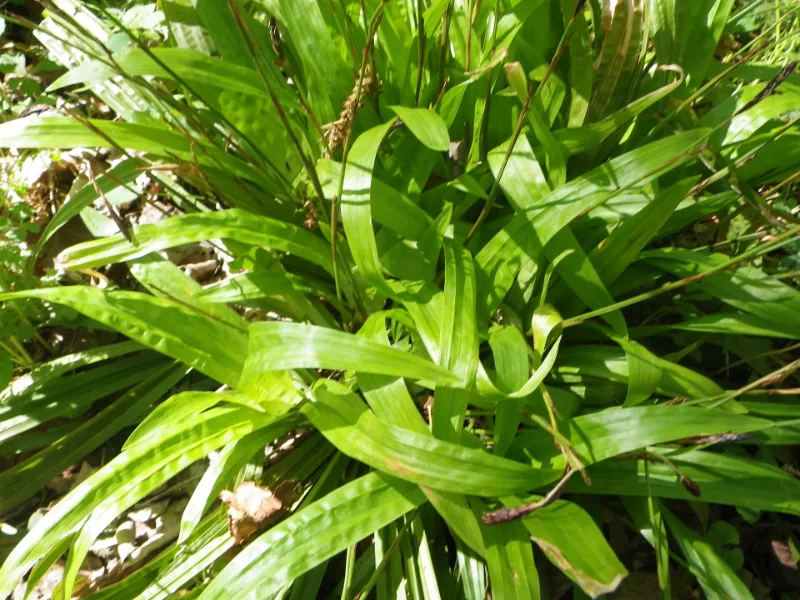
Broad, lime-green, evergreen leaves, puckered like seersucker cloth, in a neat rosette. It has the widest leaves of any native sedge.
- Size
- 12 in tall, 18 in wide
- Zones
- 4 to 8
- Light
- Part shade to shade
- Flowers
- Grown for its leaves
- Pets
- No toxicity recorded
- Job in a bed
- Drift
A bed built around seersucker sedge
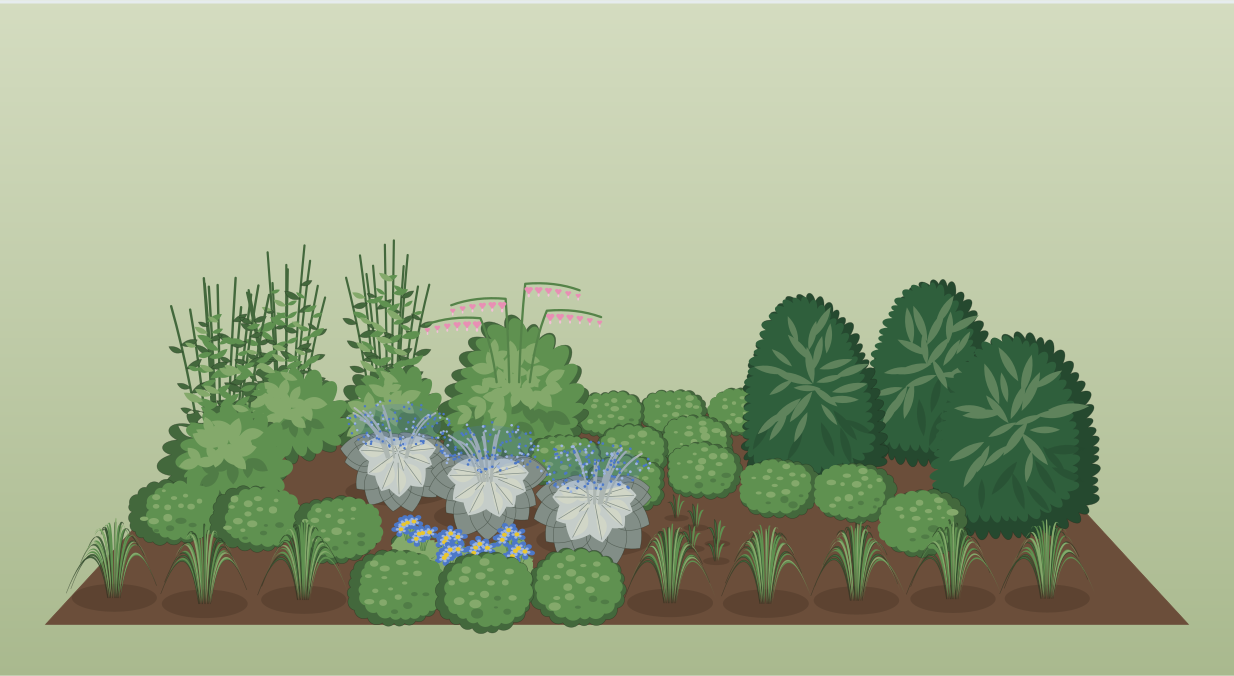
The planner designed this bed around seersucker sedge when this page was made: a 12 × 6 ft (3.7 × 1.8 m) naturalistic planting in zone 6, part shade. It chose the other plants from the 513 that suit those conditions, and says below why seersucker sedge stands where it does.
The plants
- 1 Seersucker sedge × 8, green leaves
- 2 Blue star creeper × 17, blue
- 3 White turtlehead × 3, white
- 4 Tall astilbe 'Superba' × 3, purple
- 5 Bleeding heart × 1, pink
- 6 Siberian bugloss 'Jack Frost' × 3, blue
- 7 Grecian windflower × 7, blue
- 8 Snowdrop × 5, white
Why this plant
- The only plant grown for its leaves. Leaf lasts all season, where a flower lasts a few weeks.
- The bed's only structure. Shrubs and grasses keep their shape when the perennials die down, and it is the only one here.
- Part of the matrix. The low fabric of grasses and groundcovers that the taller plants come up through.
Why here
- On the front edge. At 12 in it frames the bed without hiding it, and it is in leaf all season. It finishes 70% of the edge.
- 8 plants in 2 runs (5 and 3). Runs of different lengths make the edge a frame, not a ruled line.
Why now
- Here for its leaves, all year. They cover the 11 weeks between early March and late November when nothing on the plan is in flower.
- One of two evergreens. They are what the bed has to show from November to March.
Planned as a naturalistic planting: low grasses and groundcovers, the matrix, make up 46% of the planted ground. Blue is the colour seen most, on 3 of the 7 kinds grown for their flowers. Blue star creeper repeats along the bed to tie it together.
The planner's own design check: 12 Excellent, 5 Good. It flags one thing to watch: Nothing on this plan is highly poisonous or an aggressive spreader.
Open this bed in the planner Change its size, the sun or the style, move plants about, or swap one for another.
Where seersucker sedge goes in a border
At 12 in it belongs at the front of a bed. In the planner's ten height classes it is low (6 to 12 in).
Its job: drift. Planted in a small group of three or five, and repeated further along in the other number.
The broad, pleated leaves look more like a small hosta than a sedge, and are a fine contrast with ferns. It needs moist, leafy soil.
- Bold, evergreen texture in a woodland garden
- With ferns and spring wildflowers
- Edging shady paths
What to plant with seersucker sedge
Plants recorded as good partners for it, and what each pairing does:
- Foamflower: adds the flowers, late April to late May; spires rising out of its mound; happy in the same moist soil.
- Christmas fern: tall enough (20 in) to stand behind it.
- Wild ginger: bold leaves against its medium ones; low enough (6 in) to stand in front of it; happy in the same moist soil.
Questions about seersucker sedge
Does seersucker sedge need sun or shade?
Seersucker sedge grows in part shade (2 to 4 hours of sun, mostly in the morning) and shade (less than 2 hours of direct sun, or bright dappled light).
It wants soil that stays evenly moist, rich in organic matter, and a good soak in dry spells. It copes with soil that stays wet.
What zones does seersucker sedge grow in?
USDA zones 4 to 8. It is hardy to zone 4, which means it survives winter nights down to about −20 °F (−29 °C).
Above zone 8 it struggles: the zones measure winter cold, but a plant's top zone usually means the summers are too hot or the winters too mild for it to rest.
Gardening in Canada? Use the USDA zone for your town: Canada's own zone map uses different numbers.
How far apart should seersucker sedge be planted?
12 in (30 cm) apart, from the middle of one plant to the middle of the next. That is a little closer than its full width of 18 in (45 cm), so a group knits into one patch.
It grows 12 in (30 cm) tall. Give it the full distance from anything taller, or it will lean out towards the light.
How many seersucker sedge plants do I need?
At 12 in apart, set out in staggered rows:
- 12 to fill 10 square feet (about 1 m²)
- 11 for a single row 10 ft (3 m) long
- 38 to fill a 4 × 8 ft bed on its own
In a mixed border, plant it as a group of three or five, with a second group further along in the other number.
In the bed above, the planner used eight in two groups.
Is seersucker sedge poisonous to dogs and cats?
No toxicity is recorded for dogs, cats, horses or people, according to NC State Extension.
"Not toxic" is not "edible": a pet that eats a lot of any plant can be sick.
Do deer eat seersucker sedge?
They may. NC State does not list it as resistant to deer or rabbits. Where they visit, protect it, or plant it among ones they avoid.
What does seersucker sedge look like in winter?
Seersucker sedge keeps its green leaves all winter, so it is one of the plants that hold a bed together from November to March, when the perennials have gone.
Is seersucker sedge good for bees and butterflies?
Seersucker sedge is visited by butterflies and songbirds.
It is native to the United States and Canada.
More Carex
- Appalachian sedge Carex appalachica
- Blue sedge Carex flacca
- Blue sedge 'Blue Zinger' Carex flacca 'Blue Zinger'
- Bowles' golden sedge Carex elata 'Aurea'
- Bristleleaf sedge Carex eburnea
- Gray's sedge Carex grayi
- Japanese sedge 'Ice Dance' Carex morrowii 'Ice Dance'
- Leatherleaf sedge Carex buchananii
- Orange New Zealand sedge Carex testacea
- Palm sedge Carex muskingumensis
- Pennsylvania sedge Carex pensylvanica
- Sedge 'Bunny Blue' Carex laxiculmis 'Hobb' (Bunny Blue)
- Sedge 'Everest' Carex oshimensis 'Everest'
- Sedge 'Evergold' Carex oshimensis 'Evergold'
- Sedge 'Everillo' Carex oshimensis 'Everillo'
- Sedge 'Frosted Curls' Carex comans 'Frosted Curls'
- Tussock sedge Carex stricta
- Variegated broadleaf sedge Carex siderosticha 'Variegata'
- Variegated Japanese sedge Carex morrowii 'Variegata'
In these guides
Every fact on record
- Type
- Grass
- Size
- 12 in (30 cm) tall, 18 in (45 cm) wide
- Plant
- 12 in (30 cm) apart
- Height class
- Low (6 to 12 in)
- Place in the bed
- Front
- Flowers
- None: grown for its foliage
- Leaves
- Medium texture, evergreen; green
- Shape
- Mounding, clumping
- Hardy in
- USDA zones 4 to 8
- Light
- Part shade, shade
- Soil
- Rich, evenly moist
- Water
- Moderate
- Feeding
- Light, in spring
- Family
- Cyperaceae
- Comes from
- Native to eastern North America
- Attracts
- Butterflies, songbirds
- Stands up to
- Wet soil
Checked against NC State Extension. Flowering times are for zone 5: later in colder zones, earlier in warmer ones. Toxicity and spread information is a general gardening guide, not veterinary or medical advice, and invasive status varies by region. If a person or pet eats a plant, contact poison control or a vet. Check your local invasive species list before planting anything with a spread warning.