Creeping juniper 'Blue Rug'
Juniperus horizontalis 'Wiltonii' · Cupressaceae Popular
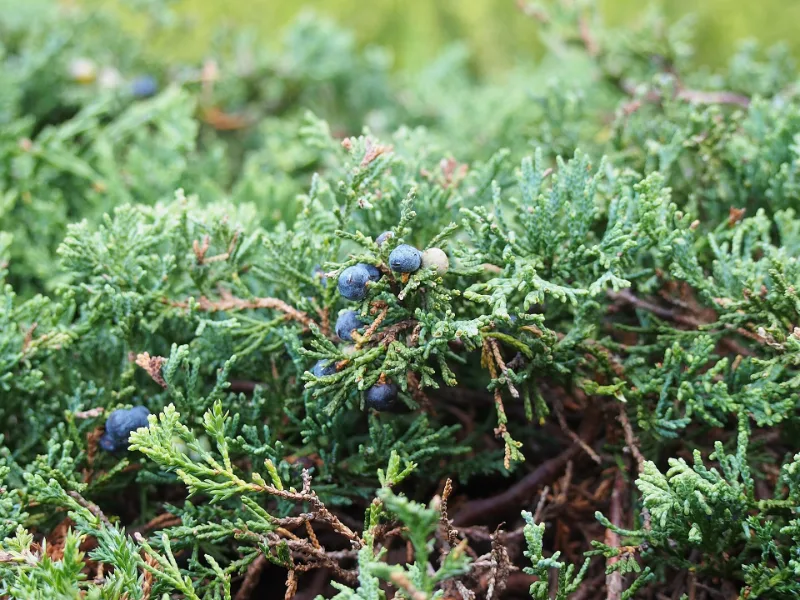
The flattest juniper: a silver-blue carpet only a hand high that spreads two metres wide and turns plum-purple in winter. A native of northern shores.
- Size
- 6 in tall, 6½ ft wide
- Zones
- 3 to 9
- Light
- Full sun
- Flowers
- Grown for its leaves
- Pets
- No toxicity recorded
- Job in a bed
- Carpet
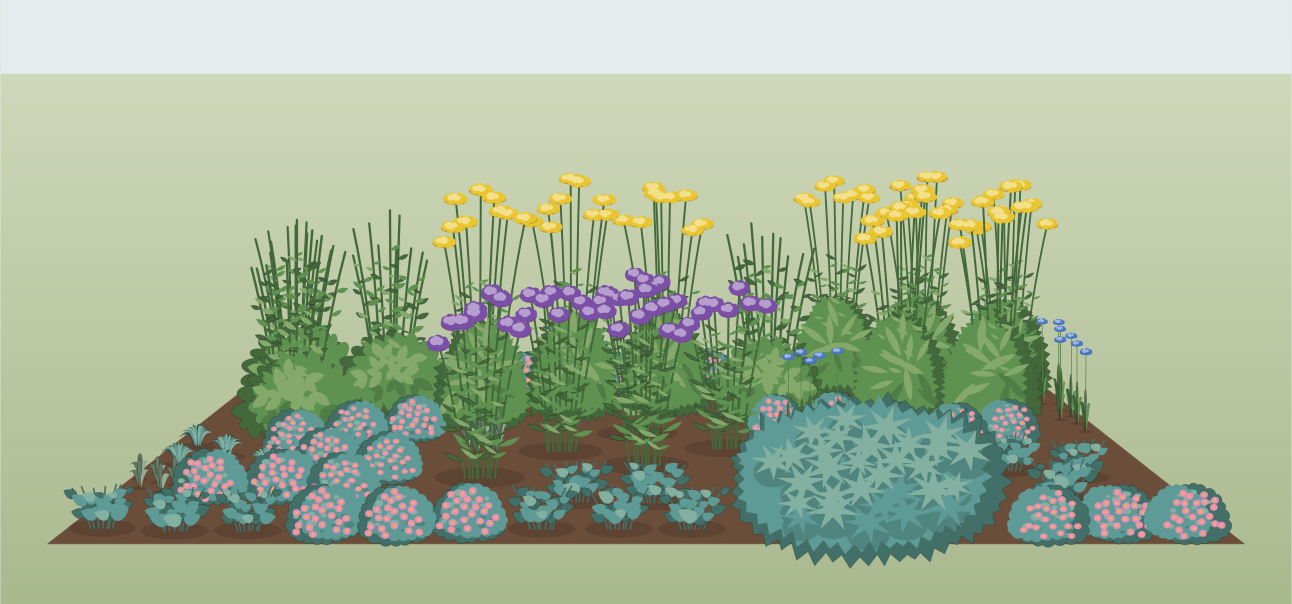
A bed built around creeping juniper 'Blue Rug'
The planner designed this bed around creeping juniper 'Blue Rug' when this page was made: a 16 × 8 ft (4.9 × 2.4 m) English border in zone 6, full sun. It chose the other plants from the 715 that suit those conditions and its dry soil, and says below why creeping juniper 'Blue Rug' stands where it does.
The plants
- 1 Creeping juniper 'Blue Rug' × 1, blue-green leaves
- 2 Cheddar pinks 'Firewitch' × 24, pink
- 3 Fernleaf yarrow 'Cloth of Gold' × 8, yellow
- 4 New England aster 'Alma Pötschke' × 4, pink
- 5 Purple milkweed × 5, purple
- 6 October daphne × 11, pink
- 7 Turkestan onion × 5, white
- 8 Lady tulip × 12, red
- 9 Triteleia 'Queen Fabiola' × 12, blue
Why this plant
- The only plant grown for its leaves. Leaf lasts all season, where a flower lasts a few weeks.
- The bed's only structure. Shrubs and grasses keep their shape when the perennials die down, and it is the only one here.
Why here
- On the front edge. At 6 in it frames the bed without hiding it, and it is in leaf all season. It finishes 26% of the edge.
- One plant, alone. A shrub is seen as an object, and needs clear ground around it.
- Fine leaf against bold. Purple milkweed is beside it: the strongest contrast of leaf there is.
Why now
- Here for its leaves, all year. They cover the 12 weeks between early March and late November when nothing on the plan is in flower.
- One of two evergreens. They are what the bed has to show from November to March.
Planned as an English border: 10 of the 11 groups (91%) are drifts, longer along the bed than they are deep. Pink runs through the planting: 3 of the 8 kinds grown for their flowers have it. Cheddar pinks 'Firewitch' stands beside Turkestan onion, a proven pairing.
The planner's own design check: 14 Excellent, 3 Good. It flags one thing to watch: Nothing on this plan is highly poisonous or an aggressive spreader.
Open this bed in the planner Change its size, the sun or the style, move plants about, or swap one for another.
Where creeping juniper 'Blue Rug' goes in a border
At 6 in it belongs at the front of a bed. In the planner's ten height classes it is ground-hugging (up to 6 in).
Its job: carpet. A groundcover planted in threes and fives to cover the soil: along the front, and just behind it.
A dense, silver-blue mat that holds a bank and keeps out weeds. Plant it only in full sun; in shade it thins and dies out.
- Evergreen groundcover for hot, dry slopes
- Trailing over walls and rocks
- Cold, exposed sites
What to plant with creeping juniper 'Blue Rug'
Plants recorded as good partners for it, and what each pairing does:
- Sedum 'Autumn Joy': adds the flowers, mid August to mid October; bold leaves against its fine ones; tall enough (24 in) to stand behind it.
- Blue fescue: tall enough (10 in) to stand behind it; happy in the same dry soil.
- Russian sage: adds the flowers, mid July to mid September; spires rising out of its mound; tall enough (4 ft) to stand behind it.
Questions about creeping juniper 'Blue Rug'
Does creeping juniper 'Blue Rug' need sun or shade?
Creeping juniper 'Blue Rug' grows in full sun (6 or more hours of direct sun a day).
It wants dry, sharply drained soil, on the lean side, with no feeding, and little watering once settled. Once settled in, it stands drought.
What zones does creeping juniper 'Blue Rug' grow in?
USDA zones 3 to 9. It is hardy to zone 3, which means it survives winter nights down to about −30 °F (−34 °C).
Gardening in Canada? Use the USDA zone for your town: Canada's own zone map uses different numbers.
How far apart should creeping juniper 'Blue Rug' be planted?
4 ft (120 cm) apart, from the middle of one plant to the middle of the next. That is a little closer than its full width of 6½ ft (200 cm), so a group knits into one patch.
It grows 6 in (15 cm) tall. Give it the full distance from anything taller, or it will lean out towards the light.
How many creeping juniper 'Blue Rug' plants do I need?
Usually one. At 4 ft (120 cm) across, it is a plant you place, not one you mass. For a hedge or screen, set them 4 ft apart: three plants for a 10 ft run.
In the bed above, the planner used one in one group.
Is creeping juniper 'Blue Rug' poisonous to dogs and cats?
No toxicity is recorded for dogs, cats, horses or people, according to NC State Extension.
"Not toxic" is not "edible": a pet that eats a lot of any plant can be sick.
Do deer eat creeping juniper 'Blue Rug'?
Mostly not. NC State lists it as resistant to deer. No plant is proof against a hungry deer in a hard winter, but this one is low on the menu.
What does creeping juniper 'Blue Rug' look like in winter?
Creeping juniper 'Blue Rug' keeps its blue-green leaves all winter, so it is one of the plants that hold a bed together from November to March, when the perennials have gone.
More Juniperus
- Creeping juniper 'Blue Chip' Juniperus horizontalis 'Blue Chip'
- Creeping juniper 'Mother Lode' Juniperus horizontalis 'Mother Lode'
- Japanese garden juniper Juniperus procumbens 'Nana'
- Juniper 'Blue Arrow' Juniperus scopulorum 'Blue Arrow'
- Juniper 'Blue Star' Juniperus squamata 'Blue Star'
- Juniper 'Gold Cone' Juniperus communis 'Gold Cone'
- Juniper 'Grey Owl' Juniperus virginiana 'Grey Owl'
- Juniper 'Old Gold' Juniperus x pfitzeriana 'Old Gold'
- Juniper 'Sea Green' Juniperus chinensis 'Sea Green'
- Juniper 'Skyrocket' Juniperus scopulorum 'Skyrocket'
- Shore juniper 'Blue Pacific' Juniperus conferta 'Blue Pacific'
In these guides
- Salt-tolerant plants for roadsides and coasts
- Plants for slopes and banks
- Pet-safe plants for a sunny border
- Garden plants native to Canada
- Low plants for the front of a border
- Groundcover plants
- Evergreen shrubs for structure
- Shrubs under 4 feet for small gardens
Zone guides: Zone 3 · Zone 4 · Zone 5 · Zone 6 · Zone 7 · Zone 8 · Zone 9
Every fact on record
- Type
- Shrub (groundcover)
- Size
- 6 in (15 cm) tall, 6½ ft (200 cm) wide
- Plant
- 4 ft (120 cm) apart
- Height class
- Ground-hugging (up to 6 in)
- Place in the bed
- Front
- Flowers
- None: grown for its foliage
- Leaves
- Fine texture, evergreen; blue-green
- Shape
- Mat-forming, spreading
- Hardy in
- USDA zones 3 to 9
- Light
- Full sun
- Soil
- Lean, dry and sharply drained
- Water
- Low
- Feeding
- None needed
- Family
- Cupressaceae
- Comes from
- Northern North America into Canada
- Stands up to
- Deer, drought, heat, salt, pollution, erosion
Checked against NC State Extension. Flowering times are for zone 5: later in colder zones, earlier in warmer ones. Toxicity and spread information is a general gardening guide, not veterinary or medical advice, and invasive status varies by region. If a person or pet eats a plant, contact poison control or a vet. Check your local invasive species list before planting anything with a spread warning.