Evergreen shrubs for structure
Evergreen shrubs that give a bed its bones: its shape in winter, and the backdrop for everything else in summer.
A designer talks about a garden's bones: the shapes that are there all year, when the flowers have gone. In a bed, the bones are evergreen shrubs. The planner plants them first, singly and off-centre, and arranges everything else around them.
Repeat one or two evergreens down a long bed rather than using one of everything: it is repetition that makes a bed look designed in winter. Rounded ones look restful, upright ones are exclamation marks; a few of each is enough.
128 plants: 128 shrubs.
The dozen to start with
-
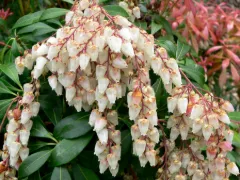
Japanese pieris
8 ft · late March to late April
An elegant evergreen with drooping chains of white or pink, lily-of-the-valley bells in early spring, and new leaves that open bronze or bright red.
-
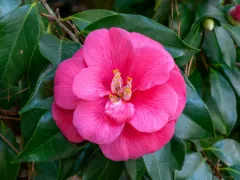
Japanese camellia
10 ft · early February to early April
Polished, dark evergreen leaves and large, formal flowers in red, pink or white from late winter into spring.
-
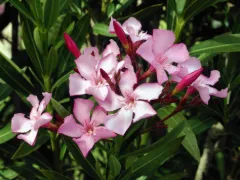
Oleander
10 ft · mid June to early October
A large evergreen with narrow, leathery leaves and clusters of pink, red or white flowers from early summer to autumn.
-
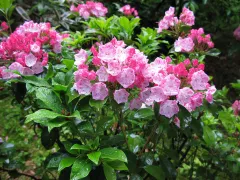
Mountain laurel
8 ft · late May to late June
A native evergreen with crimped, sugar-icing buds that open into cup-shaped flowers of white, pink or red in late spring, in clusters that cover the plant.
A bed planned only from these plants
The planner was given only the plants on this page that suit zone 6 and full sun, and designed this 16 × 8 ft (4.9 × 2.4 m) bed from them when the page was made.
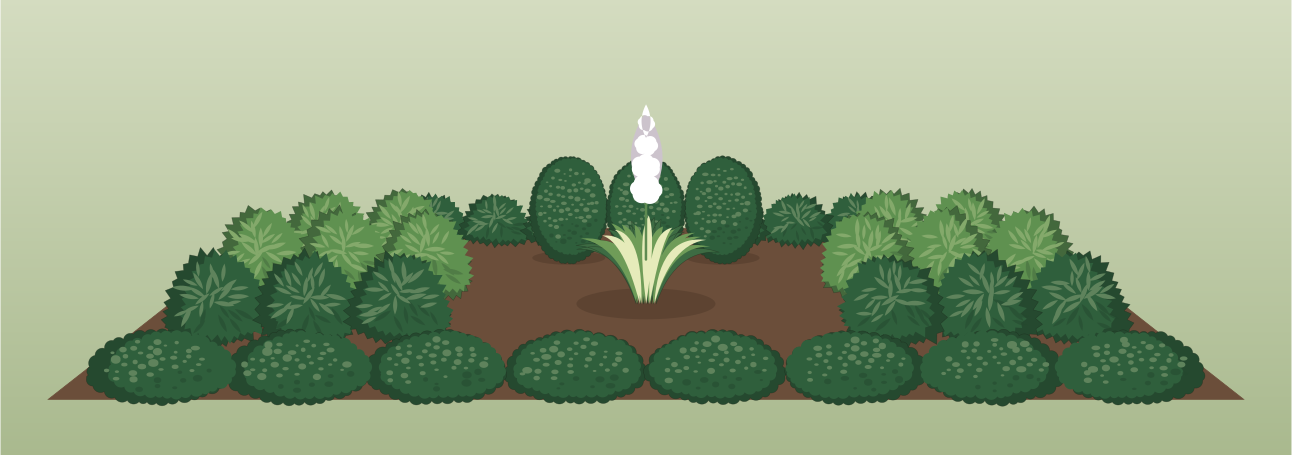
The plants
- 1 Winter heath × 6, pink
- 2 Yucca 'Color Guard' × 1, white
- 3 Winter heath 'Kramer's Red' × 6, pink
- 4 Bearberry × 8, pink
- 5 Boxwood 'Green Gem' × 3, dark green leaves
- 6 Heather × 10, purple
Planned as a formal bed: 34 of the 34 plants (100%) are mirrored across the middle of the bed: each stands on the middle line or has a twin of its own kind opposite it. Pink is the colour seen most, on 3 of the 5 kinds grown for their flowers. Among the neighbours here are two pairs of recognised partners, such as heather and winter heath.
The planner's own design check: 9 Excellent, 7 Good. It flags one thing to watch: Nothing on this plan is highly poisonous or an aggressive spreader.
Open this bed in the planner Change its size, the sun or the style, move plants about, or swap one for another.
All 128 plants
Show all 128, by where they go in a bed
Front of a bed 23
- Bearberry 8 in · early May to late May · host plant
- Bearberry cotoneaster 12 in · late May to mid June
- Bog rosemary 'Blue Ice' 16 in · early May to late May
- Boxwood 'Green Gem' 24 in · grown for its leaves
- Cliff green 12 in · grown for its leaves
- Cotoneaster 'Coral Beauty' 18 in · late May to early June
- Creeping juniper 'Blue Chip' 10 in · grown for its leaves
- Creeping juniper 'Blue Rug' 6 in · grown for its leaves
- Creeping juniper 'Mother Lode' 4 in · grown for its leaves
- Creeping mahonia 12 in · mid April to early May
- Heather 16 in · late July to mid September
- Japanese garden juniper 12 in · grown for its leaves
- Juniper 'Blue Star' 24 in · grown for its leaves
- Lingonberry 8 in · late May to mid June
- Norway spruce 'Little Gem' 18 in · grown for its leaves
- Rhododendron 'Purple Gem' 24 in · late April to early May
- Shore juniper 'Blue Pacific' 12 in · grown for its leaves
- Siberian cypress 12 in · grown for its leaves
- Sweet box 18 in · early February to late March
- Willowleaf cotoneaster 'Scarlet Leader' 24 in · late May to mid June
- Winter heath 10 in · late January to mid April
- Winter heath 'Kramer's Red' 14 in · mid January to mid April
- Wintergreen 5 in · late June to late July
Middle of a bed 25
- Adam's needle 3 ft · late June to mid July · host plant
- Arborvitae 'Hetz Midget' 3 ft · grown for its leaves
- Arborvitae 'Mr. Bowling Ball' 2½ ft · grown for its leaves
- Azalea 'Hino-Crimson' 3 ft · early May to late May
- Bird's nest spruce 3 ft · grown for its leaves
- Boxwood 'Green Velvet' 3 ft · grown for its leaves
- David viburnum 3½ ft · mid May to late May
- Dwarf balsam fir 24 in · grown for its leaves
- Dwarf English boxwood 2½ ft · grown for its leaves
- Dwarf hemlock 'Jeddeloh' 3 ft · grown for its leaves
- Globe arborvitae 'Danica' 24 in · grown for its leaves
- Inkberry 'Gem Box' 2½ ft · grown for its leaves · host plant
- Japanese holly 'Helleri' 3 ft · grown for its leaves
- Japanese holly 'Soft Touch' 2½ ft · grown for its leaves
- Juniper 'Grey Owl' 3 ft · grown for its leaves · host plant
- Juniper 'Old Gold' 3½ ft · grown for its leaves
- Mountain laurel 'Elf' 3 ft · late May to late June
- Mugo pine 'Mops' 3 ft · grown for its leaves · host plant
- Pieris 'Cavatine' 2½ ft · early April to early May
- Pieris 'Little Heath' 2½ ft · grown for its leaves
- Soapweed yucca 2½ ft · mid June to mid July · host plant
- Spreading English yew 3 ft · grown for its leaves
- Spreading plum yew 2½ ft · grown for its leaves
- Yucca 'Color Guard' 2½ ft · late June to mid July · host plant
- Yucca 'Golden Sword' 2½ ft · late June to mid July
Back of a bed 80
- Arborvitae 'Degroot's Spire' 11½ ft · grown for its leaves
- Arborvitae 'Emerald Green' 13 ft · grown for its leaves
- Arborvitae 'Rheingold' 5 ft · grown for its leaves
- Azalea 'Delaware Valley White' 4 ft · early May to late May
- Blue holly 8 ft · grown for its leaves
- Blue holly 'Blue Princess' 10 ft · grown for its leaves
- Box honeysuckle 'Baggesen's Gold' 4 ft · grown for its leaves
- Boxwood 'Green Mountain' 5 ft · grown for its leaves
- Burford holly 15 ft · grown for its leaves
- Burkwood osmanthus 8 ft · mid April to early May
- Camellia 'April Blush' 5 ft · late March to early May
- Catawba rhododendron 8 ft · late May to mid June
- Cherry laurel 'Otto Luyken' 3½ ft · late April to mid May · host plant
- Chinese fringe flower 6½ ft · late March to early May
- Christmas box 4 ft · early January to early March
- Common boxwood 10 ft · grown for its leaves
- Drooping leucothoe 4 ft · early May to late May
- Drooping leucothoe 'Rainbow' 4 ft · early May to late May
- Dwarf Alberta spruce 8 ft · grown for its leaves
- Dwarf blue spruce 4 ft · grown for its leaves
- Dwarf Hinoki cypress 5 ft · grown for its leaves
- Dwarf Japanese cedar 4 ft · grown for its leaves
- Dwarf Japanese yew 4 ft · grown for its leaves
- Dwarf white pine 5 ft · grown for its leaves · host plant
- Dwarf yaupon holly 4 ft · grown for its leaves · host plant
- Evergreen azalea 4 ft · mid April to mid May
- Firethorn 'Mohave' 10 ft · late May to early June
- Florida anise 8 ft · mid April to mid May
- Fringe flower 'Purple Diamond' 5 ft · late March to early May
- Gardenia 5 ft · late May to late July
- Globe arborvitae 'Little Giant' 4 ft · grown for its leaves
- Golden Japanese euonymus 6 ft · grown for its leaves
- Hicks yew 11½ ft · grown for its leaves
- Holly osmanthus 'Goshiki' 5 ft · grown for its leaves
- Indian hawthorn 4 ft · early April to early May
- Inkberry 6½ ft · grown for its leaves · host plant
- Inkberry 'Shamrock' 4 ft · grown for its leaves · host plant
- Irish yew 13 ft · grown for its leaves
- Japanese aucuba 6½ ft · grown for its leaves
- Japanese camellia 10 ft · early February to early April
- Japanese fatsia 6½ ft · mid October to late November
- Japanese holly 'Sky Pencil' 8 ft · grown for its leaves
- Japanese pieris 8 ft · late March to late April
- Japanese pittosporum 10 ft · mid April to mid May
- Japanese skimmia 3½ ft · mid April to early May
- Juniper 'Blue Arrow' 13 ft · grown for its leaves
- Juniper 'Gold Cone' 6 ft · grown for its leaves
- Juniper 'Sea Green' 5 ft · grown for its leaves
- Juniper 'Skyrocket' 15 ft · grown for its leaves
- Korean boxwood 'Wintergreen' 3½ ft · grown for its leaves
- Laurustinus 8 ft · early January to early April
- Littleleaf boxwood 'Winter Gem' 4 ft · grown for its leaves
- Mahonia 'Charity' 10 ft · early November to late December
- Mahonia 'Soft Caress' 4 ft · early November to late December
- Mexican orange blossom 6 ft · early May to late May
- Mountain laurel 8 ft · late May to late June
- Mountain laurel 'Olympic Fire' 6½ ft · late May to late June
- Mugo pine 5 ft · grown for its leaves
- Oleander 10 ft · mid June to early October
- Oregon grape 5 ft · early April to early May
- Pieris 'Mountain Fire' 6½ ft · late March to late April
- Reblooming azalea 3½ ft · mid April to mid May
- Rhododendron 'Cunningham's White' 5 ft · mid May to early June
- Rhododendron 'Nova Zembla' 6½ ft · late May to mid June
- Rhododendron 'Olga Mezitt' 5 ft · late April to early May
- Rhododendron 'PJM' 5 ft · late April to mid May
- Rhododendron 'Roseum Elegans' 8 ft · late May to mid June
- Rosebay rhododendron 15 ft · late June to mid July
- Rosemary 4 ft · early March to early May
- Salal 4 ft · late May to late June · host plant
- Sasanqua camellia 8 ft · early October to mid December
- Sawara cypress 'Boulevard' 10 ft · grown for its leaves
- Schip laurel 10 ft · late April to early May · host plant
- Spreading yew 'Densiformis' 4 ft · grown for its leaves
- Sweet olive 13 ft · mid September to mid November
- Threadleaf false cypress 'Golden Mop' 3½ ft · grown for its leaves
- Wax myrtle 15 ft · grown for its leaves · host plant
- Weeping Canadian hemlock 5 ft · grown for its leaves
- Winter daphne 4 ft · early February to late March
- Yak rhododendron 3½ ft · mid May to early June