Saskatoon serviceberry
Amelanchier alnifolia · Rosaceae
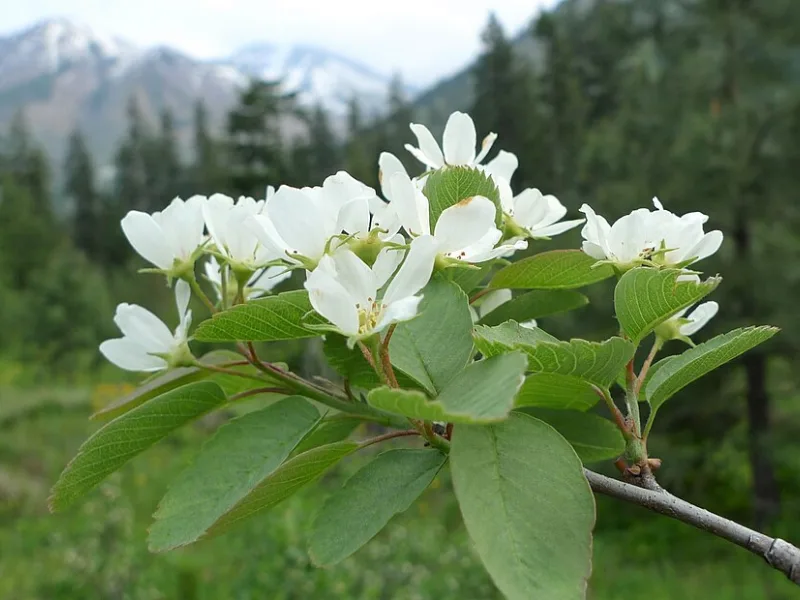
Clouds of white flowers in early spring, sweet purple berries in July, and orange-red leaves in autumn. A hardy native of the prairies and the West.
- Size
- 10 ft tall, 8 ft wide
- Zones
- 2 to 7
- Light
- Full sun to part sun
- Flowers
- Late April to early May
- Pets
- No toxicity recorded
- Job in a bed
- Anchor
A bed built around saskatoon serviceberry
The planner designed this bed around saskatoon serviceberry when this page was made: a 22 × 10 ft (6.7 × 3.0 m) English border in zone 6, full sun. It chose the other plants from the 966 that suit those conditions, and says below why saskatoon serviceberry stands where it does.

The plants
- 1 Saskatoon serviceberry × 1, white
- 2 Cheddar pinks 'Firewitch' × 33, pink
- 3 Carpathian bellflower × 8, blue
- 4 Indian grass × 3, tan
- 5 Sweet coneflower 'Henry Eilers' × 4, yellow
- 6 Little bluestem × 3, blue-green leaves
- 7 Wild lupine × 11, blue
- 8 Purple coneflower × 3, purple
- 9 Nodding onion × 24, pink
- 10 Slender mountain mint × 3, white
- 11 Winecups × 4, purple
- 12 Asiatic lily × 4, yellow
- 13 Grecian windflower × 12, blue
- 14 Surprise lily × 12, pink
Why this plant
- A classic partner for little bluestem. Both are on this plan. A pairing gardeners have proved outranks a general rule.
- Part of the bed's structure. Shrubs and grasses keep their shape when the perennials die down. So do Indian grass and little bluestem.
Why here
- Anchors a back corner. At 10 ft it is the tallest plant here, and the tallest close the ends of the bed, where they stand in front of nothing.
- A step in the back row. Next to sweet coneflower 'Henry Eilers' (4½ ft): no two neighbours there are the same height, so the back steps up and down like a skyline.
- One plant, alone. A shrub is seen as an object, and needs clear ground around it.
Why now
- In flower for three weeks. From late April to early May.
- Fills a gap. For one of those weeks nothing else on the plan is in flower.
Planned as an English border: 20 of the 22 groups (91%) are drifts, longer along the bed than they are deep. The scheme leans cool (pink, blue and purple) and uses yellow for warmth, with white and tan to calm things between them. The most in flower at one time is 7 kinds, in early August.
The planner's own design check: 13 Excellent, 3 Good, 1 Satisfactory.
Open this bed in the planner Change its size, the sun or the style, move plants about, or swap one for another.
Where saskatoon serviceberry goes in a border
At 10 ft it belongs at the back of a bed. In the planner's ten height classes it is super tall (over 6½ ft).
Its job: anchor. A shrub that gives the bed permanent structure. Planted singly, as soon as the front edge is laid; everything else is arranged around it.
A shrub for all seasons that feeds people and birds. The fruit tastes of blueberry and almond. It suckers into a thicket, which suits a hedge or a wild border.
- Edible landscaping
- Native hedges and screens
- Birds
What to plant with saskatoon serviceberry
Plants recorded as good partners for it, and what each pairing does:
- Little bluestem: its blue-green leaves are a setting for the flowers, before and after; low enough (3 ft) to stand in front of it.
- Prairie dropseed: carries the spot on into mid September; low enough (2½ ft) to stand in front of it.
- Shrubby cinquefoil: takes over when it finishes, flowering from early June; low enough (3 ft) to stand in front of it.
Questions about saskatoon serviceberry
Does saskatoon serviceberry need sun or shade?
Saskatoon serviceberry grows in full sun (6 or more hours of direct sun a day) and part sun (4 to 6 hours of sun, including some afternoon sun).
It wants ordinary well-drained soil, of average fertility, and little watering once settled.
What zones does saskatoon serviceberry grow in?
USDA zones 2 to 7. It is hardy to zone 2, which means it survives winter nights down to about −40 °F (−40 °C).
Above zone 7 it struggles: the zones measure winter cold, but a plant's top zone usually means the summers are too hot or the winters too mild for it to rest.
Gardening in Canada? Use the USDA zone for your town: Canada's own zone map uses different numbers.
When does saskatoon serviceberry flower in my zone?
In zone 5 it flowers late April to early May. As a spring flower it moves about a week for every zone: earlier where it is warmer, later where it is colder.
| Zone 3 | Early May to late May |
|---|---|
| Zone 4 | Early May to mid May |
| Zone 5 | Late April to early May |
| Zone 6 | Mid April to early May |
| Zone 7 | Mid April to late April |
Worked out from Hopkins' bioclimatic law: spring arrives about four days later for each degree of latitude north, and one zone is roughly two degrees. A warm spring or a cold one moves any garden two weeks either way.
How far apart should saskatoon serviceberry be planted?
6½ ft (200 cm) apart, from the middle of one plant to the middle of the next. That is a little closer than its full width of 8 ft (250 cm), so a group knits into one patch.
It grows 10 ft (300 cm) tall. Give it the full distance from anything taller, or it will lean out towards the light.
How many saskatoon serviceberry plants do I need?
Usually one. At 6½ ft (200 cm) across, it is a plant you place, not one you mass. For a hedge or screen, set them 6½ ft apart: two plants for a 10 ft run.
In the bed above, the planner used one in one group.
Is saskatoon serviceberry poisonous to dogs and cats?
No toxicity is recorded for dogs, cats, horses or people, according to NC State Extension.
"Not toxic" is not "edible": a pet that eats a lot of any plant can be sick.
Do deer eat saskatoon serviceberry?
They may. NC State does not list it as resistant to deer or rabbits. Where they visit, protect it, or plant it among ones they avoid.
Will saskatoon serviceberry spread?
It spreads sideways, by runners or roots; the risk of it taking over is moderate. Spreads by suckers into a thicket. Remove unwanted shoots at the base.
What flowers after saskatoon serviceberry?
Saskatoon serviceberry is over by early May. These start as it finishes and carry the same spot on, so it never goes flat:
- Shrubby cinquefoil: from early June to mid September, 3 ft tall, to stand in front of it and cover its fading stems (a recorded partner).
- Mountain laurel: from late May to late June, 8 ft tall.
- Elderberry 'Black Lace': from early June to late June, 6½ ft tall, to stand in front of it and cover its fading stems.
What does saskatoon serviceberry look like in winter?
Saskatoon serviceberry drops its leaves and stands as bare branches. That is when to see its shape, and to prune it if it needs pruning.
Is saskatoon serviceberry good for bees and butterflies?
Saskatoon serviceberry is visited by pollinators, bees, specialist bees and butterflies.
It is native to the United States.
More Amelanchier
- Shadblow serviceberry Amelanchier canadensis
In these guides
Every fact on record
- Type
- Shrub
- Size
- 10 ft (300 cm) tall, 8 ft (250 cm) wide
- Plant
- 6½ ft (200 cm) apart
- Height class
- Super tall (over 6½ ft)
- Place in the bed
- Back
- Flowers
- Late April to early May; dense clusters; white
- Leaves
- Medium texture, deciduous; blue-green
- Shape
- Upright, spreading
- Hardy in
- USDA zones 2 to 7
- Light
- Full sun, part sun
- Soil
- Average, well-drained
- Water
- Low
- Feeding
- None needed
- Family
- Rosaceae
- Comes from
- Western and Central North America
- Attracts
- Pollinators, bees, specialist bees, butterflies
Checked against NC State Extension and VASCAN (plants of Canada). Flowering times are for zone 5: later in colder zones, earlier in warmer ones. Toxicity and spread information is a general gardening guide, not veterinary or medical advice, and invasive status varies by region. If a person or pet eats a plant, contact poison control or a vet. Check your local invasive species list before planting anything with a spread warning.