Host plants for the hermit sphinx
The garden plants whose leaves hermit sphinx caterpillars eat, and a bed the planner designed around them.
The hermit sphinx (Lintneria eremitus) is a moth. Like every butterfly and moth, it can lay its eggs only on the plants its caterpillars can eat, its host plants. A garden with nectar flowers feeds the adults as they pass; a garden with host plants is where the next generation is raised.
These four garden plants are recorded by NC State as hosts for its caterpillars. Expect chewed leaves: that is the point. Do not spray, and leave fallen leaves under the plants in winter, where many caterpillars and pupae spend it.
4 plants: 4 perennials.
The host plants
-

Bee balm
3 ft · early July to early August
Shaggy, colourful flower heads that draw hummingbirds, bees and butterflies.
-
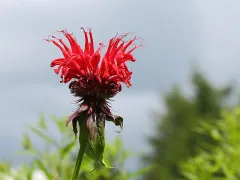
Bee balm 'Jacob Cline'
4 ft · late June to mid August
Very large, shaggy heads of true scarlet on tall, sturdy stems, with leaves that largely resist mildew.
-
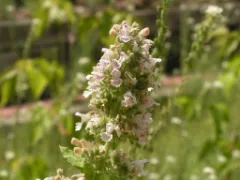
Catnip
2½ ft · grown for its leaves
The herb that cats adore: an upright, grey-green, mint-scented plant with small white flowers.
-
Bee balm 'Purple Rooster'
3 ft · late June to mid August
Flower heads of a true, deep royal purple, the purest purple in the genus, on strong, upright stems.
A bed for the hermit sphinx
The planner designed this 16 × 8 ft (4.9 × 2.4 m) bed for zone 6 and full sun when this page was made, keeping bee balm, bee balm 'Jacob Cline' and bee balm 'Purple Rooster' on it.
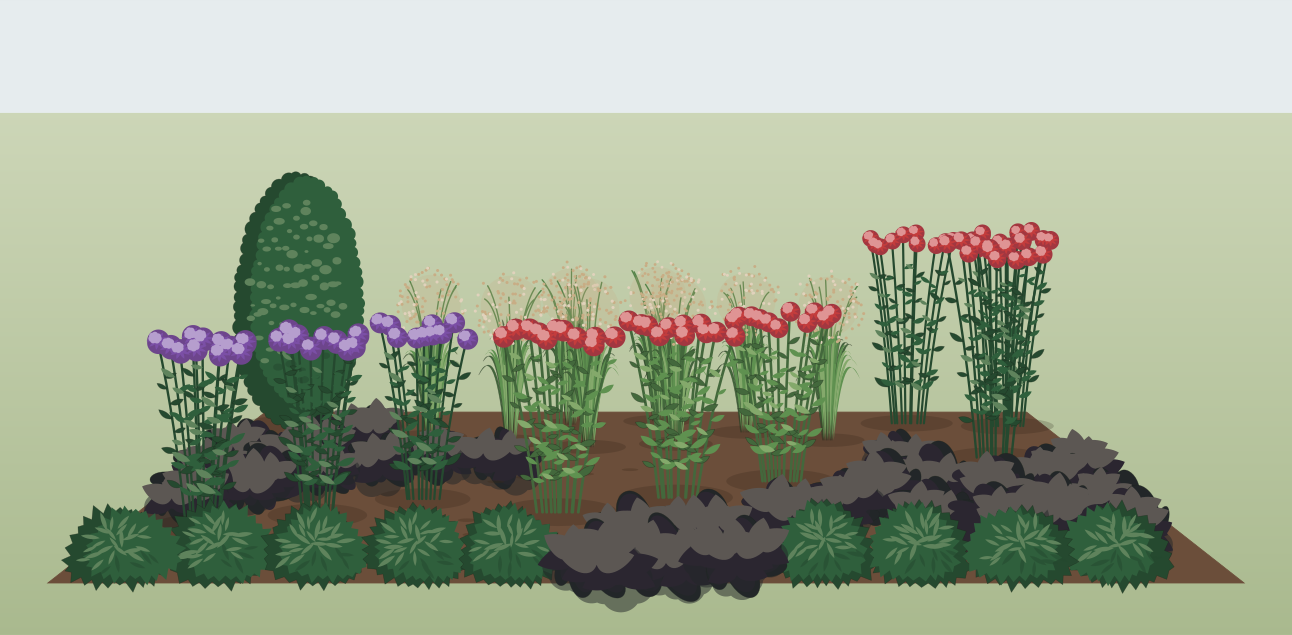
The plants
- 1 Bee balm × 3, red
- 2 Bee balm 'Jacob Cline' × 3, red
- 3 Bee balm 'Purple Rooster' × 3, purple
- 4 Winter heath × 9, pink
- 5 Bugleweed 'Black Scallop' × 29, blue
- 6 Boxwood 'Green Mountain' × 1, dark green leaves
- 7 Northern sea oats × 8, tan
- 8 Meadow saffron × 5, white
- 9 Red spider lily × 5, red
Planned as a naturalistic planting: low grasses and groundcovers, the matrix, make up 62% of the planted ground. Red runs through the planting: 3 of the 8 kinds grown for their flowers have it. The most in flower at one time is 4 kinds, from late July.
The planner's own design check: 11 Excellent, 4 Good, 2 Satisfactory. It flags one thing to watch: Meadow saffron is highly poisonous to people, dogs, cats and horses. Bee balm spreads aggressively.
Open this bed in the planner Change its size, the sun or the style, move plants about, or swap one for another.
All 4 plants
Middle of a bed 3
- Bee balm 3 ft · early July to early August
- Bee balm 'Purple Rooster' 3 ft · late June to mid August
- Catnip 2½ ft · grown for its leaves
Back of a bed 1
- Bee balm 'Jacob Cline' 4 ft · late June to mid August