Native perennials for pollinators
Perennials native to the United States that feed bees and butterflies, with a sample bed planned from them.
Native bees and the plants they visit grew up together. Many native bees can feed on many flowers, but some, the specialist bees, collect pollen from only one group of plants, and cannot raise their young without it. A garden of natives feeds both.
Every plant here is native to the United States (or is a named variety of a native) and is recorded by NC State as visited by bees, butterflies or other pollinators. The way to make a bed of them work for pollinators is succession: something in flower from April to October, in groups big enough to be worth a bee's visit, three or five of a kind rather than one.
197 plants: 197 perennials.
The dozen to start with
-
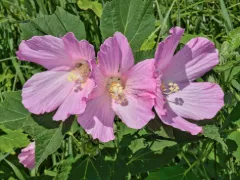
Hardy hibiscus
5 ft · late July to mid September · specialist bees
Flowers the size of dinner plates in red, pink or white from late summer, on a shrub-sized perennial that dies to the ground each winter and reappears very late in spring.
-
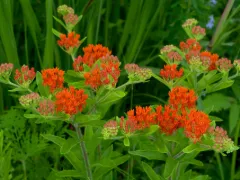
Butterfly weed
24 in · late June to early August · specialist bees · host plant
Flat clusters of vivid orange flowers in midsummer, covered in butterflies, on a low, bushy plant with a deep taproot.
-

Bee balm
3 ft · early July to early August · specialist bees · host plant
Shaggy, colourful flower heads that draw hummingbirds, bees and butterflies.
-
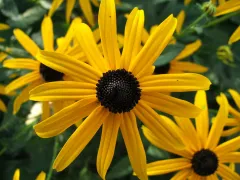
Black-eyed Susan
24 in · mid July to mid September · host plant
Masses of golden, dark-centred flowers from midsummer into fall.
A bed planned only from these plants
The planner was given only the plants on this page that suit zone 6 and full sun, and designed this 16 × 8 ft (4.9 × 2.4 m) bed from them when the page was made.
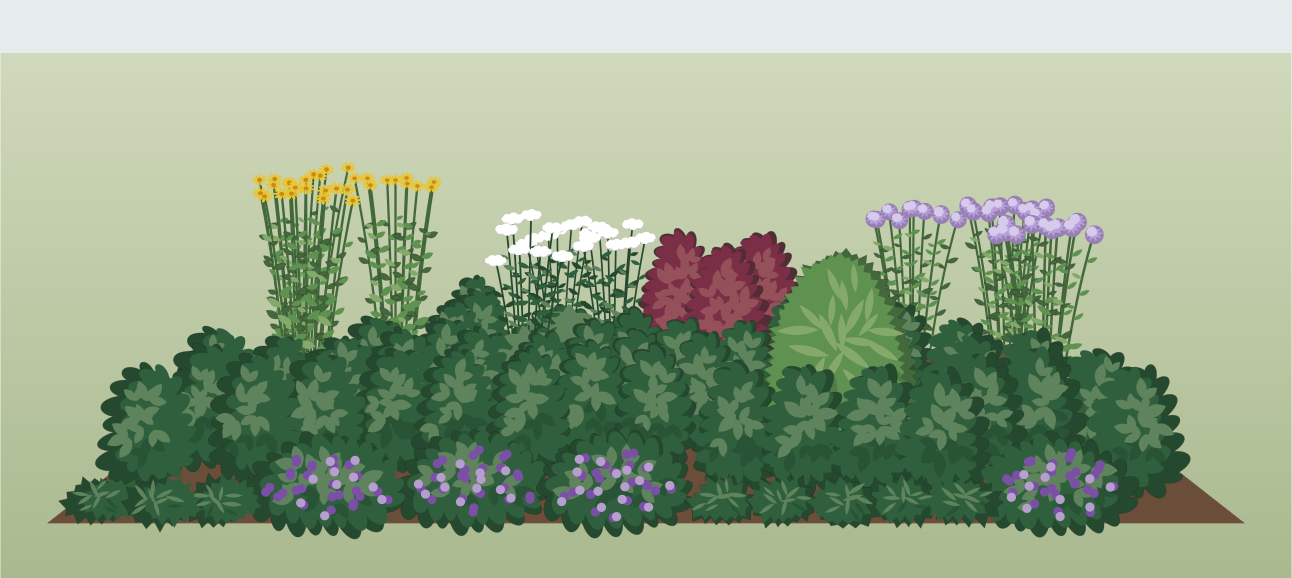
The plants
- 1 Verbena 'Homestead Purple' × 4, purple
- 2 Sea thrift × 8, pink
- 3 Wild bergamot × 3, lavender
- 4 False sunflower × 3, yellow
- 5 Aromatic aster 'Raydon's Favorite' × 1, blue
- 6 Wild quinine × 3, white
- 7 Fringed loosestrife 'Firecracker' × 3, burgundy leaves
- 8 Golden ragwort × 41, yellow
Planned as a naturalistic planting: low grasses and groundcovers, the matrix, make up 54% of the planted ground. Golden ragwort is planted in five places along the bed, which gives it rhythm. Golden ragwort is the plant there is most of: 41 of the 66.
The planner's own design check: 8 Excellent, 6 Good, 2 Satisfactory. It flags one thing to watch: Fringed loosestrife 'Firecracker' spreads aggressively. Each plant's details say more.
Open this bed in the planner Change its size, the sun or the style, move plants about, or swap one for another.
All 197 plants
Show all 197, by where they go in a bed
Front of a bed 64
- Allegheny spurge 10 in · early April to early May
- American alumroot 12 in · grown for its leaves · specialist bees
- Beach wormwood 'Silver Brocade' 8 in · grown for its leaves
- Bigleaf aster 24 in · early August to mid September
- Bird's-foot violet 5 in · late April to late May · specialist bees · host plant
- Blanket flower 'Arizona Sun' 12 in · mid June to early October
- Blanket flower 'Goblin' 14 in · mid June to early October
- Blanket flower 'Mesa Yellow' 18 in · mid June to early October
- Bloodroot 8 in · late March to mid April · specialist bees
- Blue-eyed grass 14 in · mid May to late June
- Celandine poppy 16 in · mid April to late May
- Chives 14 in · mid May to mid June
- Common blue violet 8 in · mid April to late May · specialist bees · host plant
- Coral bells 'Firefly' 10 in · late May to late July · specialist bees
- Coral bells 'Green Spice' 10 in · grown for its leaves · specialist bees
- Creeping Jacob's ladder 14 in · late April to late May
- Creeping phlox 6 in · mid April to mid May
- Creeping phlox 'Candy Stripe' 5 in · mid April to mid May
- Creeping phlox 'Emerald Blue' 5 in · mid April to mid May
- Creeping phlox 'Sherwood Purple' 8 in · early May to late May
- Creeping woodland phlox 8 in · late April to late May
- Dutchman's breeches 8 in · mid April to early May
- Dwarf crested iris 6 in · late April to mid May
- Eastern prickly pear 10 in · mid June to early July
- Foamflower 10 in · late April to late May
- Fringed bleeding heart 16 in · early May to late August
- Goldenrod 'Golden Fleece' 18 in · late August to early October · host plant
- Green-and-gold 6 in · late April to mid June
- Hairy beardtongue 18 in · late May to late June
- Heath aster 'Snow Flurry' 6 in · mid September to mid October · specialist bees
- Jack-in-the-pulpit 18 in · early May to late May
- Jacob's ladder 'Stairway to Heaven' 12 in · early May to early June
- Liverleaf 6 in · late March to late April
- Mayapple 16 in · grown for its leaves · specialist bees
- Mouse-ear coreopsis 'Nana' 8 in · early May to mid June
- Nodding onion 18 in · early July to early August
- Pink evening primrose 16 in · late May to late July · specialist bees
- Plantain-leaved pussytoes 6 in · grown for its leaves · host plant
- Red trillium 16 in · mid April to mid May · host plant
- Robin's plantain 'Lynnhaven Carpet' 6 in · early May to late May
- Rock cress 8 in · mid April to early May · specialist bees
- Rue anemone 6 in · mid April to mid May
- Scarlet coral bells 18 in · late May to late July · specialist bees
- Sea thrift 8 in · early May to mid June
- Shooting star 16 in · early May to late May
- Squirrel corn 8 in · mid April to early May
- Stokes' aster 18 in · late June to mid August
- Sundrops 18 in · late May to mid July · specialist bees
- Sundrops 'Fireworks' 18 in · early June to mid July · specialist bees
- Threadleaf coreopsis 'Moonbeam' 18 in · late June to early September
- Threadleaf coreopsis 'Zagreb' 16 in · late June to late August
- Three-toothed cinquefoil 6 in · late May to early July · specialist bees
- Tickseed 'Early Sunrise' 18 in · early June to late August
- Verbena 'Homestead Purple' 10 in · mid May to early October
- Wherry's foamflower 10 in · early May to late June
- White trillium 16 in · mid April to mid May · host plant
- Wild geranium 'Espresso' 16 in · early May to early June · specialist bees
- Wild ginger 6 in · grown for its leaves · host plant
- Wild strawberry 6 in · early May to early June · specialist bees
- Winecups 8 in · late May to late August
- Woodland phlox 12 in · late April to late May
- Woodland phlox 'Blue Moon' 12 in · late April to late May
- Woodland stonecrop 4 in · late April to late May
- Woolly yarrow 8 in · late May to early July
Middle of a bed 78
- Anise hyssop 3 ft · early July to early September
- Arkansas bluestar 3 ft · mid May to early June
- Aromatic aster 'October Skies' 20 in · mid September to late October
- Aromatic aster 'Raydon's Favorite' 3 ft · mid September to early November
- Autumn sage 2½ ft · mid May to mid October
- Beardtongue 'Husker Red' 2½ ft · late May to late June · specialist bees
- Bee balm 3 ft · early July to early August · specialist bees · host plant
- Bee balm 'Purple Rooster' 3 ft · late June to mid August · specialist bees · host plant
- Black-eyed Susan 24 in · mid July to mid September · host plant
- Black-eyed Susan 'Goldsturm' 2 ft · late July to late September
- Blanket flower 'Burgundy' 24 in · mid June to mid September
- Blazing star 3 ft · mid July to mid August · specialist bees · host plant
- Blazing star 'Kobold' 24 in · early July to early August · specialist bees · host plant
- Blue mistflower 2½ ft · late August to mid October
- Blue wood aster 3 ft · mid September to mid October · specialist bees · host plant
- Blue-stemmed goldenrod 2½ ft · early September to mid October · specialist bees · host plant
- Bluestar 3 ft · mid May to mid June
- Bluestar 'Storm Cloud' 2½ ft · mid May to mid June
- Butterfly weed 24 in · late June to early August · specialist bees · host plant
- Calico aster 'Lady in Black' 3½ ft · mid September to mid October · specialist bees
- Cardinal flower 'Queen Victoria' 3½ ft · late July to mid September
- Common blanket flower 24 in · mid June to early September
- Coneflower 'Green Jewel' 24 in · early July to early September · host plant
- Coneflower 'Kim's Knee High' 20 in · early July to late August · host plant
- Coneflower 'Magnus' 3 ft · early July to early September · host plant
- Coneflower 'PowWow Wild Berry' 22 in · late June to mid September · host plant
- Coneflower 'White Swan' 2½ ft · early July to early September · host plant
- Doll's eyes 2½ ft · early May to late May
- Eastern bee balm 20 in · early May to mid June
- False Solomon's seal 2½ ft · early May to early June
- False sunflower 'Summer Sun' 3½ ft · late June to early September
- Flowering spurge 2½ ft · early July to late August
- Fringed loosestrife 'Firecracker' 2½ ft · grown for its leaves
- Garden phlox 'Bright Eyes' 2½ ft · mid July to late August
- Garden phlox 'Laura' 2½ ft · mid July to early September
- Gaura 'Siskiyou Pink' 2½ ft · mid June to early October · host plant
- Gaura 'Whirling Butterflies' 3 ft · mid June to mid September · host plant
- Gloriosa daisy 2½ ft · late June to mid September · host plant
- Gloriosa daisy 'Indian Summer' 3 ft · early July to early October · host plant
- Golden Alexanders 2½ ft · early May to mid June · specialist bees · host plant
- Golden ragwort 20 in · mid April to late May · host plant
- Great blue lobelia 2½ ft · early August to mid September
- Hairy alumroot 'Autumn Bride' 24 in · late August to early October · specialist bees
- Ironweed 'Iron Butterfly' 2½ ft · late August to early October
- Joe-Pye weed 'Baby Joe' 2½ ft · late July to mid September
- Lanceleaf coreopsis 20 in · late May to mid July
- Large-flowered bellwort 20 in · late April to mid May · specialist bees
- Mexican hat 24 in · late June to early September
- Mountain mint 3 ft · early July to early September · host plant
- New England aster 'Purple Dome' 20 in · early September to mid October · specialist bees · host plant
- New York aster 3 ft · late August to mid October · specialist bees · host plant
- Obedient plant 'Miss Manners' 2 ft · mid July to early September
- Ohio spiderwort 2½ ft · late May to mid July
- Pale purple coneflower 3 ft · mid June to mid July · host plant
- Pearly everlasting 24 in · late July to early September
- Purple coneflower 3 ft · late June to early September · host plant
- Purple milkweed 3 ft · early June to mid July · host plant
- Red baneberry 24 in · early May to late May
- Rose turtlehead 2½ ft · mid August to late September · host plant
- Slender mountain mint 2½ ft · early July to late August · host plant
- Solomon's seal 3 ft · early May to late May
- Spotted bee balm 24 in · mid July to early September · specialist bees · host plant
- Sunset hyssop 24 in · mid July to mid September
- Tennessee coneflower 24 in · mid June to late August · host plant
- Tickseed 'Sunray' 20 in · early June to late August
- Turtlehead 'Hot Lips' 3 ft · mid August to late September
- Virginia bluebells 20 in · mid April to early May
- White snakeroot 3½ ft · late August to mid October
- White turtlehead 3 ft · early August to mid September
- White wood aster 24 in · late August to early October · host plant
- Whorled milkweed 24 in · late June to late August · host plant
- Wild columbine 24 in · early May to early June
- Wild geranium 20 in · early May to late May · specialist bees
- Wild lupine 20 in · mid May to late June · host plant
- Yarrow 24 in · mid June to late August
- Yarrow 'Cerise Queen' 24 in · mid June to late August
- Yarrow 'Paprika' 24 in · mid June to late August
- Yellow coneflower 3 ft · mid June to mid July · host plant
Back of a bed 55
- Bee balm 'Jacob Cline' 4 ft · late June to mid August · specialist bees · host plant
- Black cohosh 5 ft · early July to early August · host plant
- Blue false indigo 4 ft · late May to mid June · host plant
- Blue sage 4 ft · late August to mid October
- Blue vervain 4 ft · mid July to early September · specialist bees · host plant
- Boltonia 'Snowbank' 4 ft · early September to mid October
- Boneset 4 ft · early August to mid September
- Brown-eyed Susan 4 ft · late July to early October · host plant
- Cardinal flower 3½ ft · late July to mid September
- Common milkweed 4 ft · late June to early August · specialist bees · host plant
- Culver's root 5 ft · early July to mid August · specialist bees
- Culver's root 'Fascination' 5 ft · mid July to late August · specialist bees
- Cutleaf coneflower 6½ ft · late July to mid September · host plant
- False sunflower 4 ft · late June to early September
- False sunflower 'Summer Nights' 3½ ft · late June to early September
- Flat-topped aster 5 ft · early August to mid September · host plant
- Foxglove beardtongue 3½ ft · late May to late June · specialist bees
- Garden phlox 3½ ft · mid July to early September
- Garden phlox 'David' 3½ ft · mid July to early September
- Garden phlox 'Jeana' 4 ft · mid July to mid September
- Giant coneflower 6 ft · late June to early August · host plant
- Goat's beard 5 ft · early June to late June · host plant
- Goldenrod 'Fireworks' 3½ ft · late August to mid October · specialist bees · host plant
- Grey-headed coneflower 4 ft · early July to late August · host plant
- Hardy hibiscus 5 ft · late July to mid September · specialist bees
- Hollow Joe-Pye weed 7 ft · late July to mid September · host plant
- Joe Pye weed 'Gateway' 6 ft · late July to mid September
- Joe Pye weed 'Little Joe' 4 ft · late July to early September
- Maximilian sunflower 8 ft · early September to mid October · host plant
- Meadow blazing star 4 ft · late July to mid September
- New England aster 4 ft · early September to mid October · specialist bees · host plant
- New England aster 'Alma Pötschke' 3½ ft · late August to mid October · specialist bees · host plant
- New York ironweed 6½ ft · early August to mid September · specialist bees
- Obedient plant 3½ ft · early August to mid September
- Prairie blazing star 4 ft · mid July to late August
- Rattlesnake master 4 ft · mid July to late August · host plant
- Rough blazing star 3½ ft · mid August to late September
- Scarlet rose mallow 6½ ft · mid July to early September · specialist bees
- Showy goldenrod 4 ft · late August to mid October · specialist bees · host plant
- Smooth aster 'Bluebird' 3½ ft · early September to mid October · specialist bees · host plant
- Sneezeweed 4 ft · early August to late September
- Spotted Joe-Pye weed 5½ ft · mid July to early September
- Swamp milkweed 4 ft · early July to early August · host plant
- Swamp milkweed 'Ice Ballet' 3½ ft · early July to mid August · host plant
- Swamp sunflower 6½ ft · late September to late October · specialist bees · host plant
- Sweet coneflower 'Henry Eilers' 4½ ft · late July to mid September · host plant
- Sweet Joe Pye weed 6 ft · late July to early September
- Tall coreopsis 6 ft · early August to mid September
- Tall larkspur 5 ft · mid July to late August
- White false indigo 4 ft · late May to late June · host plant
- White snakeroot 'Chocolate' 3½ ft · mid September to mid October
- Wild bergamot 3½ ft · early July to late August · specialist bees
- Wild quinine 3½ ft · late June to late August
- Willowleaf sunflower 'First Light' 4 ft · mid September to mid October
- Woodland sunflower 4 ft · mid July to early September · specialist bees · host plant