Plants for winter interest
Plants with something to show from December to February: winter flowers, berries, coloured stems, seed heads and evergreen leaves.
A bed is judged in winter, when the flowers have gone and only its bones are left. The plants here are the ones with something to show then: flowers that open in the cold, such as witch hazels, hellebores, snowdrops and winter heath; berries and hips; red, yellow or coral stems; seed heads and grasses left standing; and evergreen leaves. After each plant is what it gives.
Many winter flowers are strongly scented, because there are so few insects about to find them: witch hazel, sweet box and winter daphne can be smelled yards away. Plant them by a door or a path you use every day, and the rest where you will see them from a window. Coloured stems and grasses look best where the low winter sun shines through them from behind.
The sample bed below is drawn as it looks in late February.
120 plants: 31 perennials, 6 ferns, 12 bulbs, 12 grasses and 59 shrubs.
The dozen to start with
-
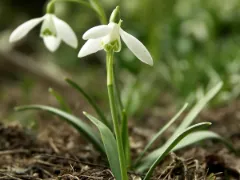
Snowdrop
6 in · early March to late March · winter flowers
Nodding white bells that push up through the last of the snow, weeks before anything else.
-
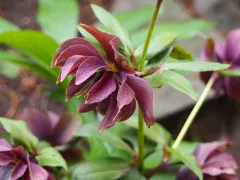
Lenten rose
18 in · late March to early May · evergreen
One of the first perennials to flower, with nodding, long-lasting blooms that often open while snow is still melting.
-
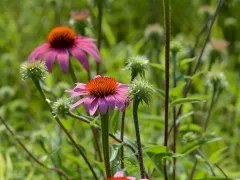
Purple coneflower
3 ft · late June to early September · seed heads · host plant
A tough native with purple-pink petals around a bronze cone, blooming for weeks in midsummer.
-

Blue false indigo
4 ft · late May to mid June · seed heads · host plant
Spikes of indigo-blue pea flowers in late spring on a plant that grows as big as a shrub, with blue-green leaves and black seed pods that rattle in winter.
-
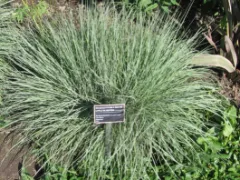
Little bluestem
3 ft · grown for its leaves · stands in winter · host plant
Blue-green summer blades turn copper and bronze in autumn and hold their colour through winter.
-
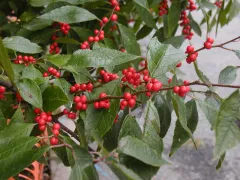
Winterberry
8 ft · grown for its leaves · berries · host plant
A native holly that drops its leaves in autumn to show branches packed with bright red berries, which last into winter until the birds take them.
-

Christmas fern
20 in · grown for its leaves · evergreen
The most useful native fern: leathery, dark green fronds that stay green through winter, in a tidy clump that never spreads.
-
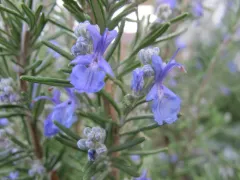
Rosemary
4 ft · early March to early May · winter flowers
The kitchen herb: a dense, aromatic, evergreen shrub with needle-like leaves and small, pale blue flowers from late winter into spring.
-
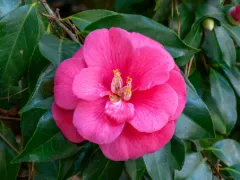
Japanese camellia
10 ft · early February to early April · winter flowers
Polished, dark evergreen leaves and large, formal flowers in red, pink or white from late winter into spring.
-
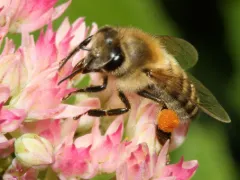
Sedum 'Autumn Joy'
24 in · mid August to mid October · seed heads
Succulent blue-green stems topped with broad flower heads that shift from pale green to pink to rusty red.
-
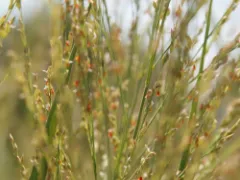
Switchgrass 'Northwind'
5½ ft · early August to early October · stands in winter · host plant
The most upright switchgrass: a narrow, rigid column of olive-blue leaves that never flops, turning gold in autumn and standing through winter.
-
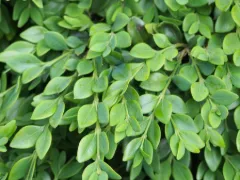
Boxwood 'Green Velvet'
3 ft · grown for its leaves · evergreen
A dense, naturally rounded evergreen that gives a bed year-round structure.
A bed planned only from these plants
The planner was given only the plants on this page that suit zone 6 and part shade, and designed this 16 × 8 ft (4.9 × 2.4 m) bed from them when the page was made.
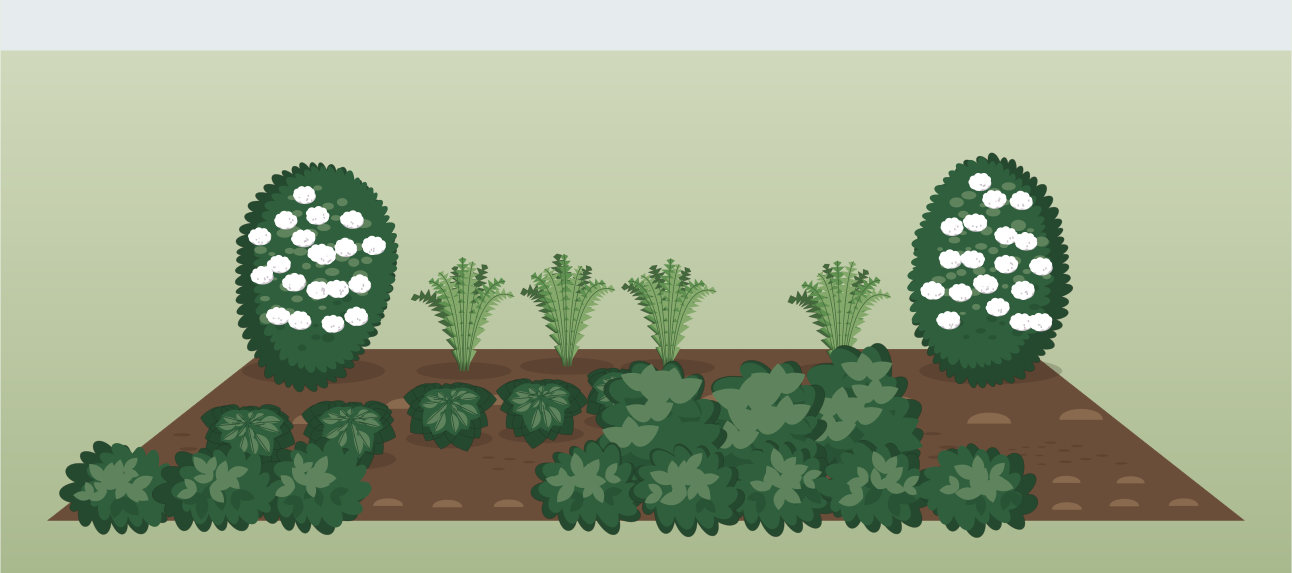
The plants
- 1 Barrenwort 'Frohnleiten' × 8, yellow
- 2 Wherry's foamflower × 8, white
- 3 Christmas box × 2, white
- 4 Astilbe 'Bridal Veil' × 8, white
- 5 Lenten rose × 3, pink
- 6 Evergreen wood fern × 4, green leaves
- 7 Bergenia × 5, pink
- 8 Hardy cyclamen × 12, pink
- 9 Snowdrop × 12, white
- 10 Winter aconite × 12, yellow
Planned as an English border: 9 of the 9 groups (100%) are drifts, longer along the bed than they are deep. Neither end outweighs the other: the visual weight is split 49 to 51, left to right. Something is in flower for 37 weeks between early January and mid October, with a pause of 5 weeks from late July.
The planner's own design check: 10 Excellent, 6 Good, 1 Satisfactory.
Open this bed in the planner Change its size, the sun or the style, move plants about, or swap one for another.
All 120 plants
Show all 120, by where they go in a bed
Front of a bed 32
- Barrenwort 'Frohnleiten' 12 in · mid April to mid May · evergreen
- Bergenia 16 in · mid April to early May · evergreen
- Bergenia 'Winter Glow' 14 in · mid April to mid May · evergreen
- Christmas rose 12 in · late February to early April · winter flowers
- Christmas rose 'Jacob' 10 in · late November to late December · winter flowers
- Common polypody 12 in · grown for its leaves · evergreen
- Crocus 'Ruby Giant' 4 in · early March to late March · winter flowers
- Double snowdrop 5 in · early February to mid March · winter flowers
- Early crocus 4 in · early March to late March · winter flowers
- Giant snowdrop 8 in · mid February to mid March · winter flowers
- Hardy cyclamen 5 in · late August to mid October · winter leaves
- Hellebore 'Ivory Prince' 16 in · early March to late April · winter flowers
- Hellebore 'Pink Frost' 16 in · late February to mid April · winter flowers
- Himalayan fleeceflower 'Darjeeling Red' 10 in · mid July to early October · winter colour
- Iris 'Katharine Hodgkin' 5 in · early March to late March · winter flowers
- Lenten rose 18 in · late March to early May · evergreen
- Netted iris 5 in · early March to late March · winter flowers
- Rock polypody 8 in · grown for its leaves · evergreen
- Sedum 'Angelina' 5 in · grown for its leaves · evergreen
- Showy stonecrop 'Neon' 20 in · late August to early October · seed heads
- Snow crocus 3 in · early March to late March · winter flowers
- Snowdrop 6 in · early March to late March · winter flowers
- Spring snowflake 10 in · early March to late March · winter flowers
- Sweet box 18 in · early February to late March · scented flowers
- Variegated Japanese sedge 12 in · grown for its leaves · evergreen
- Wherry's foamflower 10 in · early May to late June · winter leaves
- Willowleaf cotoneaster 'Scarlet Leader' 24 in · late May to mid June · berries
- Winter aconite 4 in · late February to mid March · winter flowers
- Winter cyclamen 3 in · early February to late March · winter flowers
- Winter heath 10 in · late January to mid April · winter flowers
- Winter heath 'Kramer's Red' 14 in · mid January to mid April · winter flowers
- Wintergreen 5 in · late June to late July · berries
Middle of a bed 24
- Arborvitae 'Mr. Bowling Ball' 2½ ft · grown for its leaves · evergreen
- Astilbe 'Bridal Veil' 2½ ft · late June to mid July · seed heads
- Betony 'Hummelo' 20 in · late June to early August · seed heads
- Black-eyed Susan 'Goldsturm' 2 ft · late July to late September · food for birds
- Blue grama 'Blonde Ambition' 2½ ft · mid July to mid October · stands in winter
- Boxwood 'Green Velvet' 3 ft · grown for its leaves · evergreen
- Champion's wood fern 2½ ft · grown for its leaves · evergreen
- Christmas fern 20 in · grown for its leaves · evergreen
- Corsican hellebore 2½ ft · late February to late April · winter flowers
- Cranberry cotoneaster 3 ft · late May to early June · berries
- Evergreen wood fern 2½ ft · grown for its leaves · evergreen
- Jerusalem sage 3 ft · mid June to late July · seed heads
- Little bluestem 3 ft · grown for its leaves · stands in winter · host plant
- Little bluestem 'The Blues' 3 ft · early August to early October · stands in winter · host plant
- Pale purple coneflower 3 ft · mid June to mid July · seed heads · host plant
- Purple coneflower 3 ft · late June to early September · seed heads · host plant
- Rockspray cotoneaster 2½ ft · late May to early June · berries
- Sedum 'Autumn Fire' 24 in · mid August to mid October · winter colour
- Sedum 'Autumn Joy' 24 in · mid August to mid October · seed heads
- Sedum 'Matrona' 24 in · mid August to early October · seed heads
- Sensitive fern 24 in · grown for its leaves · winter shape
- Stinking hellebore 24 in · late February to mid April · winter flowers
- Yarrow 'Terracotta' 2½ ft · late June to late August · seed heads
- Yucca 'Color Guard' 2½ ft · late June to mid July · evergreen · host plant
Back of a bed 64
- American cranberrybush 10 ft · late May to mid June · berries
- Arborvitae 'Rheingold' 5 ft · grown for its leaves · evergreen
- Big bluestem 6 ft · mid August to late September · stands in winter
- Bloodtwig dogwood 'Midwinter Fire' 6 ft · grown for its leaves · stems and bark
- Blue false indigo 4 ft · late May to mid June · seed heads · host plant
- Blue holly 8 ft · grown for its leaves · berries
- Blue holly 'Blue Princess' 10 ft · grown for its leaves · berries
- Bodinier's beautyberry 'Profusion' 8 ft · mid July to early August · berries
- Bodnant viburnum 'Dawn' 10 ft · early November to late December · scented flowers
- Burford holly 15 ft · grown for its leaves · berries
- Christmas box 4 ft · early January to early March · scented flowers
- Coral bark maple 16½ ft · grown for its leaves · stems and bark · host plant
- Coralberry 4 ft · mid July to early August · berries
- Corkscrew hazel 8 ft · late February to late March · winter flowers
- Cornelian cherry 16½ ft · early March to late March · winter flowers
- Culver's root 'Fascination' 5 ft · mid July to late August · seed heads
- Double Japanese kerria 6½ ft · mid April to mid May · stems and bark
- False indigo 'Purple Smoke' 4 ft · mid May to mid June · seed heads
- Feather reed grass 'Avalanche' 5 ft · mid June to early October · stands in winter
- Feather reed grass 'Karl Foerster' 5 ft · late June to early October · stands in winter
- Firethorn 'Mohave' 10 ft · late May to early June · berries
- Indian grass 6 ft · late August to early October · stands in winter
- Japanese camellia 10 ft · early February to early April · winter flowers
- Japanese kerria 5 ft · mid April to mid May · stems and bark
- Japanese skimmia 3½ ft · mid April to early May · berries
- Laceleaf Japanese maple 'Viridis' 8 ft · grown for its leaves · branch shape · host plant
- Laurustinus 8 ft · early January to early April · winter flowers
- Little bluestem 'Standing Ovation' 3½ ft · early August to mid September · stands in winter · host plant
- Mahonia 'Charity' 10 ft · early November to late December · scented flowers
- Mahonia 'Soft Caress' 4 ft · early November to late December · winter flowers
- Panicle hydrangea 'Little Lime' 4 ft · mid July to early October · seed heads
- Paperbush 6 ft · early February to late March · scented flowers
- Rattlesnake master 4 ft · mid July to late August · seed heads · host plant
- Red chokeberry 'Brilliantissima' 7 ft · early May to late May · berries
- Red osier dogwood 8 ft · late May to mid June · stems and bark · host plant
- Red twig dogwood 'Arctic Fire' 4 ft · grown for its leaves · stems and bark · host plant
- Rose 'Carefree Beauty' 5 ft · mid June to early October · berries
- Rosemary 4 ft · early March to early May · winter flowers
- Russian sage 4 ft · mid July to mid September · stems and bark
- Rusty foxglove 5 ft · late June to early August · seed heads
- Seven-son flower 16½ ft · late August to mid September · stems and bark
- Siberian dogwood 6½ ft · late May to early June · stems and bark
- Smooth hydrangea 'Annabelle' 4 ft · late June to early September · seed heads · host plant
- Snowberry 4 ft · mid June to mid July · berries · host plant
- Switchgrass 'Northwind' 5½ ft · early August to early October · stands in winter · host plant
- Switchgrass 'Prairie Sky' 5 ft · early August to early October · stands in winter · host plant
- Switchgrass 'Shenandoah' 4 ft · grown for its leaves · stands in winter · host plant
- Tatarian dogwood 'Ivory Halo' 6 ft · grown for its leaves · stems and bark
- Threadleaf false cypress 'Golden Mop' 3½ ft · grown for its leaves · evergreen
- Tuberous Jerusalem sage 5 ft · mid June to late July · seed heads
- Variegated red twig dogwood 6½ ft · grown for its leaves · stems and bark
- Vernal witch hazel 8 ft · mid January to early March · scented flowers
- Virginia rose 5 ft · mid June to mid July · berries
- Winged sumac 11½ ft · late July to late August · food for birds · host plant
- Winter daphne 4 ft · early February to late March · scented flowers
- Winter jasmine 4 ft · early January to late March · winter flowers
- Winterberry 8 ft · grown for its leaves · berries · host plant
- Winterberry 'Berry Poppins' 3½ ft · early June to late June · berries · host plant
- Winterberry 'Red Sprite' 4 ft · grown for its leaves · berries · host plant
- Winterberry 'Winter Red' 8 ft · early June to late June · berries · host plant
- Witch hazel 'Arnold Promise' 13 ft · early February to mid March · scented flowers
- Witch hazel 'Diane' 10 ft · early February to mid March · winter flowers
- Witch hazel 'Jelena' 11½ ft · late January to mid March · winter flowers
- Yellow twig dogwood 6½ ft · grown for its leaves · stems and bark · host plant