Weigela 'Wine & Roses'
Weigela florida 'Wine & Roses' · Caprifoliaceae Popular
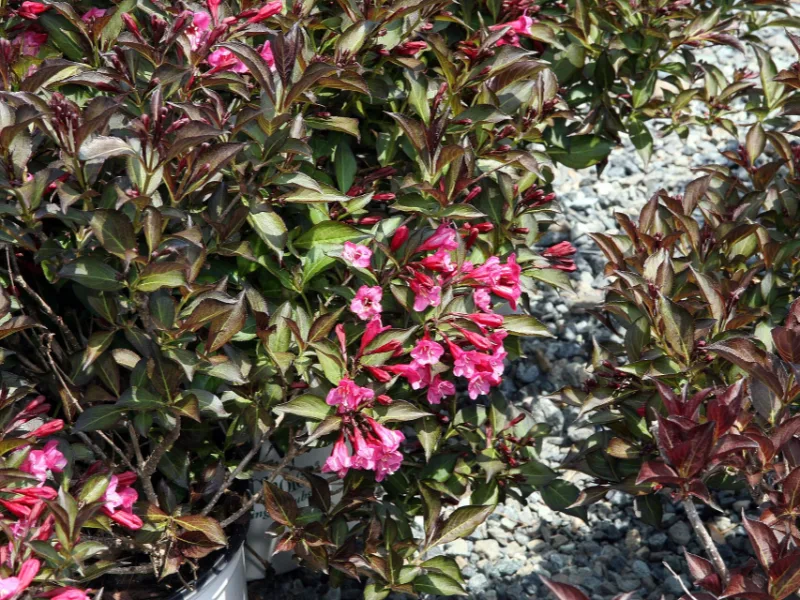
Dark burgundy-purple leaves all season, with rosy-pink, trumpet-shaped flowers in late spring that hummingbirds visit.
- Size
- 4½ ft tall, 5 ft wide
- Zones
- 4 to 8
- Light
- Full sun
- Flowers
- Late May to late June
- Pets
- No toxicity recorded
- Job in a bed
- Anchor
A bed built around weigela 'Wine & Roses'
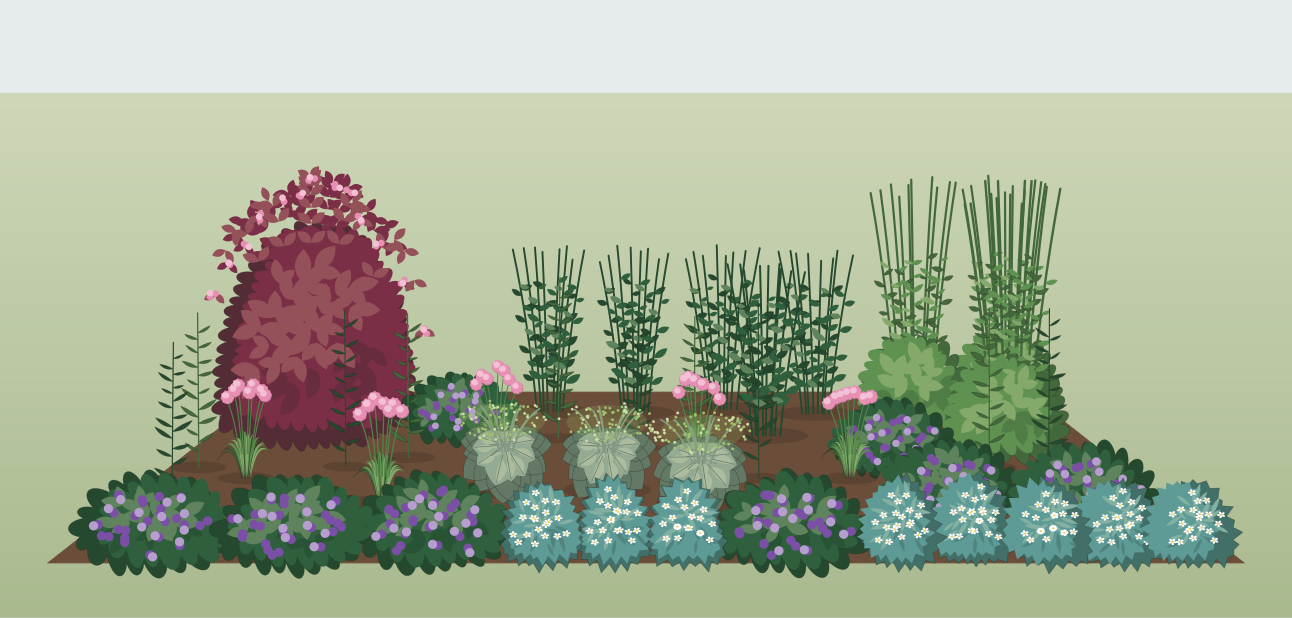
The planner designed this bed around weigela 'Wine & Roses' when this page was made: a 16 × 8 ft (4.9 × 2.4 m) English border in zone 6, full sun. It chose the other plants from the 966 that suit those conditions, and says below why weigela 'Wine & Roses' stands where it does.
The plants
- 1 Weigela 'Wine & Roses' × 1, pink
- 2 Verbena 'Homestead Purple' × 8, purple
- 3 Cottage pinks 'Mrs Sinkins' × 8, white
- 4 False sunflower 'Summer Sun' × 5, yellow
- 5 Sweet coneflower 'Henry Eilers' × 3, yellow
- 6 Lady's mantle × 3, green
- 7 Schubert's allium × 5, pink
- 8 Easter lily × 5, white
- 9 Asiatic lily × 5, yellow
Why this plant
- The bed's only structure. Shrubs and grasses keep their shape when the perennials die down, and it is the only one here.
- A classic partner for lady's mantle. Both are on this plan. A pairing gardeners have proved outranks a general rule.
Why here
- Anchors a back corner. At 4½ ft it is the tallest plant here, and the tallest close the ends of the bed, where they stand in front of nothing.
- A step in the back row. Next to false sunflower 'Summer Sun' (3½ ft): no two neighbours there are the same height, so the back steps up and down like a skyline.
- One plant, alone. A shrub is seen as an object, and needs clear ground around it.
Why now
- In flower for five weeks. From late May to late June.
- Part of the bed's peak. With verbena 'Homestead Purple', cottage pinks 'Mrs Sinkins', lady's mantle and others in late June: 6 kinds at once. No week has more.
Planned as an English border: 7 of the 7 groups (100%) are drifts, longer along the bed than they are deep. Yellow is the colour seen most, on 3 of the 9 kinds grown for their flowers. Easter lily and lady's mantle, recognised partners, are side by side.
The planner's own design check: 8 Excellent, 9 Good.
Open this bed in the planner Change its size, the sun or the style, move plants about, or swap one for another.
Where weigela 'Wine & Roses' goes in a border
At 4½ ft it belongs at the back of a bed. In the planner's ten height classes it is tall (4 to 5 ft).
Its job: anchor. A shrub that gives the bed permanent structure. Planted singly, as soon as the front edge is laid; everything else is arranged around it.
The dark leaves make everything around them brighter, and its own pink flowers show against them. The leaf colour is strongest in full sun.
- Dark foliage in a mixed border
- Hummingbirds
- A substitute for purple barberry
What to plant with weigela 'Wine & Roses'
Plants recorded as good partners for it, and what each pairing does:
- Catmint 'Walker's Low': in flower together for five weeks, from late May; spires rising out of its mound; low enough (24 in) to stand in front of it.
- Lady's mantle: in flower together for four weeks, from late May; low enough (18 in) to stand in front of it.
- Salvia 'May Night': in flower together for four weeks, from late May; spires rising out of its mound; low enough (24 in) to stand in front of it.
Questions about weigela 'Wine & Roses'
Does weigela 'Wine & Roses' need sun or shade?
Weigela 'Wine & Roses' grows in full sun (6 or more hours of direct sun a day).
It wants ordinary well-drained soil, of average fertility, and a good soak in dry spells.
What zones does weigela 'Wine & Roses' grow in?
USDA zones 4 to 8. It is hardy to zone 4, which means it survives winter nights down to about −20 °F (−29 °C).
Above zone 8 it struggles: the zones measure winter cold, but a plant's top zone usually means the summers are too hot or the winters too mild for it to rest.
Gardening in Canada? Use the USDA zone for your town: Canada's own zone map uses different numbers.
When does weigela 'Wine & Roses' flower in my zone?
In zone 5 it flowers late May to late June. As a spring flower it moves about a week for every zone: earlier where it is warmer, later where it is colder.
| Zone 4 | Late May to late June |
|---|---|
| Zone 5 | Late May to late June |
| Zone 6 | Mid May to late June |
| Zone 7 | Early May to mid June |
| Zone 8 | Early May to mid June |
Worked out from Hopkins' bioclimatic law: spring arrives about four days later for each degree of latitude north, and one zone is roughly two degrees. A warm spring or a cold one moves any garden two weeks either way.
How far apart should weigela 'Wine & Roses' be planted?
4 ft (120 cm) apart, from the middle of one plant to the middle of the next. That is a little closer than its full width of 5 ft (150 cm), so a group knits into one patch.
It grows 4½ ft (140 cm) tall. Give it the full distance from anything taller, or it will lean out towards the light.
How many weigela 'Wine & Roses' plants do I need?
Usually one. At 4 ft (120 cm) across, it is a plant you place, not one you mass. For a hedge or screen, set them 4 ft apart: three plants for a 10 ft run.
In the bed above, the planner used one in one group.
Is weigela 'Wine & Roses' poisonous to dogs and cats?
No toxicity is recorded for dogs, cats, horses or people, according to NC State Extension.
"Not toxic" is not "edible": a pet that eats a lot of any plant can be sick.
Is there a native plant like weigela 'Wine & Roses'?
Weigela 'Wine & Roses' comes from Northern China, Korea and Japan. These North American natives come closest to doing its job:
- Ninebark 'Dart's Gold': the same job in a bed, the same size and the same flowering time; white, not pink.
- Virginia rose: the same job in a bed, the same size and the same colour; flowers mid June to mid July.
- Arrowwood viburnum 'Blue Muffin': the same job in a bed and the same flowering time; 16 in taller, white, not pink.
Matched the way the planner's Swap button matches plants: the same job in a bed, then size, then flowering time.
Do deer eat weigela 'Wine & Roses'?
Mostly not. NC State lists it as resistant to deer. No plant is proof against a hungry deer in a hard winter, but this one is low on the menu.
What flowers after weigela 'Wine & Roses'?
Weigela 'Wine & Roses' is over by late June. These start as it finishes and carry the same spot on, so it never goes flat:
- Garden phlox: from mid July to early September, 3½ ft tall, to stand in front of it and cover its fading stems.
- Bee balm: from early July to early August, 3 ft tall, to stand in front of it and cover its fading stems.
- Purple coneflower: from late June to early September, 3 ft tall, to stand in front of it and cover its fading stems.
What does weigela 'Wine & Roses' look like in winter?
Weigela 'Wine & Roses' drops its leaves and stands as bare branches. That is when to see its shape, and to prune it if it needs pruning.
Is weigela 'Wine & Roses' good for bees and butterflies?
Weigela 'Wine & Roses' is visited by butterflies and hummingbirds.
More Weigela
- Dwarf weigela 'My Monet' Weigela florida 'My Monet'
- Weigela 'Red Prince' Weigela 'Red Prince'
- Weigela 'Sonic Bloom Pink' Weigela florida 'Bokrasopin' (Sonic Bloom Pink)
- Weigela 'Spilled Wine' Weigela florida 'Bokraspiwi' (Spilled Wine)
In these guides
- Salt-tolerant plants for roadsides and coasts
- Pet-safe plants for a sunny border
- Plants for hummingbirds
- Plants for butterflies
- Plants with purple and burgundy leaves
Every fact on record
- Type
- Shrub
- Size
- 4½ ft (140 cm) tall, 5 ft (150 cm) wide
- Plant
- 4 ft (120 cm) apart
- Height class
- Tall (4 to 5 ft)
- Place in the bed
- Back
- Flowers
- Late May to late June; trumpets; pink
- Leaves
- Medium texture, deciduous; burgundy
- Shape
- Rounded, clumping
- Hardy in
- USDA zones 4 to 8
- Light
- Full sun
- Soil
- Average, well-drained
- Water
- Moderate
- Feeding
- Light, in spring
- Family
- Caprifoliaceae
- Comes from
- Northern China, Korea and Japan
- Attracts
- Butterflies, hummingbirds
- Stands up to
- Deer, salt
Checked against NC State Extension. Flowering times are for zone 5: later in colder zones, earlier in warmer ones. Toxicity and spread information is a general gardening guide, not veterinary or medical advice, and invasive status varies by region. If a person or pet eats a plant, contact poison control or a vet. Check your local invasive species list before planting anything with a spread warning.